Showing posts with label UP. Show all posts

January 03, 2014

RIOTS IN UP AND ELECTIONS 2014 - Part II


HOW THE RIOTS IN WESTERN UP WILL AFFECT THE FORTUNES OF PARTIES


Catch 22 situation: Yes, that is precisely the situation that Congress finds itself in Uttar Pradesh. In 2009, following Varun Gandhi's communal speech in his constituency of Pilhibhit, the Congress surpassed all expectations winning 21 seats after minority votes swung in its favor. Back then, it was heralded as the revival of the grand old party in the country's most populous state with party leaders
Rahul meeting a Jat delegation in Delhi
and workers crediting Rahul Baba for the miracle. Putting behind the disaster in Bihar in 2010, the INC, buoyed by its performance in the national polls, made its crown prince the face of its campaign here in 2012. Probably, confident of a good show following the hype around him in the media, Rahul Gandhi even tore the manifesto of the Samajwadi Party during a rally. However, it was Akhilesh and his outfit which walked away with the crown as the INC struggled to reach a paltry figure of 28. Though the Nehru-Gandhi bastions may be safe for the time being, there is absolutely no indication that the Congress may do well in 2014 polls in UP. As far as the western areas of the state are concerned, the conviction of its face in this region - Rasheed Masood for fraudulently nominating candidates during his tenure as the Union Health minister in 1990 is a big blow. The minority leader had quit the SP to join the INC in 2011 after a fall out with Azam Khan. The Congress' hopes of doing well here by allying with Ajit Singh's RLD too has been hit following the riots. As such, some in the party believe that they may do well if they discontinue the alliance with Singh and go all alone. What is adding to its woes is the fact that Jats seem to be shifting towards the BJP after it projected Modi as its PM candidate. The visit of the PM Dr Singh, the UPA Chairperson Mrs Gandhi and her son Rahul to relief camps to 'assess' the situation is nothing but a publicity stunt, with an eye on the national elections. Meanwhile, in a bid to attract minority votes into its fold, Congress leader Rashid Alvi has criticized the SP government of failing to protect the Muslims and calling the riots here, worse than the ones in Gujarat. Reservation for the Jat community, something that they are demanding for some time now, will tilt the balance in its favor.


The right platform: For a party that rose on to national politics following the demolition of the Babri Masjid in 1992, it is surprising that the BJP is in dire straits in its former bastion. Even in 2012, its performance under Hindutva icon Uma Bharati has been disappointing. However, on the eve of the
BJP President Rajnath Singh with Modi
General Elections, things seem to be finally going the saffron outfit's way. The nomination of tainted leader Narendra Modi as its PM nominee has galvanized the cadre. Aware that UP will be the key if he wants to occupy the top post, Modi has deputed his trusted aide - Amit Shah who has been accused of his role in the infamous Godhra riots in 2002, to manage his campaign in the state. In what was a clear case of raising the communal agenda, Shah paid a visit to the Ram Janmabhoomi site in Ayodhya, reiterating his party's stand to construct a Ram temple there. The crackdown by the SP government on the Ayodhya Yatra organized by the VHP, a constituent of the Sangh Parivar has been criticized by the party's top leadership. And a few months later, the riots in Muzaffarnagar has given another opportunity to the party to win votes. Although the state government has slapped cases against two of its MLAs - Suresh Rana and Sangeet Som under the stringent National Security Act (NSA) for whipping up communal flares, the party has in fact, felicitated them. If reports coming from the region are to be believed, the Jats are moving towards the BJP, impressed by the charisma of its leader, Mr Modi. Such a shift will be a major boost to the party. For the Gujarat CM who his known for his brash style of politics, the communal violence in Muzaffarnagar may propel him to New Delhi, similar to the incidents in Godhra back in 2002, which made him the most popular leader in Gujarat.

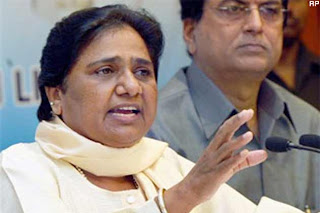
The sleeping giant: In 2007, Bahujan Samajwadi Party (BSP) supremo beat all odds to script a fairy tale victory by crossing the half way mark on its own, courtesy 'Social Engineering'. However, after completing her five year term, which was marked by brazen corruption and shameless self
BSP supremo Mayawati
glorification, Behenji was routed by her bete noire - SP's Mulayum Singh in the next state polls. The sly vixen that she is, Mayawati kept a low profile following the electoral drubbing. Like a python waiting for the prey to walk into the trap, she waited all along for the young Akhilesh to falter. With the SP government failing to deliver on all fronts in the last two years, the BSP will try to maximize its poll prospects by attacking the regime for its failure to control the riots. With the SP and the BSP being the two main political parties in the state, the mistakes made by one generally helps the other. As such, it should not be surprising if Mayawati finishes first in the four way contest for Uttar Pradesh during the 2014 Lok Sabha polls. The BSP leader has always nurtured prime ministerial ambitions; you can expect her to go all out against the Yadav regime in the coming months. Another weapon that Mayawati has in her arsenal is, as mentioned earlier - Social Engineering. Like in 2007 when she romped home to power after weaving together the Dalit-Brahmin alliance, Maya may do exceedingly well in western UP if she can chose the right candidates.


For the previous post on this topic, click here (Link)


IMAGES

(1) Rahul meeting a Jat delegation in Delhi
Source: Indian National Congress - Official Website (Link)

(2) BJP President with Modi
Source: BJP - Official Website (Link)

(3) BSP supremo Mayawati
Source: The Hindu - Mayawati sees SP-BJP conspiracy (Link)

RIOTS IN UP AND ELECTIONS 2014 - Part I


HOW THE RIOTS IN WESTERN UP WILL AFFECT THE FORTUNES OF PARTIES


Though the riots that took place in parts of western Uttar Pradesh in August last year are a blot on the secular credentials of our nation, for our political parties who seem to be least bothered by the suffering of the people, it is just another opportunity to score brownie points over their rivals. Instead of trying to bring communities together and eliminate differences, outfits are adding smoke to the fire by openly taking sides with an eye on the upcoming General Elections scheduled for May this year. With Uttar Pradesh sending 80 MPs to the Parliament - the largest amongst all states, it is said that the road to New Delhi passes via Lucknow. As such, it should hardly be surprising that our leaders can pull off even the dirtiest of all tricks to come to power, even if it means that some innocent lives are lost or thousands are displaced from their homes. While some believed that the ascend of the young Akhilesh Yadav in March 2012 would usher in a new kind of politics in our most populous state, his innumerable failures in the last year and a half have proved even his most die-hard fans, if they exist, wrong.

The complete collapse of the administration during the riots and its inability to provide basic facilities in relief camps has drawn a lot of flake from the Opposition as well as social groups. While he was quick to suspend the honest IAS officer Durga Shakti Nagpal for whipping up communal sentiments by demolishing a compound wall of a mosque - a charge that has been refuted even by the people affected by this, the callousness that his regime displayed in restoring law and order is an indication, perhaps that the young Turk intends to carry forward his father's legacy of caste based and religion based politics.Though younger Yadav deserves all the criticism that he is getting, other parties can not wash their hands off it. Reports indicated that local leaders with affiliation to the BJP, the Congress as well as the BSP played a key role in whipping up communal sentiments. Finally, after the officials succeeding in stopping the violence, the high profile visits by political leaders including RLD's Arjun Singh,  the triumvirate of the Congress and the 'funniest' of all, that of the recently jailed Lalu Yadav of the RJD is nothing but another gimmick to cash in on the situation. As the big battle for Delhi is just months away, here is my take on how the events in Muzaffaranagar will affect the poll prospects of the different stake holders.

The biggest loser: While it is difficult to predict who will derive maximum 'benefit' from this ghastly tragedy, it seems that former PM Charan Singh's son and Rashtriya Lok Dal (RLD) supremo Chaudhary Arjun Singh will be the one licking the wounds post the Lok Sabha polls. Though he has
RLD supremo Ajit Singh
always been over shadowed by the more vociferous and charismatic Mulayum Singh and Mayawati in the state politics, there is no doubt that Singh is one of the most clever politicians in the Hindi heartland. While his party may not boast of big numbers, his remarkable political acumen, his popularity in Western UP and the knack to ally with the right partners make him a prominent player in Lucknow. However, the last two years have not been a good one for either him or his party. In the 2012 state assembly polls, in spite of a pre-poll tie up with the much hyped Congress, the party dropped one seat to finish at a lowly 9 seats. Though the heir apparent and MP Jayant won the Mathura constituency, heavyweights like Baba Hardev Singh and Haji Yakub Qureshi had to bite the dust. The role of Singh who is serving as the Civil Aviation minister in the national cabinet, in pushing through the Jet-Etihad deal has raised many eyebrows. At a time when things are not going his way, the rift between the Jats and the Muslims - the traditional vote bank of the RLD following the riots may badly affect its performance, rendering it insignificant in the post poll scenario. With even the Congress re-thinking its alliance with Singh's outfit ahead of the Lok Sabha elections, the picture for Chaudhary looks gloomy.

A major blow: In March 2012, the wily Mulayum Singh Yadav took a big gamble by placing his son Akhilesh on the CM's chair. However, those who follow Indian politics know that anything that UP strong man does has a political motive behind it. By offering the post to his son, he was checking the ambitions of other big leaders - his brother Ram Gopal Yadav and the party's minority face Azam Khan. Having swept UP and after being elevated to the status of 'Netaji' by the party cadre, Singh
From left: Azam Khan, Mulayum Singh and Akhilesh
who was confident of an excellent performance in 2014 was hoping to play the King-Maker at the Centre while his son ruled from Lucknow. However, for once, his plan has backfired or at least it seems so as of now. Akhilesh's incompetency and misgovernance has led to a wave of anti-incumbency within two years of his party's outstanding results in the last state polls. The mishandling of the situation in Muzaffarnagar has alienated the Muslims - the community which, along with the Yadavs is the core vote bank of the Samajwadi Party (SP). Meanwhile, party leader Azam Khan who shares an uneasy relationship with Mulayum has been accused by many in the riot hit Muzaffarnagar district of 'orchestrating' the violence and his effigies have been burnt in several places. The only reason why I think that RLD will be the bigger loser as compared to its former ally the SP is the fact that the latter may still do well in case the Yadavs still stick with it. Though he has himself tried to maintain the moral high ground by criticizing the state government, Singh should realize that instead of such gimmicks, he must take his son to task and concentrate on improving the administration in the state. In 2009, the gravitation of a section of Muslims towards the Congress damaged the SP's performance, reducing it to a mere 23 seats. With so much negative publicity surrounding the riots, the party is under fire from all corners including former friends Ajit Singh and Lalu Yadav. However, one can never write the Pehalvan off; you never know when the master politician can pull off a surprise ahead of the big polls.

For the next post on this topic, click here (Link)

IMAGES 

(1) RLD supremo Ajit Singh
Source: Rashtriya Lok Dal - Official Website (Link)

(2) From left: Azam Khan, Mulayum Singh and Akhilesh
Source: Samajwadi Party - Official Website (Link)

March 25, 2012

THE STATES THAT MATTER - PART VII


THE RESULTS - AN OVERVIEW

Ending months of high voltage political drama, accusations, counter-accusations and mud-slinging, the results of the much awaited legislative assembly elections held between January and March in five Indian states were announced on 6th March, 2012. Earlier, beating all expectations, the electorate had come out in large numbers to choose their representatives, re-affirming their faith in the Indian democracy. However, the result pattern, cutting across all states did throw in a number of surprises, even to the most seasoned political pundits who had covered myriad elections over the years. Apart from a high voter turnout, the state elections did witness many heavyweights disappear into the oblivion whereas several young netas emerged to shine like stars on the horizon of Indian politics. Though many tainted nominees did make the cut, the electorate did boot out a size able number of controversial candidates. The masses voted for development as traditional electoral issues like caste and religion took a back burner. With the two major national parties underperforming, the momentum grew in favor of a non-Congress, non-BJP coalition - The Third Front that has been doing the rounds for a considerable period of time.   
Akhilesh Yadav was sworn in as the youngest CM of Uttar Pradesh
For the second consecutive time in a row, the mega state of Uttar Pradesh elected a party with a simple majority, squashing all speculations of a hung assembly and unholy alliances between parties of conflicting ideologies (read Congress-SP or BJP-BSP), formed purely for political gains. The Samajwadi Party, fighting the polls under the leadership of Akhilesh Yadav swept the polls winning a whopping 225 out of the 403 seats, the highest in its history. Though its true that there was a wave of discontent against the Mayawati government, the young leader is credited to be the 'real architect' of the SP's splendid performance as he garnered the anti-BSP votes into his party's kitty in spite of a 'strong' campaign by the two national parties - the Congress and the BJP who were seeing the polls as an opportunity to re-invent themselves in the state. 

While the myriad corruption scandals and lack of development under the Maya regime had significantly dented her prospects of a second consecutive term, the junior Yadav's spirited attempt to connect with the masses on the ground and a host of conscious decisions taken by him to improve his party's image seem to have gone well with the electorate. Besides vetoing against D P Yadav's entry into his outfit, Akhilesh made it clear during his popular cycle rallies that his party, if elected to power would curb goonda raj - a 'hallmark' of the Samajawadi politics during its previous terms. Realizing that their anti-technology or anti-English rhetoric may not impress the urban voter, the foreign educated Akhilesh promised free tablets and laptops for all students who pass class X and class XII exams respectively. In a move that has won him thousands of admirers, Akhilesh in an interview to the media after the resounding triumph, said that he would not raze Maya's statues, a stark contradiction to the his father's comments in this regard some weeks earlier, signaling perhaps, a new sense of maturity in the murky 'rajneeti' of UP and bringing an end to the politics of vendetta.

On the other hand, Mayawati paid the ultimate price for remaining aloof of the sufferings of the people on the ground with the BSP being reduced to just 80 seats. The host of corruption scandals and her affluent ways like wasting of public money on the constructions of her statues didn't seem to go unnoticed with the electorate, determined to teach the 'Dalit ki Beti' a lesson which she would not forget so soon. Though Maya did try to get an image makeover by dropping several of her ministers and sitting MLAs and resorted to 'Social Engineering' to exploit the caste factor to her advantage, her unimpressive report card over the last five years meant that the public didn't fall for her cheap tricks this time around.

For the national parties the wait to regain lost ground in India's most populous state seems to be extended by another five years. Though the early leads indicated that the BJP could dislodge the BSP to emerge as the second largest party in the assembly, the performance of the saffron outfit plateaued and and then declined to 47 seats, four less than the last polls. The BJP high command's decision to rope in its Hindutva icon and OBC face Uma Bharati failed miserably as the party failed to capitalize on the failures of both the state and central governments. While the Congress's performance was better when compared to 2007, the hype generated around Rahul Gandhi by the media in general and the Congress leaders in particular failed to translate into votes. Thus what was supposed to be the most important day in Baba's short and unimpressive political career so far proved to be a major embarrassment for the party already troubled by allegations of corruption at the Centre. Ironically while the party had finished second in terms of seats in the 2009 General elections in the state, it did badly even in the traditional Nehru-Gandhi bastions of Amethi and Rae Bareily.
Parkash and Sukhbir Badal retained Punjab
While Mulayam and Akhilesh took the Samajwadi Party home in Uttar Pradesh, another father-son duo, that of Parkash and Sukhbir Singh Badal created history in the state of Punjab by being the first government to retain power in nearly four decades. Though there were several cases of corruption against the Badals during their previous schemes, the last government took concrete steps towards development including the popular Atta-Dal scheme which provides flour and pulses at subsidized rates to the poor, thus seeing off the threat posed by the opposition Congress and the PPP. Besides the relatively good performance by the previous SAD-BJP regime, the dynamic image of the Akali crown prince and Deputy CM Sukhbir combined with the skills and experience of CM Parkash Singh Badal won the SAD a total of 56 seats, falling just 3 short of a simple majority on its own. After being reduced to just 4 seats in the last Lok Sabha polls, the Akalis seem to have learnt from their mistakes and did their homework well prior to the assembly polls, which was reflected in their excellent figures.

The SAD's alliance partner, the BJP whose image took a beating following raids on several of their state ministers by the CBI and friction amongst its leaders slipped from 19 to just 12 seats. While it is true that the it was a herculean tasks for the party to even come close to its out of the skins performance last time around, considering its sorry state of affairs at all levels, the party needs to take corrective measures soon to remain afloat in the state especially at a time when the Akalis are trying hard to woo the minority Hindu community - a traditional BJP vote bank. 


The Congress party's fortunes in the state were dashed primarily due to faulty distribution of tickets and the large number of rebels that were in fray across the state. Hoping to end infighting amongst the state leaders, Rahul Gandhi, during his election campaign had made it clear that former CM Amarinder Singh would be the party's nominee for the top post in case it manages to come to power in 2012. The Congress's hopes also depended largely on the Manpreet Singh Badal led PPP splitting the traditional Akali vote on the lines of the MNS in Maharashtra. However, with the PPP drawing a blank on its debut and the Congress failing to capitalize on the shortfalls of the Badal regime, it was a rather easy victory for the octogenarian leader. 
BJP's Khanduri lost to S S Negi of Congress
The state of Uttarakhand witnessed a close contest as both the BJP and the Congress failed to get a clear majority. The saffron outfit, fighting a strong wave of anti-incumbency and a long list of scams under the erstwhile CM Ramesh Pokhriyal tried hard to woo the voters by replacing the former by B C Khanduri. The new CM, who had been axed following the party's disastrous performance in 2009, enhanced the BJP's poll prospects by passing several key legislation including Anna Hazare's Jan Lokpal Bill. Surprisingly, while the 'Khanduri hain Zarori' campaign of the saffron outfit may have prevented a complete rout, the former CM lost the Kotdwar assembly seat to S S Negi of the Congress adding salt to the injury of the BJP.

Although the Congress managed to increase its tally from 21 to 32 assembly seats, the party needs to contemplate as to what went wrong in the manner in which it fought the Uttarakhand polls. In what should have been a cake walk for the party, the Congress nearly lost out to the BJP owing to the differences between its many chief ministerial aspirants and the rebels contesting as independent candidates. A simple math shows that it could have easily won atleast 5 to 10 seats more if the rebels had been placated before the state went to polls.

The key to the government formation in the hill state now depends on the 7 MLAs who have made the cut while contesting on a non-BJP and non-Congress ticket. The BSP has lost 5 seats but has still managed to finish at a tally of three. The Panwar faction of the UKKD has won a single seat whereas three independents, all former Congressmen have won from their constituencies. With the victorious rebels showing inclinations of supporting their former party and the UKKD(P) making it clear that they would not support the BJP, the stage is set for the Congress to come back to power after five years in Uttarakhand.
Okram Ibobi Singh won a straight third term
After the flop show in UP, the ignominious defeat in Punjab and a mess in Uttarakhand, the only consolation for the Congress came from the North-Eastern state of Manipur where it single handedly won  70% of the seats, a rise of 12 seats as compared to the previous polls. In fact, there were several hurdles that CM Okram Ibobi Singh had to overcome to get a continuous third term in Imphal. A conglomerate of seven underground groups had warned the people against voting for the party. Besides, many parties including MPP, NCP, rivals - JD(U) and RJD and Left Front had joined hands to bring down the Ibobi government. However, in the end, not only did the Congress improve its tally, the united Opposition was decimated and it managed to win only a single seat. 

The Manipur State Congress Party (MSCP) which was reduced to 0 seats in 2007 grabbed 5 seats whereas the Naga People's Front (NPF) did well in the Naga dominated regions to finish with 4 seats.  Mamata Bannerjee's impressive campaigning in Manipur seems to have paid off as the Trinamool, which like the NPF is a new entrant in the state politics won 7 seats on debut and will be the principal Opposition in the new assembly.

While it was Manipur for the Congress, Goa saved the blushes for the BJP which was voted out of power in Uttarakhand and whose performance both in UP and Punjab was below par to say the least. Under former CM Manohar Parrikar, the saffron outfit bagged 21 seats and winning a simple majority on its own for the first time in the coastal state. Its coalition partner the MGP won three seats, thereby managing to retain its political symbol. With two independents supported by the BJP also making the cut, the strength of the new government is set to be 26 in a house of 40 members.
Parrikar led BJP to a spectacular victory
The Congress which was in power since 2005 was dealt a severe blow with several of its key leaders losing to new faces fielded by the BJP-MGP combine. The inability of the government to deal effectively against illegal mining and the distribution of tickets to several members of the same family were the prime reasons that led to the downfall of the Congress. Meanwhile, its coalition partner the NCP failed even to open its account. The Goa Vikas Party (GVP), fighting the elections in agreement with the UGDP bagged 2 seats whereas independents won in five constituencies.

The elections results have thrown in a mixed bag and two years prior to the next General elections, it is not much clear as to which national alliance - the ruling UPA or the NDA has the edge. Neither the Congress nor the BJP seem to have anything much to cheer about from the assembly election results. Sensing this as a proper opportunity, the advocates of the Third Front are trying hard to woo the constituents of the big coalitions in a bid to strengthen their numbers. With political re-alignments expected in the aftermath of the results, it looks like the political battle for the 2014 elections may just have begun.


IMAGES

(1) Akhilesh Yadav was sworn in as the youngest CM of Uttar Pradesh (Link
Source: India Today - Election Results - Akhilesh pedals Samajwadi Party to victory in Uttar Pradesh

(2) Parkash and Sukhbir Singh Badal retained Punjab (Link
Source: Samay Live - Badal to be sworn in as Punjab CM on March 14th

(3) BJP's Khanduri lost to S S Negi of Congress (Link
Source: Hillpost - Khanduri improves party position but fails to win

(4) Ikram Obibi Singh won a straight third term (Link
Source: Today News - Assembly polls - Big Winners and Big Losers

(5) Parrikar led the BJP to a spectacular victory Parrikar (Link
Source: HeraldGoa - I will not become CM if forced to take support of undesirable elements  

March 03, 2012

THE STATES THAT MATTER - PART V


 BATTLEGROUND UP - Part B

With a population of over 20 crore people and encompassing an area of over 2.43 lakh sq km, Uttar Pradesh is the big daddy amongst all states of the Indian Union. Though blessed with fertile land and vast bounty of natural and human resource, the state has lagged behind others in terms of infrastructure development and social progress. While UP has given the country eight Prime Ministers since independence, ironically, the state which has been the melting pot of various cultures in ancient and medieval times, and its people have remained largely backward in many aspects. A crucial reason for this has been the fact that the politics of UP has been dominated by insignificant factors like caste and religion. 

In the last assembly elections conducted in the state in 2007, an important factor, apart from the ‘Social Engineering’ strategy that led to the BSP’s excellent showing was a strong wave of anti-incumbency against the Mulayam Singh regime. With the BJP jostling with infighting amongst its top leaders and the state unit of the Congress in complete disarray, the anti-SP votes went into Maya’s kitty leading her to a simple majority in the Uttar Pradesh Vidhan Soudha. However, this time around the tables have turned on the BSP. With the few development schemes of the Mayawati government being overshadowed by the numerous corruption scandals, poll pundits have predicted that the party may find it extremely tough to cross the 150 mark, let alone coming into power on its own.
UP CM  Mayawati
The Samajwadis have undergone significant changes in their ranks in the last five years that they were in the opposition. After the Left parties pulled out their support to the UPA - I government on the issue of the Nuclear bill, it was the SP that bailed the Central government out with the help of its 39 MPs. However, with differences over the Congress on seat sharing in the state, the SP joined the ‘Fourth Front’, comprising of the RJD, LJP and SP. Although the party was reduced to 23 seats in the Lok Sabha, it salvaged some pride by finishing at the top in the four way contest in Uttar Pradesh. In January 2011, industrialist cum politician Amar Singh was expelled from the SP. Known for his affluent lifestyle, links with Bollywood personalities and accused in several cases of corruption, Singh’s exit has added more credibility to the outfit.


The Samajwadi Party has launched a massive campaign, titled ‘Ummed ki Cycle’ to wrest back power from the BSP. Leading the poll bandwagon is Kannauj MP and the party’s Yuvraj Akhilesh Yadav. The young leader’s cycle rallies across different corners of the state have been a huge hit and have witnessed sizable crowds. The state polls will be a crucial phase in the young scion’s political career and a good showing by the SP will firmly establish him as a prominent player in North Indian politics. The foreign educated Akhilesh has also made it clear that his party is not against computers or English, a paradigm shift from its earlier stand and an attempt to reach out to the urban youth. However, he has maintained that emphasis will be on Hindi and Urdu in case his father gets a fourth term as the state’s Chief Minister.

However, the greatest worry for the SP is losing the anti-BSP votes to a resurgent Congress. After being out of power for the last 22 years and reduced to a mere 21 seats in the last elections, the UP unit of the party has been rejuvenated by the entry of Rahul Gandhi into the election campaign. Though his charisma failed to impress the electorate in Bihar, Rahul seems to have touched a chord with the people of UP. This was evident in the superb performance of the Congress in the General elections where it bagged as many as 21 seats surpassing all expectations.

Realizing that a strong presence in the state will hold the key to his party’s future, the young leader has never missed any opportunity to hit at the Mayawati government, be it the Bhatta-Parsaul agitation against forcible land grabbing, lack of development or the allegations of corruption against Behenji and her colleagues. In his speeches, Rahul has blamed the successive SP, BSP and BJP governments in Lucknow for the lack of infrastructure development in the state, ignoring the fact that no worthwhile development was done during the 40 year long period when the Congress was in power in the state. An alliance with Ajit Singh’s RLD has also enhanced the Congress’s poll prospects. While her older brother is campaigning across the nook and corner of the state, Priyanka Gandhi, the other half of the famous Gandhi siblings is canvassing for the party’s candidates in the family bastions of Amethi and Rae Bareli.

With so much media hype revolving around Rahul, many are claiming that this could be the make-or-break elections for him A good showing by the Congress will be regarded as a vote for Rahul rather than for the Congress’s ideology by the loyal party workers and will be heralded as his coming of age in the arena of Indian politics, thereby accelerating his ascent towards the PM’s post. However, an average performance could end up giving more ammunition to the BJP and other parties to ridicule the Congress’s poster boy. Though there is little doubt that senior party leaders will defend Rahul baba at all costs in case of an electoral drubbing, like they did after the Bihar polls in 2010, the whole situation will surely be embarrassing for the Congress, to say the least.

Even the BJP is trying hard to retain lost ground in the state. The saffron outfit which ruled the state under Kalyan Singh and Rajnath Singh has been consistently losing ground in the state over the last few years. For a party that began its journey to the top of Indian politics from UP, it is ironically that today, the BJP finds itself in such a hopeless position in the state. Strengthening the party in Uttar Pradesh is one of the topmost priorities of the chief Nitin Gadkari. With this objective in mind the party has made Hindutva firebrand and its OBC face, Uma Bharathi as the spearhead of its election campaign. Also the party is trying hard to woo back the upper caste votes that had gone to the BSP in the last election.
Babu Singh Kushwaha
Ever since the whole nation stood behind Anna Hazare in the fight for a strong and effective Lokpal, corruption has become a major political issue in every state that goes to polls this year and Uttar Pradesh is no exception. With fresh allegations of corruption cropping up at regular intervals against Behenji and her ministers, the Opposition has upped its ante against the state government. Many will remember that during her previous tenure, the UP CM was accused of accepting graft to give clearance to the multi-crore Taj Corridor project, ignoring all environmental concerns and the damaging effects it would have on the World Heritage Monument. Though no significant progress has been made in the CBI investigation looking into the scam, a slew of corruption charges against the Dalit icon’s cabinet ministers and close aides might cut short her dream of retaining the mega state.

Probably, the most well-known of all the scams that have tarnished the BSP government is the National Rural Health Mission (NRHM) scam in which top ministers, bureaucrats and their aides have been accused of siphoning off an estimated Rs 10,000 crore released by the Central government for improving health care in remote areas of the state. Moreover, the death of several heath department officials under mysterious circumstances is been widely viewed as an attempt to cover up the scam by eliminating key links that lead to the actual perpetrators of the crime. Meanwhile, Union Rural Development minister Jairam Ramesh has asked Mayawati to order a CBI investigation into the embezzlement of funds meant for the implementation of the Mahatma Gandhi National Rural Employment Guarantee Act (MGNREGA) in several districts of the state. The myriad cases of land grabbing, amassing of disproportionate assets, misuse of power and public wealth have clearly put the elephant on the back foot.

Rahul Gandhi is raking up the issue of widespread corruption in the Maya government to get the Congress into power in Lucknow. In every rally that the PM-in-waiting has addressed so far in the state, he has accused the BSP’s Hatthi of eating all money released by the UPA government for the welfare of the state. On similar lines, the father-son duo of Mulayam Singh and Akhilesh Yadav has also focused on the issue of corruption to catapult the SP back to power. The BJP, which had earlier accused the Maya government of indulging in widespread corruption, scored a self-goal by welcoming the former state minister Babu Singh Kushwaha into the party after he was shown the door by Behenji following investigations into the NRHM scam. Besides, hitting the credibility of the saffron outfit, it has also damaged the morale of the cadre, who reports suggest, were against the move taken unilaterally by the high command.

As always, instead of taking all the criticism lying down, the ‘Iron Lady’ of Uttar Pradesh has launched a major campaign to get an image makeover ahead of the polls. After a report by the CAG indicted the state health and family welfare ministries in the NHRM scam, Mayawati dropped two of her closest ministers, Babu Singh Kushwaha (Family Welfare) and Anant Kumar Mishra (Health) from her cabinet and her party. Several tainted babus including Awadhesh Verma (Backward Class Development), Fateh Bahadur Singh (Forest), Anis Ahmed (Minorities Welfare & Haj), Awadhpal Singh Yadav (Animal Husbandry & Diary Development), etc were sacked after the state Lokayukta started probing allegations against them. Others like Shrinath (Chairman of UP SC/ST Commission), Disha Chamber (Chairman of UP Scheduled Caste Finance Commission) and Ashok Kumar Dhore (Water Resource) were dismissed for reasons like extra-marital affair, indiscipline and misconduct respectively. Like the BJP in Uttarakhand, the BSP has dropped nearly a third of all its sitting MLAs, including nearly 20 ministers in the incumbent government.

While it is true that Maya’s record in the last five years in tackling corruption in UP has been dismal, to say the least, no political party can claim moral high ground on this issue. To counter Rahul tirade against the BSP government for being inefficient to tackle this menace, Mayawati has hit back by highlighting the several scandals that have plagued the Congress-led UPA government at the Centre. The entry of Kushwaha into the BJP has dealt a severe blow to the party’s campaign in the state and it has failed to derive any political mileage out of the catch 22 situation that the Congress and the BSP find themselves in. The Samajwadis have decided to play it safe and have slammed its doors on all cabinet ministers and MLAs who wanted to join its rank after being dumped by the BSP. Meanwhile, investigations into allegations of corruption against Mulayam and his close relatives, including Akhilesh are still in progress. 
Dalit women
Probably, the biggest issue in all elections in UP so far, from the Lok Sabha elections to the Panchayat elections has been the caste factor. Whether one accepts or not, it is rather sad that the caste of the candidate decides whom the voter votes for in. Over the years, regional satraps like Maya and Mulayam have become masters of this trade.

Behenjihas emerged to be the most popular Dalitleader in India and her party's vote bank is primarily the Harijan votes. In 2007, she reached out to other communities, most notably the upper castes with her unique experiment of 'Social Engineering' - a brainchild of leader, Subhash Mishra, and came to power with an absolute majority. The Brahmin leader was sidelined in the BSP after he was accused of appointing his family members to party posts, leading to protests from the Dalit leaders who felt that this would cause the party's core vote bank to drift away. Soon their fears turned into reality when a significant chunk of Dalit votes went to the Congress and the BSP managed to get only 20 seats in the last general elections. Hoping to retain her post and the to woo the Brahmin community, Mayawati has brought back Mishra into the forefront ahead of the polls. 

Like Mayawati, the SP's primary vote bank is the Yadav and OBC community to which its leader Mulayam belongs to. The Congress is also hoping to win the Dalit and OBC communities to its side, with Rahul Gandhi making every effort possible to reach out to them. The BJP on its part is going all out to bring back the Brahmin votes, which it had lost to the BSP in 2007, to its kiity. Also, by making OBC leader Uma Bharati the face of its state campaign, the saffron outfit is hoping to increase its chances of winning as many seats as possible. Besides, it has also risked roping in Babu Kushwaha to win over the Kushwaha community that accounts for 3% of the state's population.

More on the Uttar Pradesh Assembly Elections 2012

(1) Zee News –Multi-crore MNREGA scam in UP, alleges Ramesh (Link)

(2) Wikipedia – Taj Corridor Scam, UP NHRM scam, Akhilesh Yadav (Link) 

(3) BSP claims Mayawati sacked ministers after survey – India Today (Link)

(4) With eye on UP polls, Mayawati intensifes clean-up – India Today (Link)

(5) Mayawati woos Brahmins in run up to elections, projects SC Mishra as leader (Link)

IMAGES

(1) UP CM Mayawati (Link)
Source: Zee News

(2) Babu Singh Kushwaha (Link)
Source : India Today

(3) Dalit women (Link)
Source : Jagran Post

February 02, 2012

THE STATES THAT MATTER - PART I


AN OVERVIEW

The stage is set, the contenders are ready and the stakes are high. As seven states go to the polls in this year, political parties will leave no stone upturned in a bid to form and retain governments in the Vidhan Sabha. Once the votes are cast and the results (The States That Matter - Part VII) start coming in, one state after another, there will be political upheavals both at the state level and the Centre. Long time allies will part ways and new alliances will be forged. Political heavyweights will put everything on line; while some will emerge successful, others will sink into the oblivion and new leaders will emerge to replace the older brigade. A total of 941 assembly seats are up for grabs which translates into 132 Lok Sabha seats and more importantly, 57 seats in the Rajya Sabha, whose importance has suddenly risen, thanks to the Central government’s inability to pass the Lokpal bill in the Upper House of the Parliament as it failed to get the required numbers.

In fact, the 2012 assembly polls will be, in several ways, a litmus paper test for the Manmohan Singh government, half way in its second consecutive term. The states that are scheduled to vote this year are spread out across the country, except for the south. Though the local issues dominate assembly polls, the rampant corruption in the Union government, magnified by Anna Hazare’s movement may impact the minds of the voters as they fulfill their fundamental duty to vote. A good show by the Congress and its allies will be a big boost for the UPA, struggling to get a makeover whereas an electoral setback may give more ammunition to the Opposition as it tries to tighten its noose around the Singh government. With Mamata Bannerji sending overtures to the JD (U), the prospects of the revival of a much stronger Third Front look brighter than ever in case the regional parties fare better than the national parties.
UP CM Mayawati with S C Mishra (Courtesy: IBN Live)
Although the Indian Constitution gives equal status to all the states and union territories, few will argue that Uttar Pradesh – India’s most populous and second largest state is the big daddy and the complexities involved in conducting polls in this province are next only to the general elections. Considering its sheer size, the fragile law and order situation and the infrastructure needed to conduct elections in a free and fare manner, the Election Commission of India (ECI) has decided that voting for the Vidhan Sabha will be split into seven phases, starting 8th February to 3rd March and the results will be declared on 6th March, 2012.

The incumbent CM Kumari Mayawati having completed her full term, is keen to replicate her spectacular success in the 2007 where her party won a simple majority thanks to her unique strategy – Social Engineering that won her votes from all segments of the society. However, with new cases of corruption cropping up against her and her cabinet ministers day after day, Behenji may find it difficult to convince the electorate to give her a second chance in spite of sacking several of her tainted ministers and denying tickets to a large number of her sitting MLAs. Projecting the ECI’s decision to cover her statutes as an opposition’s conspiracy to belittle the Dalit community, Mayawati has gone back to caste based politics to retain the CM’s chair. By demanding that the mega state be split into four smaller units, she is aiming to put her many rivals into a tight spot. The principal opposition, the Samajwadi Party (SP) has undertaken a ‘Kranti Rath Yatra’ to reach out to the people and highlight the shortcomings of the Bahujan Samajwadi Party (BSP) government. The father-son duo of Mulayam Singh and Akhilesh Yadav are expecting their traditional Yadav-Muslim vote bank to back the party as it hopes to emerge as the single largest party in the state. (The States That Matter - Part II)

Buoyed by its superb performance in the Lok Sabha elections in the state of UP, the Congress under the leadership of Rahul baba has never missed out any opportunity to hit out at the BSP government and was at the forefront of the Bhatta-Parsaul agitation against forcible land acquisition. Realizing the fact that the polarization of Muslim votes in its favour was a chief reason for their political success in UP in 2009, the party has gone all out to appease the community with soaps like reservation for Muslim OBCs under the 27 per cent OBC quota and has roped in its minority face, Digvijay Singh to campaign in UP. Union Aviation Minister Ajit Singh’s Rashtriya Lok Dal (RLD), which is a pre-poll alliance of the Congress, is hoping to maintain its stronghold in western UP. The Bharatiya Janata Party (BJP) in absence of any pan-UP mass leader, is banking on its OBC face, Uma Bharati to eat into the BSP’s vote bank and is trying hard to woo back the upper caste votes that had deserted the saffron outfit in the last few elections. 
Punjab CM Prakash Singh Badal (Courtesy: Free Visuals 4 U)
Like in Uttar Pradesh, Punjab CM Parkash Singh Badal and son and deputy CM, Sukhbir Singh Badal will be battling charges of corruption and anti-incumbency as Punjab goes to polls on 30th January. The Shiromani Akali Dal (SAD) – BJP coalition government has been accused of shoddy implementation of central schemes and lack of infrastructure development in the state during its 5 year tenure by the opposition. However, the biggest headache for the Badal government will be losing votes to the Manpreet Singh Badal’s People’s Party of Punjab (PPP). The nephew of the Punjab CM and former finance minister parted ways after a series of differences over governing issues with cousin Sukhbir in November 2010. The ‘Sanjha Morch’ consisting of the PPP, CPI (M), CPI and SAD (Longowal) is gaining momentum and may end up spoiling the prospects of several prominent candidates. It will be interesting to see if the PPP can emerge as a successful alternative for the Punjabi people or will fizzle out like Cheeranjivi’s erstwhile Praja Rajyam did in Andhra after all the initial hype. (The States That Matter - Part III)

Interesting all is not well within the Congress camp too. Captain Amarinder Singh, the head of the party’s Punjab unit is seen as arrogant. Several candidates who were denied tickets have will either entered the contest as independents or have switched over to the SAD including Amarinder’s brother, Malwinder Singh. Besides, Mayawati is hoping to ride on the wave of Dalit assertion in the Daoba region, asking people to make her mentor, Kanshi Ram’s dream of a BSP government in his home state of Punjab come true and open her account in the state.
Uttarakhand CM Khanduri with ex CM Pokhriyal (Courtesy: India Today)
In the third assembly elections since its creation, Uttarakhand will see a straight fight between the ruling BJP and the Congress. Following the 2009 Lok Sabha elections that witnessed a 5-0 whitewash for the saffron party, the BJP high command replaced the sitting CM B C Khanduri with Ramesh Pokhriyal Nishank. However, the move backfired and with a slew of corruption charges against Nishank, he came to be seen as the ‘Yeddyurappa of the North’ and soon became an embarrassment for the party. Although Khanduri, who replaced Pokhriyal has managed to salvage back some pride for the BJP by passing Anna Hazare’s version of Lokpal bill, reports of in fighting between the two leaders may harm the prospects of the party. Besides, former CM Bhagat Singh Koshiyari still nurtures the dream of returning as the state’s CM. (The States That Matter - Part IV)

The Congress is raising the issue of regular power cuts and lack of regular water supply in the state as it tries to replicate it superb performance in the state in the last general elections. Led by Harak Singh Rawat, the Congress is hopeful that delimitation exercise will benefit it in the upcoming polls. Although at the forefront of the movement for statehood, Uttarakhand Kranti Dal (UKD) has failed in its objective to emerge as the state’s premiere political party. A coalition partner in the present government, the UKD will be hoping to get as many seats as it can so that it can emerge as a king maker in case both the national parties make to get a clear majority like in the last assembly elections. Like in Punjab, the BSP is hoping to make inroads in Uttarakhand in the 30th January elections.
Manipur CM Okram Ibobi Singh (Courtesy: IBN Live)
As the volatile state of Manipur goes to polls on 30th January, the emotive issues will determine who forms the next government in Imphal. Congress CM Okram Ibobi Singh will be trying his best to seek a consecutive third term in office. The principal opponent this time around will be a pre-poll alliance between the Nationalist Congress Party (NCP), JD-U (Janata Dal – United), RJD (Rashtriya Janata Dal), CPI (M) and Manipur People’s Party (MPP). Like several other North-eastern states, insurgency has crippled the economy of Manipur leading to widespread unemployment and discontent amongst the local population. The Armed Forces Special Powers Act (AFSPA), dubbed by Manipuris as ‘Draconian’ has given sweeping powers to the army and alleged atrocities by the men in uniform, including fake encounters and sexual molestation has further alienated the people from the Indian mainstream. 

The ethnic strife between the Nagas, demanding a greater Nagaland – ‘Nagalim’, comprising of areas dominated by the Naga people and the Kurkis demanding for a separate district in the Sadar hills region is another major political issue. The blockade by the Kurkis and the parallel blockade imposed by the Nagas on the state’s two national highways that lasted for over 100 days led to a severe shortage of essential commodities, with prices of food items and fuel skyrocketing. Hoping to en cash on the situation, Nagaland People’s Front (NPF) has decided to contest the Manipur polls and may do well in the Naga dominated Senapati district.
Goa CM Digambar Kamat (Courtesy: Top News)
Also going to polls in the first half of 2012 is the tiny state of Goa. The Congress which is in power since February 2005, is facing the heat as several of its prominent leaders are facing charges in the illegal mining scam. The report has indicted present CM Digambar Kamat and former CM and Speaker Pratapsinh Rane for colluding with the mining mafia and not taking action against them. The illegal land grabbing by the Russian mafia and non-Goans along with the ‘Bhasha Andolan’, a movement for making regional languages as the medium of instruction at the primary level are the major issues for the opposition, the BJP as it tries to whip regional sentiments for its benefit. (The States That Matter - Part VI)

The BJP under the leadership of Manohar Parriker is hoping to capitalize on the Congress government’s failure in the last 7 years to come back to power. The Maharashtrwadi Gomantak Party (MGP), which ruled the state till the late 80s will be fighting for its very survival as it has to win at least 3 seats to retain its poll symbol. Although the MGP is keeping its options open and is yet to decide on its alliance with the BJP, the Goa unit of the NCP has finalized to chalk out a seat sharing pact with the Congress. Meanwhile, former state cabinet minister, Mickey Pachecho of the Goa Vikas Party (GVP) has forged an alliance with the United Goans Democratic Party (UGDP) and is aiming to muster as many seats as possible so that he can emerge as a king maker in case of a hung assembly like in the past.

6th March – the day on which the election results will be declared, will certainly be one of the most important days in the year’s political calendar. From religious ceremonies to freebies to promises, politicians are using all tricks to gain power. But like always it’s the people’s mandate and the masses will decide who will get win and who will bite the dust. We may not be able to predict who will win first round of the battle of states, the whole exercise will, for sure, strength the ethos of Indian democracy.


SOURCES

(1) Wikipedia - Legislative Assembly Elections India, 2012 (Link)


(2) NDTV - Issues that matter (Link)

IMAGES

(1)  UP CM Mayawati with S C Mishra (Courtesy: IBN Live) (Link)
Source: IBN Live - Mayawati slams Congress on quota, scams

(2) Punjab CM Parkash Singh Badal (Courtesy: Free Visuals 4 U) (Link)

Source: Free Visuals 4 U - Punjab Chief Minister, Prakash Singh Badal

(3) Uttarakhand CM Khanduri with Pokriyal (Courtesy: India Today) (Link)
Source: India Today - Nishank fired after drama to delay exit flops

(4) Manipur CM Okram Ibobi Singh (Courtesy: IBN Live) (Link)
Source: IBN Live - Congress will win minimum 35 seats: Manipur CM  

(5) Goa CM Digambar Kamat (Courtesy: Top News) (Link
Source: Top News - Fight against attempts to defame state: Digambar Kamat