Showing posts with label Ganga. Show all posts

June 07, 2014

Q TIME: THE RIVERS OF INDIA - II


(1) Which is the longest amongst the rivers that flow entirely within the territorial limits of India?
Godavari
Krishna
Narmada
Kaveri

(2) The names ‘Panjnad’ and ‘Satnad’ are associated with which Indian River?
Ganag
Indus
Brahmaputra
Narmada

(3) Which of the following is not a southward flowing tributary of the Ganga?
Gomati
Son
Ghaghara
Kosi

(4) Which of the following rivers flows through the maximum number of NE states?
Brahmaputra
Manas
Barak
Luhit

(5) According to the Puranas, after relieving millions of people of their sins, the River Ganga assumes the form of a black cow and takes a dip in another river of peninsular India to cleanse herself. Which river are we referring to?
Narmada
Kaveri
Krishna
Godavari

(6) The Farakka Barrage pumps water from the Ganges into which river?
Teesta
Hooghly
Damodar
Torsa

(7) The Periyar River is the said to be the lifeline of which Indian state?
Karnataka
Andhra
Kerala
Tamil Nadu

(8) Which is the famous temple town on the banks of the river Vegavathi?
Kanchipuram
Madurai
Thanjore
Coimbatore

(9) Name the largest tributary of Krishna.
Malaprabha
Ghataprabha
Tungabhadra
Bhima

(10) Which is the longest road bridge in India?
Indira Gandhi Setu
Jawaharlal Nehru Setu
Mahatma Gandhi Setu
Rajiv Gandhi Setu

(11)The Palar river rises in which state?
Karnataka
Tamil Nadu
Andhra
Telangana

(12) Arrange the major rivers according to the ascending order based on their total length.
(i)Brahmaputra (ii)Indus (iii)Ganga (iv)Narmada (v)Godavari (vi)Krishna (vii)Sutlej (viii)Yamuna
(ii) - (i) - (iii) - (v) - (vii) - (viii) - (vi) - (iv)
(iii) - (i) - (ii) - (viii) - (vi) - (iv) - (vii) - (vi)
(i) - (ii) - (iii) - (vi) - (v) - (iv) - (v) - (iv)
Jhelum & Tawi

(13) The three islands of Srirangapatnam, Shivanasamudram and Srirangam are located in which river?
Krishna
Godavari
Kaveri
Periyar

(14) Which is the largest tributary of the Ganga by volume?
Yamuna
Ghaghara
Ramganga
Son

(15) Match the Peninsular Rivers and the places where they originate at.
(i) Narmada (ii) Godavari (iii) Kaveri (iv) Krishna (v) Tapi
(a) Talakaveri (b) Multai (c) Amarkantak (d) Mahabaleshwar (e) Triambakeshwar
(i)(d) - (ii)(b) - (iii)(a) - (iv)(e) - (v)(c)
(i)(e) - (ii)(b) - (iii)(a) - (iv)(c) - (v)(d)
(i)(b) - (ii)(c) - (iii)(a) - (iv)(d) - (v)(e)
(i)(c) - (ii)(e) - (iii)(a) - (iv)(d) - (v)(b)

(16) According to Indian mythology, which of the following river is the sister of Lord Yama?
Jamuna
Chambal
Gomati
Kosi

(17) On which river is Hyderabad located?
Indravati
Mutha
Musi
Mula-Mutha

(18) Which Indian river is also known as Siang?
Brahmaputra
Indus
Satlej
Jhelum

(19) Which of the following rivers does not meet the Bay of Bengal?
Narmada
Godavari
Krishna
Kaveri

(20) Name the sage who is associated with the birth of Godavari in Hindu mythology.
Gautam
Agastya
Valmiki
Vishwamitra

(21) Amongst the following tributaries of the River Indus, which has the longest flow within India?
Satluj
Jhelum
Chenab
Ravi

(22) According to a peace treaty signed between Emperor Harsha Vardhan and Chalukyan Emperor Pulakeshin II, which river was to serve as the boundary between the two empires?
Godavari
Tapi
Narmada
Krishna

(23) Which is the highest dam in India?
Bhakra
Nagarjuna Sagar
Hirakud
Tehri

(24) Arrange these towns according to how you will encounter them will moving in a ferry downstream along the Ganga.
(i) Varanasi – (ii) Patna – (ii) Kanpur – (iv) Allahabad
(i) – (iii) – (iv) – (ii)
(iii) – (i) – (iv) – (ii)
(iii) – (iv) – (i) – (ii)
(iv) – (i) – (iii) - (ii)

(25) The River Arkavathy flows through which Indian city?
Hubli
Mysore
Bengaluru
Mangalore


For the previous post in this series, click here (Link.

June 05, 2014

Q TIME: THE RIVERS OF INDIA - I


So after a hiatus of over two weeks, I am back to blogging. Having written extensively during the recently concluded elections, I thought I needed a break. While covering politics, especially from the perspective of individual states was fun and a knowledge enriching experience, I wanted to make sure that I don't over do it. Also, having devoted most of my time post the office hours to watching news and writing about Indian politics, I felt that I have to blog more about other topics too. During the last two months, I have collected a list of 50 questions on the topic: Rivers of India, which I would post in a two part series. Hope you enjoy it. And yes, the analysis of Narendra Modi's stupendous victory is something I will start blogging about soon.


(1) On the banks of which Indian River did Alexander the Great defeat King Porus in what is believed to be the most costly battle in the Macedonian King’s Eurasian campaign?
Indus (Sindhu)
Hydaspes (Jhelum)
Zarodros (Satluj)
Acesines (Chenab)

(2) Which of the following river derives its name from the Sanskrit word for 'Salt'?
Son
Banas
Luni
Jawai

(3) The Dibang, the Lohit and the Dhansiri are the left ward tributaries of which Indian River?
Brahmaputra
Mahanadi
Tapi
Godavari

(4) Which of the following is not one of the four rivers that meet the Yamuna at Pachnada?
Chambal
Pahuj
Parbati
Kuwari

(5) Which Indian river has a namesake in Thailand?
Mahi
Narmada
Tapi
Sabarmati

(6) Which river is also referred to as 'Rewa'?
Godavri
Tapi
Narmada
Yamuna

(7) Kabini is the tributary of which of the following rivers?
Kaveri
Krishna
Periyar
Godavari

(8) Which city in Maharashtra is located on the bank of the Mula-Muthi River?
Nagpur
Pune
Mumbai
Nashik

(9) By what name is the Mahadei river more popularly known as?
Zuari
Netravati
Mapusa
Mandovi

(10) The sacred Saligrama Sila stones are associated with which Indian River?
Kosi
Ghaghara
Gandaki
Son

(11) River Ganga and its tributaries flow through how many different Indian states?
13 states
12 states
11 states
10 states

(12) The summer and the winter capitals of India’s northernmost state are located on which rivers?
Beas & Tawi
Indus & Ravi
Chenab & Jhelum
Jhelum & Tawi

(13) The Coringa Mangrove forests are located on the delta of which river?
Krishna
Godavari
Kaveri
Ganga-Brahmaputra

(14) The island of Majoli is located in which river?
Ganga
Indus
Brahmaputra
Narmada

(15) The Gandhi Sagar, the Pratap Sagar and the Jawahar Sagar are dams associated with which Indian river?
Chambal
Ken
Son
Betwa

(16) Which of the following cities is located on the banks of the Karamana River?
Thiruvananthapuram
Chennai
Bengaluru
Hyderabad

(17) The river Teesta is the lifeline of which north eastern state?
Arunachal
Sikkim
Meghalaya
Assam

(18) Which Indian River is sage Agasthya associated with?
Krishna
Godavari
Kaveri
Tungabhadra

(19) The river Ganga is the confluence of five head streams that join the Alaknanda. Arrange the other 5 according to how they join the Alaknanda while travelling from north to south.
(i) Bhagirathi – (ii) Mandakini – (iii) Nandakini – (iv) Pindar Ganga – (v) Dhauli Ganga
(ii)-(v)-(iii)-(i)-(iv)
(i)-(iii)_(iv)-(ii)-(v)
(iv)-(ii)-(v)-(iii)-(i)
(v)-(iii)-(iv)-(ii)-(i)

(20) The rivers - Shetrunji, Bhadar and Machchu flow in which Indian state?
Rajasthan
Bengal
Gujarat
Orissa

(21) Besides Orissa, which other state does the Mahanadi flow through?
Jharkhand
Chattisgarh
Bengal
Andhra

(22) The famous Jog Falls is formed by which river?
Sharavathi
Hemvathi
Indravati
Vegavathi

(23) According to mythological sources, the birth of the river Vaigai is associated with which Tamil dynasty?
Pandyas
Cheras
Pallavas
Cholas

(24) The name 'Chandrabhaga' is associated with which Indian River?
Chambal
Kaveri
Chenab
Godvari

(25) Which of the following rivers flows through Mumbai?
Mula
Musa
Mithi
Mandovi


For the next post in this series, click here (Link).

March 23, 2014

THE PARADOX


MODI AND VARANSI: ANOTHER CONTRADICTION IN INDIA'S POLITICAL TAMASHA

Original: World HD Wallpaper

India is a land of 'contradictions'. In our country, we see paradoxes in all spheres, be it our culture, our society or even our economics. In fact, our politics, more than anything else personifies this word. How many times have we seen political parties switch sides without any regards to their 'ideology' either to gain power or for electoral benefits. On the eve of the General Elections, our leaders seem to have no problem in switching sides; the babus who have been with a particular political party for years show no remorse while walking over to the opposition camp and mingling with erstwhile political rivals. Forget that, the voters in the world's largest democracy too can, at times, take contradictory stance while exercising the most important right guaranteed by the Constitution. In fact, I see a whole bundle of contradictions in the BJP's decision to field its PM nominee Narendra Modi from the seat of Varanasi in Uttar Pradesh. Of course, it is easy to see why the saffron outfit took this decision. By making the Gujarat CM stand from a seat in the east, the NDA wants to demonstrate that the Modi wave spans across the country and is not a phenomenon restricted to the West. Besides, performing well in UP is extremely crucial for the party in its quest to gain power in 2014. In fact, the BJP is hoping that the move will reap benefits across the Hindi heartland. There is another section of people which thinks that there is a hidden 'Hindutva' agenda behind this, considering the fact that Kashi is an extremely holy place for Indians. Finally, there are those who feel that it is a part of the BJP's strategy to get their leader elected from a 'safe seat'. Keeping the politics apart, I too have certain views on it.

(1) The Idea of India: Located right in the heart of the rich and fertile Gangetic plain, Varanasi or Benaras is one of the centres where the great Indian culture evolved over a period spanning several millennia. It was here that the 'Idea of India' was born - a country which derives its strength from its diversity; a nation to people who worship different Gods, speak myriad languages and belong to varied races; a nation which believes in peaceful co-existence, non-violence and harmony; a country which prides itself as the torchbearer of humanity. In fact, even the demographics of the city (80% Hindus, 18% Muslims and 2% Others) is pretty similar to that of the rest of the country. Now contrast this to the image of the Gujarat CM Narendra Modi. In 2002, he failed to protect the minorities in his state, though he may not have been directed involved in the riots. While the courts may have given him a clean chit, the fact remains that the BJP's PM nominee has, on several occasions hurt the sentiments of the Muslims. His refusal to wear a skull cap during his 'Sadbhavana' fast or his puppy dog remark have been in bad taste. The saffronists may justify this saying that Modi's intentions were noble. However, a leader who aims to be the next Prime Minister of the country must learn to pick his words correctly. Considering his 'not-so-secular' credentials, the Gujarat CM's nomination is in complete contrast to Idea of India which is personified by the city of Benaras. At the same time, I need to clarify that I am in no way a supporter of the 'pseudo-secularism' practiced by the Congress or the likes of Mulayum or Lalu. In fact, playing the minority card is as dangerous as believing in appeasing the majority for the future of the country.

(2) The Old and the New India: I am not sure as to how many of you agree with me on this. Varanasi is one of the oldest continuously inhabited places on the Earth. While India is today considered to be one of the fastest growing nations in the world, the city along the banks of the Holy Ganga continues to hold on to its old world charm. Drenched in traditions and soaked in spirituality, the narrow by lanes lanes of the city, littered with waste on either side are shared by both, the residents and the cows. It is so much different from the big cities and metros in the country which have attracted companies and firms from all across the world. While Varanasi may still be bound by the ideals and the values of the past, for many, especially the youth, Modi represents a young and a dynamic India, poised to play a major role in international politics. His success in getting foreign investments from different parts of the world to Gujarat, his love for technology, his innovative ideas, his vision for a stronger India and his pro-development agenda has made him very popular with younger voters. Many of his supporters address him as the 'Vikas purush'. Again, I find some contradiction here.

(3) The Caste Factor: Now this is one contradiction that I am so proud of. Abode of the Lord Kashinath, Varanasi is one of the holiest places in Hinduism. According to the Puranas, it is the favorite city of Shiva - the Destroyer. Lakhs of devotees visit this pilgrimage centre each year to seek the blessing of the resident deity and take a dip in the Holy Ganga. In fact, it is believed that anybody who dies here is liberated from the cycle of birth, thereby attaining 'Moksha'. As such, the Brahmins, the priestly class amongst the Hindus yield considerable influence in the city. However, the BJP's nominee from here is an OBC by birth. Narendra Modi's humble origins are well known. He is the son of a tea vendor, who used to sell tea at the railway station in Mehsana. The very fact that a person from the so-called 'lower' caste can contest and possibly win from a seat dominated by the 'higher' castes is, in my opinion, a contradiction. Whether he wins or not or whether he becomes the next PM or not is not important. We have to appreciate the it is the vision of our founding fathers and a great triumph for our democratic values that caste lines have blurred, at least to some extent. Now it goes without saying that we need to do a lot more. At the same time, we also have to acknowledge that at least some progress has been done.

September 03, 2010

THE DESCENT OF THE GANGA


BHAGIRATH PRAYATNA


Ganga – the National River of India, for years, has been an integral part of the historical, religious and cultural heritage of the people of the Sub-continent. Ever since the decline of the Indus Valley civilization, the Ganga and her myriad tributaries have taken the centre stage in the transformation of Indians from small agricultural communities that settled on its banks, nearly four millennia ago, to a nation that is on the threshold of becoming a Superpower, today. In fact the Ganga upholds the virtue of ‘Unity in Diversity’ which is the cornerstone of the Indian culture, as it takes as many as six headstreams (Alaknanda, Dhauliganga, Nandakini, Pindar, Mandakini and Bhagirathi) and five confluences (Vishnuprayag, Nandprayag, Karnaprayag, Rudraprayag and Devprayag) to form the mainstream of the mighty river. In fact the many symbolic meanings of the river on the Indian Sub-continent were spoken to in 1946 by Jawaharlal Nehru in his book – ‘The Discovery of India’

"The Ganges, above all is the river of India, which has held India's heart captive and drawn uncounted millions to her banks since the dawn of history. The story of the Ganges, from her source to the sea, from old times to new, is the story of India's civilization and culture, of the rise and fall of empires, of great and proud cities, of adventures of man

Although geologists believe that the Ganga, along with its mythical father, the Himalayas, was born as a consequence of the collision of the Indian and the Asian plates around fifty five million years ago, the Puranas give various versions for the birth of the river. According to one version, the Ganga was born when the sacred water from Lord Brahma’s kamandalu became personified as a maiden. The Vaishnavas believe that the Brahma had reverently washed the feet of Lord Vishnu’s fifth avatar – Vamana, and collected the water in his kamandalu. According to a third version, she was the daughter of Himavan, King of the Mountains, and his consort Mena, and thus a sister of the Goddess Parvati. However, all accounts declare that she was raised in the heavens, under the tutelage of Lord Brahma.

Several years later, a king named Sagara of the Suryavamsa or Solar dynasty, ascended the throne of Kosala. He had sixty thousand sons from his wife, Sumati and one son, named Asmanjan from his other wife, Kesini, whom he later abandoned for being wild and wicked. When the king chose to perform the Ashwamedha Yagna, his royal agents lost the track of the sacrificial horse. According to one version, the horse was stolen by the jealous Indra, who did not want the Yagna to succeed and hid it in a cave where Rishi Kapila was meditating in order to escape being accused of stealth. Sagara ordered his sixty thousand sons to track down the horse. The proud and mercurial princes raged across Bharat, burning down forests and uprooting life and property to find the horse. They finally arrived at the quiet spot where the great sage was sitting in meditation. Besides him, was tied the white sacrificial horse. Thinking that the sage had abducted the horse, the enraged princes condemned the Rishi as a thief started hurling abuses at him. The powerful Kapila who had not opened his eyes for several years turned the princes to ashes using his mystic powers.


Worried for his sons, the king sent his grandson, Anshuman, the son of Asmanjan to enquire about the princes and to retrieve the horse. When the young prince reached the cave where Rishi Kapila was meditating, he returned the horse and informed him about the fate of his uncles. He also told Anshuman that the souls of the dead princes could only raise to heaven would be through the offering of niravapanjali with the sacred waters of the Ganga, which was flowing only in the Swarga. According to another version, the information regarding the death of his uncles and about the relief from Kapila’s curse was given by Garuda, maternal uncle of Asmanjan.

Bringing Ganga back to Earth was a near impossible task and required many years to be spent in tapasya and prayer. The Kosala kings of successive generations could not do this while managing their duties as kings. As a result, the sins of the thousand princes multiplied in their destructive energy, and began resulting in natural disasters. The kingdom began to lose its peace and prosperity, and by the time Bhagiratha, a descendent of Sagara and a forefather of Lord Rama, ascended the throne, he found it impossible to attempt to govern in this situation that had only one solution.

Turning over the kingdom to trusted ministers, Bhagiratha set off to the Himalayas to perform an arduous tapasya in the extreme climate. For one thousand years, he performed an excruciatingly harsh penance to please Lord Brahma. At the end of the thousand years, Brahma came to him and told him to ask for anything. Bhagiratha asked Brahma to bring down the river Ganga to earth so that he may perform the ceremony for his ancestors.

Lord Brahma asked Bhagiratha to propitiate Lord Shiva, for only he would be able to break the Ganga's fall. It was the largest river, and it would be impossible for anyone save Him to contain the destructive impact of this event. Bhagiratha performed a tapasya for Lord Shiva, living only on air. The compassionate Shiva appeared only after a year's penance, and told Bhagiratha he should not have to perform tapasya to accomplish a noble goal such as this. He assured Bhagiratha that he would break Ganga's fall.


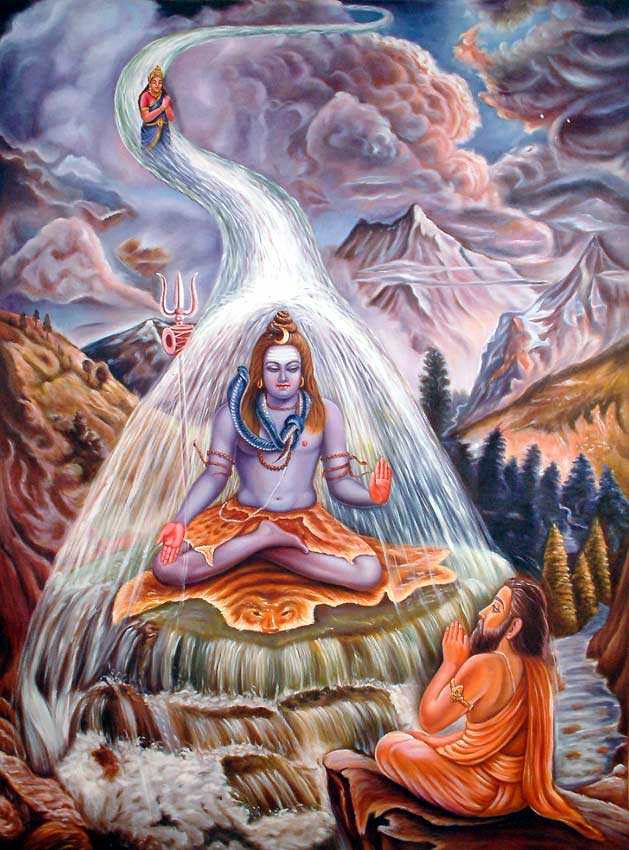
After eons of being flattered and praised by the Devas, Ganga had become vain. She scoffed at Brahma when he asked her to flow down to earth, but could not disobey him as he was her father. But Ganga was sure, as much as Bhagiratha was afraid that no one could stop her fall, which would devastate the Earth for a long time. As she cascaded across and down from Swarga, Bhagiratha and celestial observers were terrified of the roar generated by the gallons of water as the Ganga descended down. But Lord Shiva appeared from out of nowhere and captured all of Ganga just as she launched herself onto Earth, in his jata (hair). Ganga struggled to set herself free, but Shiva could not be budged. Bhagiratha worshipped Shiva, who let Ganga free after crushing her vanity. She flowed, and is still believed to flow, from Shiva's jata down to Earth at a gentler pace. The touch of Shiva further sanctified Ganga. King Bhagiratha led the way for Ganga on his chariot, and she followed him across the north and east of Bharat and finally merging with the ocean. In her course she washed the ashes of Sagara's sixty thousand sons, who ascended to heaven while praising and blessing Bhagiratha.

As Ganga travelled to the nether-worlds, she created a different stream to remain on Earth to help purify unfortunate souls there. She is the only river to follow from all the three worlds - Swarga (Heaven), Prithvi (Earth) and, Patala (Hell). Thus is called "Tripathagā" (one who travels the three worlds) in Sanskrit language. Because of Bhagiratha’s efforts, Ganga descended on to Earth and hence the river is also known as Bhagirathi, and the term "Bhagirath Prayatna" is used to describe valiant efforts or difficult achievements.

Another name that Ganga is known by is Jahnavi. Story has it that once Ganga came down to Earth, on her way to Bhagiratha, her rushing waters created turbulence and destroyed the fields and the sadhana of a sage called Jahnu. He was angered by this and drank up all of Ganga's waters. Upon this, the Gods prayed to Jahnu to release Ganga so that she could proceed on her mission. Pleased with their prayers, Jahnu released Ganga from his ears. Hence Ganga is also mentioned as ‘Jhanavi’, which means ‘The Daughter of Jhanavi’.

The Amazon which is around 7000 km in length is three times as long as Ganges. Unlike the Nile, Hwang-ho, Tigris-Euphrates or even her own cousin, Indus (Sindhu), the Ganga is no one of the earliest cradles of human civilization. But Ganga holds a unique distinction, of being the holiest and most celebrated river ever known to man. This river is mentioned in all ancient Indian texts, with several hymns being dedicated to her and many festivals being celebrated in her honour, even today. In her 2500 odd km long journey from the snow capped peaks of the Himalayas to its sink in the Bay of Bengal, Ganga plays several roles in the lives of Indians. For a pious Hindu, she is a revered goddess and bathing in her waters causes the remission of all sins and facilitates the attainment of liberation from the cycle of life and birth. For a farmer who cultivates paddy on the banks, the river is a perennial source of water and a supplier of fertile soil. For the River Dolphins (Susu) and Gavial (Gharial) that inhabit it, she is a mother who sustains all their needs. And finally for India, Ganga is her lifeline, her soul, her eldest and most beloved daughter and a companion in good and bad times. Perhaps, the most fitting tribute to this great river is given by the veteran Bollywood lyricist Shailendra in the song ‘Hothon pe Sachhai’ where he pens down the following lines:-


Hothon pe sachhaee rehti hain
Jahaa dil mein safaee rehti hain
Hum us desh ke wassee hain
Jis desh mein Ganga behti hain

September 02, 2010

THE CHILDREN OF THE GANGA


THE GANGES RIVER DOLPHIN


Ever since the dawn of civilization in the Indian Sub-continent, the Ganga has played a pivotal role in the political, religious, cultural and economic matters concerning the people of the region. Apart from being a perennial source of water, the fertile alluvium brought down by this mighty river has made the North Indian plain, one of the most productive, prosperous and populous region of the world. Since time immemorial, the wealth and grandeur of cites of the Ganga valley have lured people from different parts of the world towards India. In fact the Ganga plain is the crucible from which the ‘Great Civilization of India’, based on the virtues of equality, love and freedom came into existence. Besides being the holiest river in Hinduism, the Ganga, India’s National River finds a mention in all the ancient Vedic texts and continues to be our symbol all over the world.

While the various aspects of the Ganga and its relevance in the Story of India are well documented, the fact most often overlooked about the river is the rich bio-diversity that it supports in its 2500 km long journey that encompasses several different vegetative patterns including the confiners in the higher altitudes of the Himalayas to the Sundri trees of the Sunderban delta region. Perhaps, the most well-known of all faunal species that inhabits it, is our National Aquatic animal – The Ganga River dolphin.

Unlike their oceanic cousins who are occasionally sighted in fresh waters near the mouth of rivers, the river dolphins of the world, classed in the Platanistoidea super family of cetaceans reside in fresh water rivers and estuaries. The two types of dolphins differ somewhat in physical appearance with river dolphins having a much larger snout of about 30 centimeters. On the contrary, they have smaller eyes, and their vision is poorly developed because they live in dark, muddy water. This environment also makes river dolphins less active than marine dolphins.

Of the four species of the river dolphins the largest is the Boto or The Amazon River dolphin endemic to the Orinoco, Amazon and Araguaia/Tocantins River systems of South America. The other fresh water dolphin found in this continent is the La Plata or Franciscana dolphin, which is also found in the ocean and saltwater estuaries. The third member is the Baiji or Chinese River dolphin that once inhabited the Yangtze River, but fell prey to China’s rapid industrialization and was declared “functionally extinct” in December 2006. And lastly, the South Asian River dolphins, the two sub-species of freshwater dolphins found in two great rivers of the Sub-continent, the Ganga and the Sindhu. The Ganges River dolphin or the Ganges Susu is primarily found in the Ganges and Brahmaputra Rivers and their tributaries in India, Bangladesh and Nepal, while the Indus River dolphin or Bhulan is found in the Indus River in Pakistan and its Beas and Sutlej tributaries. From the 1970s until 1998, they were regarded as separate species; however, in 1998, their classification was changed from two separate species to subspecies of a single species.
Credit: Francois Xavier / WWF India
Having a fairly thick, yet sturdy body with light grey-brown skin, often with a hue of pink, river dolphins of the Ganga, like other species of this kind are characterized by a large snout that thickens towards its end. The teeth are visible in both the upper and lower jaws even when the mouth is closed. The flippers and tail are thin and large in relation to the body size while the dorsal fin is under developed and reduced to a triangular lump. These aquatic mammals display sexual dimorphism with the mature adult females being much larger than the males because the female rostrum continues to grow even after the male rostrum stops growing, eventually reaching approximately 20 centimeters more. Having an average weight of about 150 kilograms, the species have been recorded to live for as many as 28 years in captivity. The males attain sexual maturity at an age of about 10 to 12 years, while the females mature much earlier. After a gestation period that is thought to be approximately 10 months, the dolphins give birth to a single calf, once in 2 to 3 years. The young which are chocolate brown at the time of the birth become grayish brown in adulthood with a smooth and hairless skin. The teeth of the young are almost an inch long, thin and curved; however, as the animals age the teeth undergo considerable changes and in mature adults become square, bony and flat disks. Calves have been observed between January and May and do not appear to stay with the mother for more than a few months.

In fact what sets this creature apart from all others that inhabit the river is the unique manner in which they navigate and catch their prey in the muddy waters of the holy Ganga. These mammals do not have a crystalline eye lens, rendering them effectively blind and earning it the nickname – The Blind River dolphin, although the eyes may still be able to detect the intensity and direction of light. As such, navigation and hunting are carried out using the technique of echolocation – commonly known as the Biosonar, and found in many other animal species like bats, whales, porpoises etc. This technique comes in handy as they live in an underwater habitat that has favourable acoustic characteristics and where vision is extremely limited in range due to absorption and turbidity. The dolphin emits an ultrasonic sound from its snout in the directions of its head, which reaches the prey or any obstacle in the path and is reflected back. The echoes are received using fatty structures around the lower jaw as the primary reception path, from where they are transmitted to the brain. The dolphin then registers this image in its mind and subsequently avoids the obstacles or catches hold of its prey which includes a variety of shrimp and fish, including the carp, catfish, mahseers, gobies and freshwater shark. It does much of its feeding at or near the bottom, swimming on one side, and probing the river bottom with its snout and flipper, which has led to them being referred to as - The Side Swimming dolphins.

The marked seasonal changes in the distribution and density of the Ganges River dolphin over much of its range are due, at least in large part, to fluctuations in water levels. During the dry season from October - April, many dolphins leave the tributaries of the Ganges - Brahmaputra system and congregate in the main channels, only to return to the tributaries the following rainy season. They may become isolated in pools and river branches during the dry season. Reports from the 19th century speak of large schools of dolphins to be seen near most large towns on the Ganga River. However, in more recent times, this dolphin has usually been found to occur in small groups or alone with relatively high densities being recorded at sites near the confluence of two or more rivers, in areas where the current is relatively weak, off the mouths of irrigation canals, and near villages and ferry routes, sharing their habitat with other critically endangered species like gharials, fresh water turtles. In India, their distribution range covers seven states and several rivers – The Upper Ganga River (Uttar Pradesh), Chambal River (Madhya Pradesh and Uttar Pradesh), Ghagra and Gandak Rivers (Bihar and Uttar Pradesh), Ganga River (Varanasi to Patna), Sone and Kosi Rivers (Bihar), Brahmaputra River from Sadia (Arunachal Pradesh) to Dhubri (Bangladesh border) and its tributary, Kulsi River.

Once present in tens of thousands of numbers, the Ganges River dolphin has dwindled abysmally to less than 2000 during the last century. Probably the greatest factor that goes against it is the fact that its habitat – The Indo-Gangetic Plain, supports nearly one-tenth of the world human population. Though deliberate killing of this species for meat and oil seem to have declined in most of the areas, the various reasons that have contributed to a steady decline in their numbers are as follows:-

(1) Habitat Fragmentation: The construction of 50 or more dams and barrages within the Ganges River dolphin’s historic range has drastically altered its habitat and fragmented the population. More such structures are planned or are under consideration. Approximately 3500 km of embankments have been constructed along the main channel of the Ganges and its tributaries which interrupts access to spawning habitat for floodplain-dependent fishes and eliminate eddy counter-currents where the dolphins spend much of their time.

(2) River Pollution: Dredging and the removal of stones, sand, and woody debris also compromise the ecological integrity of the riverine environments, especially in small tributaries. Concentrations of toxic chemicals such as organochlorine and butyltin in the tissues of Ganges River dolphins are high enough to cause concern about adverse effects.

(3) Indiscriminate Fishing/Entanglement: Incidental mortality in fishing gear, especially gillnets, is a severe problem for the Ganges River dolphin throughout most of its range. The demand for these products means that there is little incentive for fishermen to reduce the by catch or to release dolphins that are still alive when found in nets.
Credit: Roland Seitre
Placed in Schedule-I of the Wildlife Protection Act, 1972, and listed by IUCN as ‘Endangered’, the Ganges River dolphin enjoys high levels of legal protection both nationally and internationally. This species was declared as the National Aquatic Animal of India by a decision taken in the first meeting of the National Ganga River Basin Authority (NGRBA) chaired by Dr. Manmohan Singh on 5th October, 2009. It has been recently found that fish oils can be used in the place of dolphin oil for the preparation of bait. Popularization of fish oil as bait may reduce the poaching of dolphins for its oil.

Yet its numbers continue to decline. The absence of a coordinated conservation plan, lack of awareness and continuing anthropogenic pressure, are posing an incessant threat to the existing dolphin population. In fact several conservation programs have been launched in the Vikramshila Gangetic dolphin Sanctuary, the only protected area for the Ganges dolphin in India, to study these creatures, to understand their behavior and to protect them. These include:-

(1) The Vikramshila Biodiversity Research and Education Centre (VBREC), led by Dr. Sunil Chaudhary, together with the Whale and dolphin Conservation Society (WDCS), the Environmental Biology Laboratory of Patna University, and T.M. Bhagalpur University, has initiated a project to improve the conservation value of Vikramshila Gangetic dolphin Sanctuary.

(2) Aaranyak, a registered NGO working in the North-East has initiated a project entitled “Conservation of Gangetic dolphin in Brahmaputra” in collaboration with the Dibrugarh University to evaluate the conservation status of these mammals throughout the Brahmaputra River System by carrying out research into its population status, distribution, habitat preferences and threats.

(3) WWF India has also started ‘The Ganges River Dolphin Conservation Program’ to build a scientific database of the population status of the species and study the habitat quality of the dolphins' distribution range. A 'River Watch Program' has been initiated to identify hot spots and develop management plans with the help of the Forest Department and create awareness in target areas.

Dolphins are amongst one of the oldest creatures in the world along with some species of turtles, crocodiles and sharks. In Hindu mythology the Ganges River dolphin is associated with Ganga Mata, the deity of the Ganges River. The dolphin is said to be among the creatures which heralded the goddess' descent from the heavens and her mount, the Makara, is sometimes depicted as a dolphin. In the Rig Veda,the Ganga (Jhanavi) and the River dolphins are mentioned in adjacent verses. This mammal is also said to represent the purity of the holy Ganga as it can only survive in pure and fresh water. It is indeed our duty to protect and preserve this Wonder of the Natural World that Mother Nature has bestowed upon us.


SOURCES


(1) Wikipedia – South Asian River Dolphin (Link)

(2) WWF India – Ganges River Dolphin (Link)

(3) Animal Info: Endangered Animals – Platanista gangetica gangetica (Link)

(4) Indian Government – National Aquatic Animal (Link)

(5) India Divine – The Triveni Sangam (Link)

IMAGES


(2) Credit: Francois Xavier (Link)
Original: Francois Xavier PELLETIER /WWF Canon

(3) Credit: Roland Seitre (Link)
Original: FedePhoto