Showing posts with label Wildlife. Show all posts

August 15, 2015

WHEN THE HUNTER GETS HUNTED

Cecil the lion at Hwange National Park (4516560206)
Cecil the Lion (Wikipedia)
In June 2015, a lion was found dead on the outskirts of the Hwange National Park in Zimbabwe; while it is common even for the 'King of the Jungle' to sometimes fall prey to competitors including other lions, packs of hyenas and wild dogs, the carcass revealed another gruesome story. The lion had been mercilessly shot, then skinned, beheaded and its majestic head with that distinct blackish mane had been taken as a trophy, clearly suggesting that the culprit was that disgusting creature we know as 'Man'. Unfortunately for the hunter - a Minnesota based dentist Walter Palmer, the beast he had shot down was no ordinary lion, it was the magnificent Cecil, the most famous attraction of the Hwange National Park, a favorite with the tourists which was being studied by researchers at the Oxford University to understand big cat behavior for some years now. As the news of the lion's brutal death spread and gory details regarding the hunt emerged, netizens across the world condemned the heinous act with many flooding Walter's social media pages with thousands of 'hate' messages. In fact, the fight was taken right up to the doctor's doorsteps as protesters left placards and flowers in memory of the slain animal outside his clinic. The hunter's weak apology and assurance to co-operate with the investigating agencies found no takers with a 1,00,000 strong petition urging the US authorities to extradite the 'poacher' to Zimbabwe to face the law.

All along, the dentist has maintained that he had followed the due process and relied on local hunting experts in bringing down the big cat. In fact, in several African nations, it is legal to kill even the most endangered animals if the necessary permissions have been obtained from the concerned authorities. In most of these countries, there is a stringent screening process to evaluate the animal before the nod is given to hunt it. With Cecil being still in his prime and jointly leading a pride, it did not meet this 'criteria' for elimination for sure. In fact, it is being alleged that Parker and his accomplice - professional hunter Theo Bronkhorst lured the beast out of the park limits where it was hunted with an arrow on the property of one Honest Ndlovu. The poor creature was tracked down 40 hours later and then shot dead with a rifle. It now emerges that both Bronkhorst and Ndlovu did not have the necessary permits for lions. The Zimbabwean authorities have started proceedings against the two whereas a demand has been made to extradite the dentist to atone his sins.

The murder of Cecil has put the spot light on legal hunting with many across the world appealing to governments in various African nations to ban it altogether. As per reports, hundreds of lions, leopards, elephants, giraffes, rhinos and antelopes fall prey to hunters each year. At a time when many of these species are staring at the brink of extinction, the death of even a few individuals could deliver a serious blow towards conservationist efforts. Then again, there is this other side of the story. Legal hunting ends up generating millions of dollars in revenue for these African nations and this money is apparently used in wildlife conservation as well as improving the lives of the local populace. This was precisely the reason that the move by some major airlines to ban the transfer of animal trophies was condemned by officials in South Africa and Nigeria. Here is where the support from the more developed nations or the United Nations in terms of monetary funds to more poorer African nations could help and the reliance on this 'ghastly' practice could be reduced over a period of time.

The biggest positive to emerge out of the whole episode is the massive outpouring of grief by thousands of people across the world who used social media as a tool to voice their opinion in favor of wildlife conservation. With the ever increasing human population and technological advancement putting an unprecedented pressure on the environment, the future of many species looks gloomy. Habitat destruction, hunting, poaching, introduction of invasive species and pollution is threatening to wipe off a large number of animals from the face of the Earth which could seriously damage the ecology and threaten our own existence. At this time, the unity displayed by people all around shows that there are many who still care for the wildlife. It is sad that Cecil has perished; ironically though, his death has furthered the cause of wildlife conservation.

May 24, 2015

BIRDS OF GOA: APRIL'15 - PART 2

JUNGLE BABBLER

Popularly known as the 'Seven Sisters', the Jungle Babblers are medium sized gregarious birds that are common to the country. Extremely noisy yet adorably cute, they can be easily found in the countryside, foraging for grains and worms.

The below pictures were clicked at the back-side of the Chapora fort i.e. the side facing the Chapora river which is in fact a heaven for bird lovers as I discovered during my last trip. I will post more pictures of the avians that I encountered here in the later posts in this series.

Click on the below snaps to see them in better quality.


More from the series: THE BIRDS OF GOA: APRIL'15

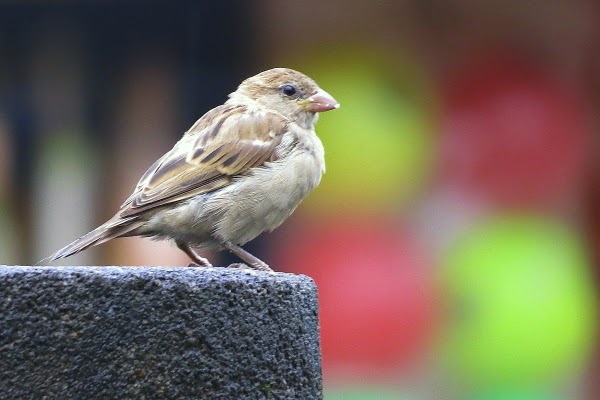
(1) Sparrow (Link)

(2) Jungle Babbler (Link)

(3) Purple Sunbird (Link)

(4) Brahminy Kite (Link)

(5) Black Headed Oriole (Link)

(6) Indian Koel (Link)


January 28, 2015

ROARING

INDIA'S TIGER POPULATION GROWS BY 30% OVER THE LAST FOUR YEARS

As per the latest tiger census carried out by the government in association with several wildlife organizations, India is home to 2,226 wild tigers, a jump of 30 percent from the last survey that was concluded in 2010. With the numbers of the magnificent stripped felines being reduced to 1,411 way back in 2008, the rise in the figures is in many ways a testimonial to the sustained efforts of conservationists, tiger experts, government officials and wildlife enthusiasts in the last few years. However, a lion share of credit goes to the security guards who put their own lives at risk to protect our national animals from hunters and poachers. The best part is that the results of the census are fool-proof since the whole exercise has been conducted with some of the most modern methods like camera trapping and collection of paw marks and droppings.

Courtesy: Trade Wallpaper (Link)
Some of the biggest positives from this survey are as follows:
  • India is home to nearly 70 percent of the world's wild tiger population. Other nations with significant feline numbers include Bangladesh, Malaysia, Russia and Indonesia.
  • In the country, Karnataka leads other states with a tiger population in excess of 400, followed by Uttarakhand, Tamil Nadu, Madhya Pradesh and Maharashtra. Most importantly, the national animal has been spotted in over 20 Indian states, showing that the favorable habitat for these beasts is found across the country.
  • In another study entitled 'Economic Valuation of Tiger Reserves', researchers have found that six tiger reserves - Corbett, Kanha, Kaziranga, Periyar, Ranthambore and Sundarbans contribute a staggering Rs 1,49,000 crores to the Indian economy. This first of its kind survey, will hopeful help people realize the benefits of saving our forests and the creatures that inhabit them.
  • More importantly, as per the reports, India can add up to 1,500 more tigers to the existing numbers. This is perhaps the most important take away from the entire exercise and should be a source of inspiration for people involved in tiger conservation to keep up their good work.
  • Lastly, speaking at the press conference, Environment Minister Prakash Javadekar said that his government was open to give a few of the big cats to the countries that want to revive their tiger numbers. This, in my opinion is excellent news since it is our moral duty to do our bit in helping the stripped felines survive, keeping politics away from such a noble cause. Of course, before doing that, we need to make sure that the countries that we are sending our tigers are in a position to protect them.
Courtesy: Free Images (Link)
At the same time, we cannot afford to drop our guard, the reasons being as follows:
  • As per the census, India lost 83 tigers to poachers in the last four years. Besides, another 109 feline deaths were termed as 'unexplained'. This clearly shows that there is still a lot we can do in saving our big cats.
  • We still do not have the green corridors connecting major tiger reserves in the country that are crucial in maintaining the gene pool by preventing inbreeding amongst closely related individuals. This task of setting up forests that connect big cat habitat should be taken up with utmost priority.
  • Lastly, the numbers of Black Tiger - a sub-species of Bengal Tigers with much darker black stripes has come down from 32 in 2010 to 28 now. These felines are only found in Simlipal and Santakosia reserves in Odisha.

September 13, 2014

GOKARNA DIARIES: AUG'14 - Part V

INDIAN BULL FROG


The cottages in Namaste Cafe have few tiny artificial ponds where one can easily spot Indian Bull Frogs. Sitting still either on land or just lazying around in the waters, they are extremely photogenic. We spotted about five of them; they were huge, bigger than the smaller frogs that I was familiar with in Goa. Those black eyes and the bronze ring around it, the thin yellow line running through the center and those light green spots, make them look so beautiful.

Over the last few decades, frog meat has become very popular in certain parts of the country. Thousands of frogs are caught every year, especially during the monsoon when they are found in plenty. A large number of people seem to have acquired a taste for frog legs. Considering that these amphibians play a key role in controlling the population of pests and other insects, the decline in their numbers will lead to huge agricultural losses. Over exploitation of species like Indian Bull Frogs should be avoided as it could seriously jeopardize the eco-system and impact our grain production. Please bear this in mind the next time you visit a hotel and order your favorite frog dish. Remember, when the buying stops, the killing will stop too!

Prince Charming?
Look at those eyes....
Frogs use their powerful hind legs while jumping

For more posts in the series: GOKARNA DIARIES: AUG'14, click here (Link)

August 16, 2014

MURDESHWAR DIARIES: AUG'14 - Part II

GREATER COUCAL or CROW PHEASANT


One of the birds that I look forward to on all my trips to Murdeshwar is the Greater Coucal or the Crow Pheasant (Wiki Link). Last year when I had been there at this time of the year, I remember seeing three of these, foraging in our backyard for worms and frogs. While they may look fiery in their black and brown coat, especially with those bright red eyes, they are extremely shy and will fly away whenever you close in on them to get a good shot. On this trip, I found one coucal who had just caught a frog. Later, in the evening, I saw it again, this time with a worm in its beak. As it flew into the trees with its prey, I spotted a juvenile which she was rearing. While the little coucal was perched, mummy went about getting food for it. This was the first time that I had seen a mother coucal with her chick. Though I could not get both of them in one frame, just watching the mother taking pains to rear her young was in itself such a pleasure.


Other posts in this series: 
Murdeshwar Diaries: Aug'14 - Part I - Part IV (Link)

MURDESHWAR DIARIES: AUG'14 - Part I

THE HOUSE SPARROW


August began on a good note as all of us, except Pappa headed to our native town of Murdeshwar. We were there primarily to attend Vaini's (my maternal grand-mom's) third death anniversary, which happened to fall on the first day of the month - a Friday. The plan was to leave for Gokarna (Link) the next morning and spend the weekend on the Om Beach, even as Mom and my cousin Poonam headed back to Bengaluru. Not so surprisingly, I was thrilled to be back on the coast in spite of the fact that it was raining cats and dogs. Another reason for all the excitement was that I was dying to use my Canon SX50HS after a very long time. It had been months since I had not gone out on any birding sessions with our new house, election coverage on the blog and official work occupying much of my time. Monsoon is a good time to spot birds in this part of the world; actually you will find several different kinds of Aves on the Arabian coast throughout the year, however the probability of finding rare ones during rains is high.

I will begin this series with one of my favorite birds - the House Sparrow (Wiki Link). Though they have become extremely difficult to find in our cities, these 'small packets of joys' can still be found in sizable numbers in our towns and villages. In Murdeshwar, they are generally seen in groups of up to 5 individuals on wires, compound walls and most commonly near shutter boxes of shops where they breed their young. While they may not be attractive to the eyes, watching them go about their daily routine is such a pleasure. And yes, there is no better way to start your day than listening to the chirping sounds of these little creatures. Isn't it sad, that sparrow - a bird that has been so closely associated with human culture across the world has declined so dramatically over the years... While ornithologists and experts may still be analyzing the root cause of the problem, I hope that the sparrows make a grand come back in our cities too.


Other posts in this series:
Murdeshwar Diaries: Aug'14 - Part I - Part IV (Link)

February 18, 2014

SUB-LIME


LIME BUTTERFLY - PAPILO DEMOLEUS


Named after its penchant for citrus plants, the Lime Butterfly is a member of the swallow tail family. It is ironically though that it lacks a prominent tail. The wings measuring about 8 to 10 cm in size consist of irregular spots on a predominantly black background when from the upperside. The red tornal spot with blue edging is difficult to miss. However, it is the underside that I find particularly attractive as seen from the snaps. The pattern is like a maze of white and black with orange spots that have a distinct blue edge, visible only when you have a closer look. The tornal spot only adds to the beauty. It is a resident of the Arabian peninsula, the Indian sub-continent, China, Japan, parts of South East Asia, Australia and some Pacific islands. Owing to its excellent adaptability and high rate of reproduction, it is spreading into several islands in the Caribbean Sea. There are four other species of lime butterflies, three of which are endemic to Madagascar whereas the fourth is found in Sub-Saharan Africa. An interesting feature about the species is that its mode of flight differs as the day progresses. In the mornings, it will fly leisurely whereas the flight is straight and low in the later part of the day. When the weather is hot, it prefers resting on damp surfaces from where it derives moisture.


SOURCES

(1) Wikipedia: Papilo Demoleus (Link)

February 02, 2014

LALBAGH DIARIES: JAN 2014 - VI


RED RINGED PARAKEET


I was almost done with bird photography when I came across a pair of Red Ringed Parakeets perched on a nearby tree. Although the ground was sloping, thanks to my woodland shoes, I was able to get some brilliant snaps of the duo. As mentioned in an earlier post, I am extremely happy with the photos that I clicked here. I guess the best part of bird photography, of course apart from the avians is the fact that it is unpredictable. Just when you think it is done, you may get an amazing moment to capture.


Links to all posts in the series:
(1) Lalbagh Diaries: Jan 2014 - I (Link)
(1) Lalbagh Diaries: Jan 2014 - II (Link)
(1) Lalbagh Diaries: Jan 2014 - III(Link)
(1) Lalbagh Diaries: Jan 2014 - IV (Link)
(1) Lalbagh Diaries: Jan 2014 - V (Link)
(1) Lalbagh Diaries: Jan 2014 - VI (Link)

LALBAGH DIARIES: JAN 2014 - V


THE INDIAN CORMORANT


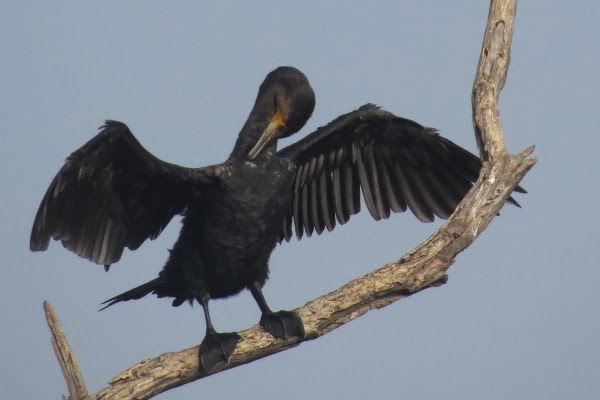
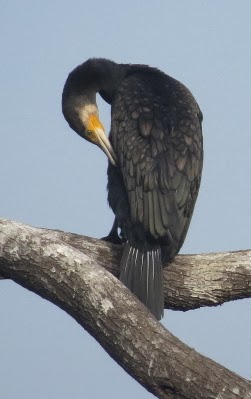
If there was one bird which I was happy to shoot at Lalbagh, it was the Indian Cormorant. Slightly larger than its cousin the Little Cormorant, this bird is pretty much similar to other cormorants. Distinguishing the two species can be difficult. One good link in this regard is this (Link).


I would like to share one story here. As I was busy clicking the Cormorants, a visitor who was jogging with his friends made the following comment, probably aimed at me: "When you come to Lalbagh on Sunday mornings, even crows look exotic". I do not have any problem with the jibe at me. But I have a different take on it. Isn't it sad that even the educated class in a city like Bangalore are so ignorant about our feathered friends. I mean, the Indian Cormorants are some of the most common birds in the country and yet people have no idea about them. This says a thing or two about our education system, the level of awareness we have about environment and more importantly, about ourselves too.

Links to all posts in the series:
(1) Lalbagh Diaries: Jan 2014 - I (Link)
(1) Lalbagh Diaries: Jan 2014 - II (Link)
(1) Lalbagh Diaries: Jan 2014 - III(Link)
(1) Lalbagh Diaries: Jan 2014 - IV (Link)
(1) Lalbagh Diaries: Jan 2014 - V (Link)
(1) Lalbagh Diaries: Jan 2014 - VI (Link)

LALBAGH DIARIES: JAN 2014 - IV


THE GREY HERON


I found this Grey heron at the western end of the Lalbagh Lake. Amongst the avians that had gathered here on that morning, this one was the second, behind the majestic Pelican. Grey Herons are very common in Begur; however, you can easily spot them in Agara, Madivala and here in Lalbagh too. Mature adults have a grey plumage whereas the neck is white, besides the black mark on its head which extends in the form of black spots along the neck. I wonder where Nature get these colors from. Like all herons, they patiently wait in water, stalking prey and then catching it with a strike in lightning speed.


Grey Heron

Grey Heron with Indian Cormorant


Links to all posts in the series:
(1) Lalbagh Diaries: Jan 2014 - I (Link)
(1) Lalbagh Diaries: Jan 2014 - II (Link)
(1) Lalbagh Diaries: Jan 2014 - III(Link)
(1) Lalbagh Diaries: Jan 2014 - IV (Link)
(1) Lalbagh Diaries: Jan 2014 - V (Link)
(1) Lalbagh Diaries: Jan 2014 - VI (Link)

LALBAGH DIARIES: JAN 2014 - III


LITTLE CORMORANT & INDIAN DARTER


After shooting the avians in the Lotus Pond (Link), I headed towards the Lalbagh lake. I was a tad disappointed as the raft of ducks that are a big hit with the visitors were not to be seen. On a closer inspection, I found that they had gathered in the vegetation at the centre of the lake, far away from view. Nonetheless, the other feathered creatures like the Cormorants were present in sizable numbers.


Little Cormorant

The Little Cormorant is a pocket sized power house. If you observe them for long, you will you will notice that these guys just do two things during most of the day. Fist, they will dive into the water, remaining submerged for short intervals in which they hunt for small fish. Once a fish is caught, they come out of water and swallow it. This is repeated about five times. Next, they will fly to a nearby branch, spread their wings and remain motionless. This is the best time to get good snaps. Watching them is a visual treat.

Indian Darter

Belonging to the family Suliformidae, the Indian Darter or the Oriental Darter is commonly known as the Snake Bird because of the peculiar shape of its long and slender neck. A resident of the South and South East Asia, it is a Near Threatened species. As such, I was very excited at getting a chance to see them. There was just one darter on that morning, elegantly perched on the leafless branch, watching the still waters for prey.

Spot Billed Pelican
The Spot Billed Pelican is one of the iconic birds of the city. A Near Threatened species, there was just one pelican in the lake. Generally, one can see them congregate in large numbers, sometimes in association with painted Storks too. Far away from other avians, it was fishing with its huge, characteristic beak.

Links to all posts in the series:
(1) Lalbagh Diaries: Jan 2014 - I (Link)
(1) Lalbagh Diaries: Jan 2014 - II (Link)
(1) Lalbagh Diaries: Jan 2014 - III(Link)
(1) Lalbagh Diaries: Jan 2014 - IV (Link)
(1) Lalbagh Diaries: Jan 2014 - V (Link)
(1) Lalbagh Diaries: Jan 2014 - VI (Link)

February 01, 2014

LALBAGH DIARIES: JAN 2014 - II


THE BIRDS AT THE LOTUS PONDS


Indian Pond Heron
A native of the Indian Subcontinent, South and South-East Asia, the Indian Pond Heron is one of the most common birds of the country. From the beaches of Goa to the lakes of Bengaluru to nearby nullahs, you can find them in places with proximity to water. In fact they are generally found in association with egrets. They are generally camera shy. However, this one was pretty brave. It looked like it was enjoying ll the attention it was getting from the several birding enthusiasts who were there.

White Breasted Waterhen

While the Pond Heron was posing for the shutterbugs, the White Breasted Waterhen was in some sort of hurry. It made me dance all around and yet I could not get a decent shot. Like the herons, they are residents of Southern and South-eastern Asia. It can be identified from the white marks on the face, neck and breast. As compared to other members of the Rallidae family, they are dull in color and are relatively less abundant in the city.

Purple Moorhen

Unlike their cousins, the Purple Moorhen have been gifted with brilliant colors - bluish purple coat and red beak making them irresistible to the eyes. In fact, the best places to spot them in the city are the lakes of Agara and Madivala (BTM). This is because here vast stretches of water is covered with vegetation which is ideal habitat for them. On the contrary, the waters in the Lalbagh lake are free from all kinds of vegetation. Its range stretches over most of the Old World extending up to Australia. This individual in Lalbagh had several hatchlings; the young ones are black in color.

Common Moorhen
A resident breeder of vast regions of Asia, Africa and Europe, the Common Moorhen is not as common as its purple cousin, at least in the city. It is easily recognizable from its frontal red shield. Out of the five sub species, the one found in the mainland is known as the Eurasian Common Moorhen.

Links to all posts in the series:
(1) Lalbagh Diaries: Jan 2014 - I (Link)
(1) Lalbagh Diaries: Jan 2014 - II (Link)
(1) Lalbagh Diaries: Jan 2014 - III(Link)
(1) Lalbagh Diaries: Jan 2014 - IV (Link)
(1) Lalbagh Diaries: Jan 2014 - V (Link)
(1) Lalbagh Diaries: Jan 2014 - VI (Link)