Showing posts with label Indian Wildlife. Show all posts

May 31, 2015

BIRDS OF GOA: APRIL'15 - PART 6

INDIAN KOEL

I clicked this male Indian Koel as I was coming out of the Hanuman Temple at Housing Board, Porvorim. The fiery red eyes and the balck coat against the backdrop of the clear blue sky is pleasing. The females of this species who are notorious for laying their eggs in a crow's nest are polka dotted and are more elusive to find.

Click on the below snaps to see them in better quality.


More from the series: THE BIRDS OF GOA: APRIL'15

(1) Sparrow (Link)

(2) Jungle Babbler (Link)

(3) Purple Sunbird (Link)

(4) Brahminy Kite (Link)

(5) Black Headed Oriole (Link)

(6) Indian Koel (Link)


BIRDS OF GOA: APRIL'15 - PART 5

BLACK HEADED ORIOLE

The brightly colored Black Headed Oriole is one of the most beautiful avians to be found in Goa. Though it is common in the region, spotting them amidst the foliage is difficult. I had a tough time clicking this individual in Goa Velha; unfortunately, though it made me run around the bush for sometime, none of the clicks have come out well. A couple of years ago, I had a similar experience with another Oriole while climbing down the Church of Our Lady of the Mount at Old Goa.


More from the series: THE BIRDS OF GOA: APRIL'15

(1) Sparrow (Link)

(2) Jungle Babbler (Link)

(3) Purple Sunbird (Link)

(4) Brahminy Kite (Link)

(5) Black Headed Oriole (Link)

(6) Indian Koel (Link)


BIRDS OF GOA: APRIL'15 - PART 4

BRAHMINY KITE

One of the most beautiful birds of prey to be found in the Indian peninsular region, the Brahminy Kite is associated with the mythical creature Garuda, the king of the birds and the mount of Lord Vishnu in several cultures around the world. I shot this wonderful avian while it was perched on a coconut palm near my Bhabi's place at Goa Velha.

Click on the below click to enlarge them.


More from the series: THE BIRDS OF GOA: APRIL'15

(1) Sparrow (Link)

(2) Jungle Babbler (Link)

(3) Purple Sunbird (Link)

(4) Brahminy Kite (Link)

(5) Black Headed Oriole (Link)

(6) Indian Koel (Link)


For more posts on Brahminy Kites, click here (Link)

May 24, 2015

BIRDS OF GOA: APRIL'15 - PART 3

PURPLE SUNBIRD

Another lovely bird that came across while I was getting down the Chapora Fort was this Purple Sunbird. Considering that these birds seem to be always in a hurry, the time for any photographer to get their snaps is extremely limited. Luckily, I did manage to get a few good snaps.

Click on the below snaps to see them in better quality.


More from the series: THE BIRDS OF GOA: APRIL'15

(1) Sparrow (Link)

(2) Jungle Babbler (Link)

(3) Purple Sunbird (Link)

(4) Brahminy Kite (Link)

(5) Black Headed Oriole (Link)

(6) Indian Koel (Link)


BIRDS OF GOA: APRIL'15 - PART 2

JUNGLE BABBLER

Popularly known as the 'Seven Sisters', the Jungle Babblers are medium sized gregarious birds that are common to the country. Extremely noisy yet adorably cute, they can be easily found in the countryside, foraging for grains and worms.

The below pictures were clicked at the back-side of the Chapora fort i.e. the side facing the Chapora river which is in fact a heaven for bird lovers as I discovered during my last trip. I will post more pictures of the avians that I encountered here in the later posts in this series.

Click on the below snaps to see them in better quality.


More from the series: THE BIRDS OF GOA: APRIL'15

(1) Sparrow (Link)

(2) Jungle Babbler (Link)

(3) Purple Sunbird (Link)

(4) Brahminy Kite (Link)

(5) Black Headed Oriole (Link)

(6) Indian Koel (Link)


May 02, 2015

BIRDS OF GOA: APRIL'15 - PART 1

COMMON SPARROW

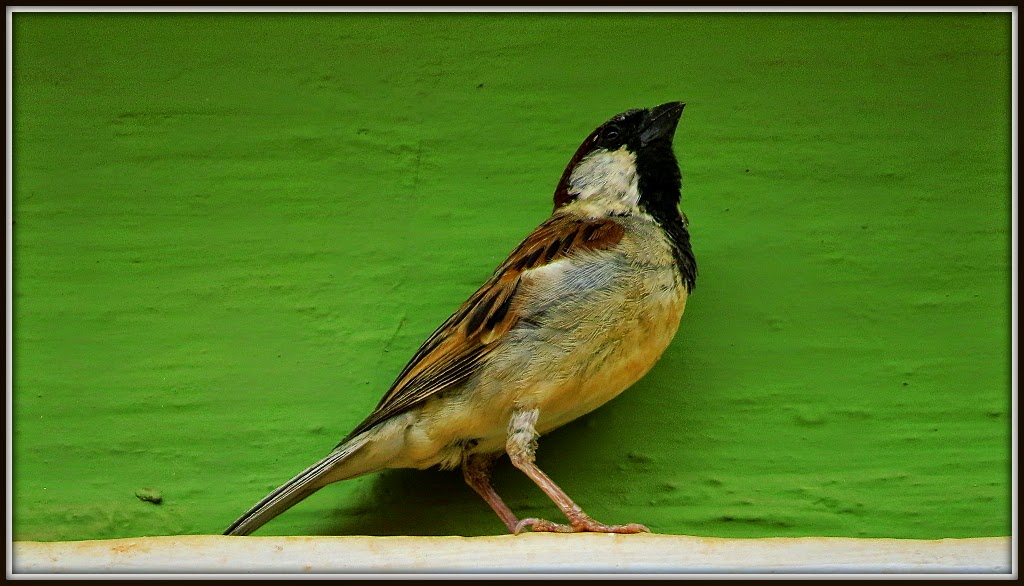
Bordering the Rua de Ourem, the wards of Fontainhas and Sao Tome are amongst the oldest residential areas of Panjim. The best part of these localities is that they have still retained the old world charm; a walk through the narrow by-lanes lined by bungalows painted in vivid colors here is such a pleasure.

Apart from the beautiful Indo-Portuguese villas, one of the highlights of such a walk are the numerous Sparrows that inhabit these wards; watching these passerine birds flying by, chasing each other or feeding on grains is a treat to the eyes, especially for those of who live in urban centres devoid of these beautiful birds. In fact, here, it is very easy to see these wonderful creatures engaged in their daily activities at a very close range.


More from the series: THE BIRDS OF GOA: APRIL'15

(1) Sparrow (Link)

(2) Jungle Babbler (Link)

(3) Purple Sunbird (Link)

(4) Brahminy Kite (Link)

(5) Black Headed Oriole (Link)

(6) Indian Koel (Link)


For more posts on Sparrows, click here (Link)

January 28, 2015

ROARING

INDIA'S TIGER POPULATION GROWS BY 30% OVER THE LAST FOUR YEARS

As per the latest tiger census carried out by the government in association with several wildlife organizations, India is home to 2,226 wild tigers, a jump of 30 percent from the last survey that was concluded in 2010. With the numbers of the magnificent stripped felines being reduced to 1,411 way back in 2008, the rise in the figures is in many ways a testimonial to the sustained efforts of conservationists, tiger experts, government officials and wildlife enthusiasts in the last few years. However, a lion share of credit goes to the security guards who put their own lives at risk to protect our national animals from hunters and poachers. The best part is that the results of the census are fool-proof since the whole exercise has been conducted with some of the most modern methods like camera trapping and collection of paw marks and droppings.

Courtesy: Trade Wallpaper (Link)
Some of the biggest positives from this survey are as follows:
  • India is home to nearly 70 percent of the world's wild tiger population. Other nations with significant feline numbers include Bangladesh, Malaysia, Russia and Indonesia.
  • In the country, Karnataka leads other states with a tiger population in excess of 400, followed by Uttarakhand, Tamil Nadu, Madhya Pradesh and Maharashtra. Most importantly, the national animal has been spotted in over 20 Indian states, showing that the favorable habitat for these beasts is found across the country.
  • In another study entitled 'Economic Valuation of Tiger Reserves', researchers have found that six tiger reserves - Corbett, Kanha, Kaziranga, Periyar, Ranthambore and Sundarbans contribute a staggering Rs 1,49,000 crores to the Indian economy. This first of its kind survey, will hopeful help people realize the benefits of saving our forests and the creatures that inhabit them.
  • More importantly, as per the reports, India can add up to 1,500 more tigers to the existing numbers. This is perhaps the most important take away from the entire exercise and should be a source of inspiration for people involved in tiger conservation to keep up their good work.
  • Lastly, speaking at the press conference, Environment Minister Prakash Javadekar said that his government was open to give a few of the big cats to the countries that want to revive their tiger numbers. This, in my opinion is excellent news since it is our moral duty to do our bit in helping the stripped felines survive, keeping politics away from such a noble cause. Of course, before doing that, we need to make sure that the countries that we are sending our tigers are in a position to protect them.
Courtesy: Free Images (Link)
At the same time, we cannot afford to drop our guard, the reasons being as follows:
  • As per the census, India lost 83 tigers to poachers in the last four years. Besides, another 109 feline deaths were termed as 'unexplained'. This clearly shows that there is still a lot we can do in saving our big cats.
  • We still do not have the green corridors connecting major tiger reserves in the country that are crucial in maintaining the gene pool by preventing inbreeding amongst closely related individuals. This task of setting up forests that connect big cat habitat should be taken up with utmost priority.
  • Lastly, the numbers of Black Tiger - a sub-species of Bengal Tigers with much darker black stripes has come down from 32 in 2010 to 28 now. These felines are only found in Simlipal and Santakosia reserves in Odisha.

November 29, 2014

OFFICE DIARIES: NOV'14 - Part I

AJAA MERI BULBUL

Since time immemorial, the Bulbul is considered to be the epitome of beauty; one look at the passerine bird and you know why it continues to be an inspiration for poets and lyricist especially while describing feminine grace and charm. In case you have not yet noticed, the title of this post is borrowed from a hit song from the movie Ishq where Aamir Khan and Ajay Devgn shook their legs with model turned actress Shweta Menon. The small round eyes and the bright red spots on either side of the cheeks make them extremely pleasing to the eyes. Probably, even Mother Nature seems to agree with this; No wonder she has gifted this petite bird with a 'diadem' that the bulbul flaunts as it moves from one branch to another. And that is not all. Their 'sweet' calls are probably next only to the Asian Koels amongst the common birds found in this part of the world.

The pictures posted here are of the Red-Whiskered Bulbul that I clicked last Saturday (November 21, 2014) while on a birding trip in my office. A colleague of mine - Sunny Bhatia who has recently bought a Canon EOS 1200D accompanied me. Thanks to Sunny, I have started exploring the various options available on my camera :). The images here were clicked in the Sports Mode of the Canon SX50HS which comes with an inbuilt image stabilizer.


This is the first in a series of three posts that were clicked on 21st November, 2014 at my office premises.
The complete series can be found here (Link).

September 27, 2014

VARTHUR DIARIES: SEPT'14 - Part III

THE GEN-NEXT WEAVERS


After clicking the Munias, as I was walking towards the bus stand, noises coming from the bushes nearby caught my attention. As I went to have a closer look, what I saw was probably the best part of the entire birding trip. Wikipedia mentions that juvenile Baya Weavers are known to leave their nests and disperse to newer locations in the vicinity. What I had come across was in opinion, one such 'Baya Weaver Play School'. I found about six little Weavers there; in fact, the Gen Next was much more approachable than the adults. I was able to get some very good captures; yeah, I love some of the clicks that I have posted here. At the same time, I was careful enough not to attract the attention of predators like Crows and Eagles. After all, the young Weaver can be easy picking for these predators.


For more posts in the series VARTHUR DIARIES: SEPT'14, click here (Link)

VARTHUR DIARIES: SEPT'14 - Part II

THE SCALY-BREASTED MUNIA


After spending about 30 minutes with the weavers, I spotted this pair of Scaly-Breasted Munia as I was heading back to the bus stand. This small yet beautiful bird is native to the Sub-Continent, South-Eastern Asia and Eastern parts of Australia. It seems that Mother Nature has been extremely kind to this little bird; the color combinations and the patterns are brilliant. The head is darker brown while the feathers are much lighter. The underside has a unique pattern in the form of scales that have a black border. The pair that I saw on that day were quite comfortable sharing space with the weavers.


For more posts in the series VARTHUR DIARIES: SEPT'14, click here (Link)

VARTHUR DIARIES: SEPT'14 - Part I

MEETING THE WEAVERS


It was a Sunday morning and I decided to go to the Varthur Lake for birding. The second largest lake in the city is hardly 4 km from our new house and I was expecting to spot several avians here. I was hopeful that like Agara, BTM and Lalbaugh, there would be a jogging track across the circumference of the lake from where I could capture some nice clicks. However, I was in for a shock. After getting down at the bus stand, I kept on walking on the road that goes from Whitefield towards the Varthur Police Station, looking for the entry gate. Though much of this side of the lake was covered with water hyacinth, there was still a lot of water. Sadly though, I could not see any birds. I walked for about 20 minutes with vehicles passing by at break neck speeds and was cursing myself for having come here; I turned back and started walking towards the bus stop.

Not the one to give up so easily, especially on birding trips, I decided to try the other route. After crossing a small temple, I came across several flower and vegetable gardens. Not so surprisingly, there were several birds here. Then came the big moment; I spotted this colony of about ten Baya Weaver nests hanging from some coconut trees along the edge of the lake. It was always my dream to click these amazing creatures against the backdrop of their unique nests. While they may be said to be 'common', finding them, especially in our cities can be very difficult. I had spotted one such colony in November last year on our trip to Hampi but could not spend anytime there since we were to board our bus back to Bangalore in a few hours. Meanwhile, most of the nests in the colony were complete; many of the birds were in fact giving some finishing touches to their marvelous creations. At regular intervals, the birds would go the lake, pick up some straws and then go about weaving their homes using their tiny beaks. I took my time clicking the pictures and admiring the birds. At a short distance, there was another colony of 15 nests. In fact, the location of the trees here was such that, I could get better pictures here.

Baya Weavers are passerine birds common in the Sub-continent and South-Eastern Asia. The females are very similar to House Sparrows and distinguishing the two can be difficult. However, breeding males have a distinct yellow crown that makes them easy to identify. It is the male of the species that takes the onus of building those beautiful nests. After the nest is in, what is referred to as 'helmet stage', the males start courting the ladies. Once a female is impressed, the pair will go on completing their 'home'.


For more posts in the series VARTHUR DIARIES: SEPT'14, click here (Link)

September 21, 2014

GOKARNA DIARIES: AUG'14 - Part XIX

WIRE-TAILED SWALLOW


As we were walking through the Car Street, I found this Wire-tailed Swallow (Wiki Link) perched on a wire. Though not very clear from the picture, this lovely bird has a patch of brown on its head apart form a white underside and black feathers. Found in abundance across the country, they can be easily identified by those two wire-like threads.

Wire-Tailed Swallow
Prunning...
Hirundo smithii filifera


For more posts in the series: GOKARNA DIARIES: AUG'14, click here (Link)

September 13, 2014

GOKARNA DIARIES: AUG'14 - Part V

INDIAN BULL FROG


The cottages in Namaste Cafe have few tiny artificial ponds where one can easily spot Indian Bull Frogs. Sitting still either on land or just lazying around in the waters, they are extremely photogenic. We spotted about five of them; they were huge, bigger than the smaller frogs that I was familiar with in Goa. Those black eyes and the bronze ring around it, the thin yellow line running through the center and those light green spots, make them look so beautiful.

Over the last few decades, frog meat has become very popular in certain parts of the country. Thousands of frogs are caught every year, especially during the monsoon when they are found in plenty. A large number of people seem to have acquired a taste for frog legs. Considering that these amphibians play a key role in controlling the population of pests and other insects, the decline in their numbers will lead to huge agricultural losses. Over exploitation of species like Indian Bull Frogs should be avoided as it could seriously jeopardize the eco-system and impact our grain production. Please bear this in mind the next time you visit a hotel and order your favorite frog dish. Remember, when the buying stops, the killing will stop too!

Prince Charming?
Look at those eyes....
Frogs use their powerful hind legs while jumping

For more posts in the series: GOKARNA DIARIES: AUG'14, click here (Link)