BHAGIRATH PRAYATNA
Ganga – the National River of India, for years, has been an integral part of the historical, religious and cultural heritage of the people of the Sub-continent. Ever since the decline of the Indus Valley civilization, the Ganga and her myriad tributaries have taken the centre stage in the transformation of Indians from small agricultural communities that settled on its banks, nearly four millennia ago, to a nation that is on the threshold of becoming a Superpower, today. In fact the Ganga upholds the virtue of ‘Unity in Diversity’ which is the cornerstone of the Indian culture, as it takes as many as six headstreams (Alaknanda, Dhauliganga, Nandakini, Pindar, Mandakini and Bhagirathi) and five confluences (Vishnuprayag, Nandprayag, Karnaprayag, Rudraprayag and Devprayag) to form the mainstream of the mighty river. In fact the many symbolic meanings of the river on the Indian Sub-continent were spoken to in 1946 by Jawaharlal Nehru in his book – ‘The Discovery of India’
"The Ganges, above all is the river of India, which has held India's heart captive and drawn uncounted millions to her banks since the dawn of history. The story of the Ganges, from her source to the sea, from old times to new, is the story of India's civilization and culture, of the rise and fall of empires, of great and proud cities, of adventures of man
Although geologists believe that the Ganga, along with its mythical father, the Himalayas, was born as a consequence of the collision of the Indian and the Asian plates around fifty five million years ago, the Puranas give various versions for the birth of the river. According to one version, the Ganga was born when the sacred water from Lord Brahma’s kamandalu became personified as a maiden. The Vaishnavas believe that the Brahma had reverently washed the feet of Lord Vishnu’s fifth avatar – Vamana, and collected the water in his kamandalu. According to a third version, she was the daughter of Himavan, King of the Mountains, and his consort Mena, and thus a sister of the Goddess Parvati. However, all accounts declare that she was raised in the heavens, under the tutelage of Lord Brahma.
Several years later, a king named Sagara of the Suryavamsa or Solar dynasty, ascended the throne of Kosala. He had sixty thousand sons from his wife, Sumati and one son, named Asmanjan from his other wife, Kesini, whom he later abandoned for being wild and wicked. When the king chose to perform the Ashwamedha Yagna, his royal agents lost the track of the sacrificial horse. According to one version, the horse was stolen by the jealous Indra, who did not want the Yagna to succeed and hid it in a cave where Rishi Kapila was meditating in order to escape being accused of stealth. Sagara ordered his sixty thousand sons to track down the horse. The proud and mercurial princes raged across Bharat, burning down forests and uprooting life and property to find the horse. They finally arrived at the quiet spot where the great sage was sitting in meditation. Besides him, was tied the white sacrificial horse. Thinking that the sage had abducted the horse, the enraged princes condemned the Rishi as a thief started hurling abuses at him. The powerful Kapila who had not opened his eyes for several years turned the princes to ashes using his mystic powers.

Worried for his sons, the king sent his grandson, Anshuman, the son of Asmanjan to enquire about the princes and to retrieve the horse. When the young prince reached the cave where Rishi Kapila was meditating, he returned the horse and informed him about the fate of his uncles. He also told Anshuman that the souls of the dead princes could only raise to heaven would be through the offering of niravapanjali with the sacred waters of the Ganga, which was flowing only in the Swarga. According to another version, the information regarding the death of his uncles and about the relief from Kapila’s curse was given by Garuda, maternal uncle of Asmanjan.
Bringing Ganga back to Earth was a near impossible task and required many years to be spent in tapasya and prayer. The Kosala kings of successive generations could not do this while managing their duties as kings. As a result, the sins of the thousand princes multiplied in their destructive energy, and began resulting in natural disasters. The kingdom began to lose its peace and prosperity, and by the time Bhagiratha, a descendent of Sagara and a forefather of Lord Rama, ascended the throne, he found it impossible to attempt to govern in this situation that had only one solution.
Turning over the kingdom to trusted ministers, Bhagiratha set off to the Himalayas to perform an arduous tapasya in the extreme climate. For one thousand years, he performed an excruciatingly harsh penance to please Lord Brahma. At the end of the thousand years, Brahma came to him and told him to ask for anything. Bhagiratha asked Brahma to bring down the river Ganga to earth so that he may perform the ceremony for his ancestors.
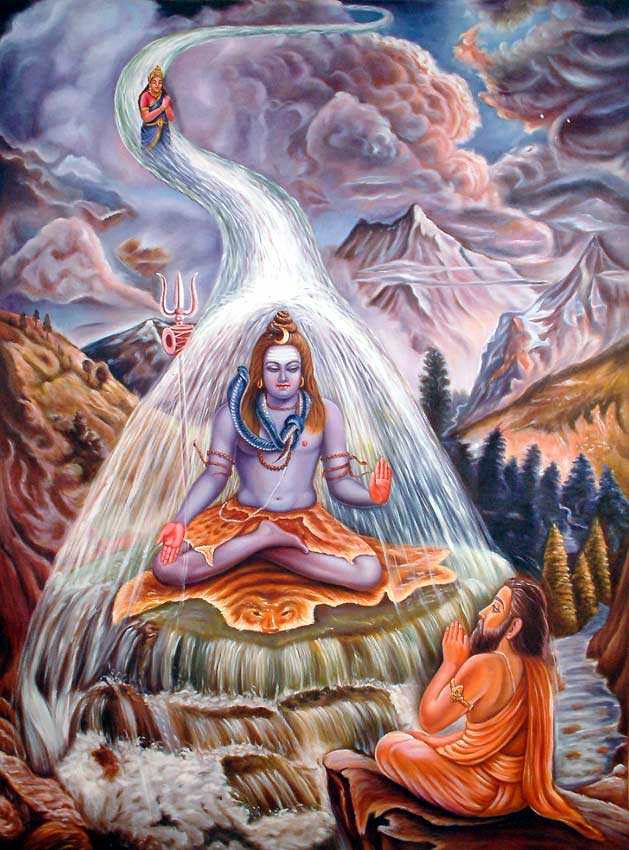
Lord Brahma asked Bhagiratha to propitiate Lord Shiva, for only he would be able to break the Ganga's fall. It was the largest river, and it would be impossible for anyone save Him to contain the destructive impact of this event. Bhagiratha performed a tapasya for Lord Shiva, living only on air. The compassionate Shiva appeared only after a year's penance, and told Bhagiratha he should not have to perform tapasya to accomplish a noble goal such as this. He assured Bhagiratha that he would break Ganga's fall.
Several years later, a king named Sagara of the Suryavamsa or Solar dynasty, ascended the throne of Kosala. He had sixty thousand sons from his wife, Sumati and one son, named Asmanjan from his other wife, Kesini, whom he later abandoned for being wild and wicked. When the king chose to perform the Ashwamedha Yagna, his royal agents lost the track of the sacrificial horse. According to one version, the horse was stolen by the jealous Indra, who did not want the Yagna to succeed and hid it in a cave where Rishi Kapila was meditating in order to escape being accused of stealth. Sagara ordered his sixty thousand sons to track down the horse. The proud and mercurial princes raged across Bharat, burning down forests and uprooting life and property to find the horse. They finally arrived at the quiet spot where the great sage was sitting in meditation. Besides him, was tied the white sacrificial horse. Thinking that the sage had abducted the horse, the enraged princes condemned the Rishi as a thief started hurling abuses at him. The powerful Kapila who had not opened his eyes for several years turned the princes to ashes using his mystic powers.

Worried for his sons, the king sent his grandson, Anshuman, the son of Asmanjan to enquire about the princes and to retrieve the horse. When the young prince reached the cave where Rishi Kapila was meditating, he returned the horse and informed him about the fate of his uncles. He also told Anshuman that the souls of the dead princes could only raise to heaven would be through the offering of niravapanjali with the sacred waters of the Ganga, which was flowing only in the Swarga. According to another version, the information regarding the death of his uncles and about the relief from Kapila’s curse was given by Garuda, maternal uncle of Asmanjan.
Bringing Ganga back to Earth was a near impossible task and required many years to be spent in tapasya and prayer. The Kosala kings of successive generations could not do this while managing their duties as kings. As a result, the sins of the thousand princes multiplied in their destructive energy, and began resulting in natural disasters. The kingdom began to lose its peace and prosperity, and by the time Bhagiratha, a descendent of Sagara and a forefather of Lord Rama, ascended the throne, he found it impossible to attempt to govern in this situation that had only one solution.
Turning over the kingdom to trusted ministers, Bhagiratha set off to the Himalayas to perform an arduous tapasya in the extreme climate. For one thousand years, he performed an excruciatingly harsh penance to please Lord Brahma. At the end of the thousand years, Brahma came to him and told him to ask for anything. Bhagiratha asked Brahma to bring down the river Ganga to earth so that he may perform the ceremony for his ancestors.
Lord Brahma asked Bhagiratha to propitiate Lord Shiva, for only he would be able to break the Ganga's fall. It was the largest river, and it would be impossible for anyone save Him to contain the destructive impact of this event. Bhagiratha performed a tapasya for Lord Shiva, living only on air. The compassionate Shiva appeared only after a year's penance, and told Bhagiratha he should not have to perform tapasya to accomplish a noble goal such as this. He assured Bhagiratha that he would break Ganga's fall.

After eons of being flattered and praised by the Devas, Ganga had become vain. She scoffed at Brahma when he asked her to flow down to earth, but could not disobey him as he was her father. But Ganga was sure, as much as Bhagiratha was afraid that no one could stop her fall, which would devastate the Earth for a long time. As she cascaded across and down from Swarga, Bhagiratha and celestial observers were terrified of the roar generated by the gallons of water as the Ganga descended down. But Lord Shiva appeared from out of nowhere and captured all of Ganga just as she launched herself onto Earth, in his jata (hair). Ganga struggled to set herself free, but Shiva could not be budged. Bhagiratha worshipped Shiva, who let Ganga free after crushing her vanity. She flowed, and is still believed to flow, from Shiva's jata down to Earth at a gentler pace. The touch of Shiva further sanctified Ganga. King Bhagiratha led the way for Ganga on his chariot, and she followed him across the north and east of Bharat and finally merging with the ocean. In her course she washed the ashes of Sagara's sixty thousand sons, who ascended to heaven while praising and blessing Bhagiratha.
As Ganga travelled to the nether-worlds, she created a different stream to remain on Earth to help purify unfortunate souls there. She is the only river to follow from all the three worlds - Swarga (Heaven), Prithvi (Earth) and, Patala (Hell). Thus is called "Tripathagā" (one who travels the three worlds) in Sanskrit language. Because of Bhagiratha’s efforts, Ganga descended on to Earth and hence the river is also known as Bhagirathi, and the term "Bhagirath Prayatna" is used to describe valiant efforts or difficult achievements.
Another name that Ganga is known by is Jahnavi. Story has it that once Ganga came down to Earth, on her way to Bhagiratha, her rushing waters created turbulence and destroyed the fields and the sadhana of a sage called Jahnu. He was angered by this and drank up all of Ganga's waters. Upon this, the Gods prayed to Jahnu to release Ganga so that she could proceed on her mission. Pleased with their prayers, Jahnu released Ganga from his ears. Hence Ganga is also mentioned as ‘Jhanavi’, which means ‘The Daughter of Jhanavi’.
The Amazon which is around 7000 km in length is three times as long as Ganges. Unlike the Nile, Hwang-ho, Tigris-Euphrates or even her own cousin, Indus (Sindhu), the Ganga is no one of the earliest cradles of human civilization. But Ganga holds a unique distinction, of being the holiest and most celebrated river ever known to man. This river is mentioned in all ancient Indian texts, with several hymns being dedicated to her and many festivals being celebrated in her honour, even today. In her 2500 odd km long journey from the snow capped peaks of the Himalayas to its sink in the Bay of Bengal, Ganga plays several roles in the lives of Indians. For a pious Hindu, she is a revered goddess and bathing in her waters causes the remission of all sins and facilitates the attainment of liberation from the cycle of life and birth. For a farmer who cultivates paddy on the banks, the river is a perennial source of water and a supplier of fertile soil. For the River Dolphins (Susu) and Gavial (Gharial) that inhabit it, she is a mother who sustains all their needs. And finally for India, Ganga is her lifeline, her soul, her eldest and most beloved daughter and a companion in good and bad times. Perhaps, the most fitting tribute to this great river is given by the veteran Bollywood lyricist Shailendra in the song ‘Hothon pe Sachhai’ where he pens down the following lines:-
As Ganga travelled to the nether-worlds, she created a different stream to remain on Earth to help purify unfortunate souls there. She is the only river to follow from all the three worlds - Swarga (Heaven), Prithvi (Earth) and, Patala (Hell). Thus is called "Tripathagā" (one who travels the three worlds) in Sanskrit language. Because of Bhagiratha’s efforts, Ganga descended on to Earth and hence the river is also known as Bhagirathi, and the term "Bhagirath Prayatna" is used to describe valiant efforts or difficult achievements.
Another name that Ganga is known by is Jahnavi. Story has it that once Ganga came down to Earth, on her way to Bhagiratha, her rushing waters created turbulence and destroyed the fields and the sadhana of a sage called Jahnu. He was angered by this and drank up all of Ganga's waters. Upon this, the Gods prayed to Jahnu to release Ganga so that she could proceed on her mission. Pleased with their prayers, Jahnu released Ganga from his ears. Hence Ganga is also mentioned as ‘Jhanavi’, which means ‘The Daughter of Jhanavi’.
The Amazon which is around 7000 km in length is three times as long as Ganges. Unlike the Nile, Hwang-ho, Tigris-Euphrates or even her own cousin, Indus (Sindhu), the Ganga is no one of the earliest cradles of human civilization. But Ganga holds a unique distinction, of being the holiest and most celebrated river ever known to man. This river is mentioned in all ancient Indian texts, with several hymns being dedicated to her and many festivals being celebrated in her honour, even today. In her 2500 odd km long journey from the snow capped peaks of the Himalayas to its sink in the Bay of Bengal, Ganga plays several roles in the lives of Indians. For a pious Hindu, she is a revered goddess and bathing in her waters causes the remission of all sins and facilitates the attainment of liberation from the cycle of life and birth. For a farmer who cultivates paddy on the banks, the river is a perennial source of water and a supplier of fertile soil. For the River Dolphins (Susu) and Gavial (Gharial) that inhabit it, she is a mother who sustains all their needs. And finally for India, Ganga is her lifeline, her soul, her eldest and most beloved daughter and a companion in good and bad times. Perhaps, the most fitting tribute to this great river is given by the veteran Bollywood lyricist Shailendra in the song ‘Hothon pe Sachhai’ where he pens down the following lines:-

Hothon pe sachhaee rehti hain
Jahaa dil mein safaee rehti hain
Hum us desh ke wassee hain
Hum us desh ke wassee hain
Jis desh mein Ganga behti hain


