Showing posts with label Hindu Mythology. Show all posts

July 01, 2026

Lakshman: The Awake Warrior

Sage Agastya visiting King Sri Ram's court at Ayodhya

The dust of Lanka had settled, and the celebratory echoes of Rama’s victory resonated through Ayodhya. Yet, behind the grand triumph lay mysteries that even the gods whispered about.

It was during this period of peace that the venerable Sage Agastya visited the court of King Rama. As they sat together, Rama began recounting the grand saga of the war, detailing the fall of mighty warriors like Kumbhakarna, Ahi-Mahiravana and the fierce battles that shook the earth.

However, Sage Agastya suddenly raised his hand, gently interrupting the King. "O Rama," Agastya said, his eyes gleaming with a profound curiosity. "The defeat of Ravana was destined, and the fall of the others expected. But tell me specifically—who killed Meghanath, and how?"

Rama looked at the sage, mildly amused but deeply intrigued. "Respected Sage, of all the fierce battles, why does the death of Meghanath command your deepest attention?"

Agastya smiled gravely. "Because, Rama, Meghanath was not just a warrior; he was an absolute anomaly. The universe had bound his death to a set of impossible conditions. To kill him required a man who defied the very laws of human nature. I wish to know how those conditions were met."

The Rise of Meghanath: The Conqueror of Gods


Lord Brahma requesting Prince Meghanath to release Lord Indra

To understand why his death was an impossibility, one must understand who Meghanath was. Born to the Asura king of Lanka - Ravana and his chief consort, Mandodari, his birth cry sounded like thunder, earning him the name Meghanath - the roar of the clouds.

Ambitious and fiercely intelligent, he performed severe penances to the Lords, thereby securing celestial weapons, including the Brahmastra, Vaishnavastra, and Pashupatastra. But his crowning achievement came when he waged war on the heavens, single-handedly defeated Indra, the King of the Devas, and dragged him to Lanka as a prisoner. As he was about to kill Indra, Lord Brahma intervened and secured his release. Acknowledging Meghnath's stunning victory over Indra, Lord Brahma gave him the title of Indrajit (the conqueror of Indra).

Besides, the creator of the universe also granted him a supreme boon: before any battle, if Indrajit performed a secret Yajna (fire ritual) at the Nikumbhila temple, an invincible chariot would emerge. As long as he rode that chariot, no force in the cosmos could kill him. Moreover, the demon prince could only be killed by a man who had fulfilled a set of conditions, deemed impossible, making him virtually invincible.

Henceforth, Meghnath's arrogance knew no bounds. He even descended into Patala (underworld) and forcibly married Sulochana, the beautiful daughter of the serpent king Shesh Naag, without seeking the consent or blessings of the higher realms. He deemed himself untouchable - and by all cosmic laws, he was.

The Unsung Sacrifice of Lakshman & Urmila


Urmila bidding good-bye to Lakshman as he accompanies Rama and Sita into exile

Sage Agastya listened intently, then continued, "The boon stated that Indrajit could only be slain by a man who had not slept, had not eaten, and had not looked at the face of a woman for fourteen long years. Where could such a man be found?"

Rama smiled warmly, looking toward his brother. "The answer, O wise sage, lies in my brother, Lakshman."

When Rama was exiled, Lakshman chose duty over comfort. He vowed to protect Rama and Sita day and night. On their first night in the forest, Nidra Devi (Goddess of Sleep) approached Lakshman. He begged her to exempt him from sleep for the period of exile so that he could guard his brother and sister-in-law,. The Goddess agreed, but by the laws of nature, someone had to bear the burden. Lakshmana’s devoted wife, Urmila, willingly accepted the condition, sleeping for fourteen years so her husband could remain awake.

Furthermore, out of sheer reverence, Lakshman never looked at Sita’s face, only ever looking at her feet to offer respect. For fourteen years, consumed by his meditative focus on serving his brother, Lakshman survived purely on cosmic energy, completely abstaining from regular food. Without knowing it, this avataar (manifestation) of Shesh Naag had spent fourteen years perfectly fulfilling the exact, impossible conditions required to break Indrajit’s immortality.

While Lakshman’s resolve was legendary, it was entirely sustained by the profound sacrifice of his wife, Urmila. When her husband chose to accompany his brother into exile, Urmila stayed back in Ayodhya, willingly taking upon herself the burden of his sleep. By sleeping continuously for fourteen years, she granted Lakshman the waking hours required to fiercely guard Rama and Sita, day and night without fatigue. Without her silent, steadfast devotion, the impossible conditions of the boon could never have been met.

The Clash of Titans and the Fall of the Conqueror

Prince Lakshmana of Ayodhya slaying Lankan Crown prince Meghanatha

When the war reached its peak, the stakes couldn't have been higher. Recognizing that Indrajit was fundamentally unbeatable as long as he completed his divine rituals, Vibhishana who had crossed over to the Rama's side, guided Lakshman to the Nikumbhila temple to disrupt the secret Yajna, that Meghnath was performing.

Caught off guard and forced to fight without his invincible celestial chariot, Indrajit flew into a terrifying rage. What followed was a duel of cosmic proportions. Arrows blocked out the sun, the ground trembled under their weight, and the air crackled with lethal mantras as they matched each other weapon for weapon.

During an earlier encounter in the fierce conflict, Indrajit had unleashed his devastating Shakti weapon, gravely wounding Lakshman and leaving him on the brink of death. It was the divine ape - Hanuman who flew across the skies to the Himalayas, lifting the entire Dronagiri mountain to bring the life-saving Sanjeevani herb back to the battlefield, successfully restoring Lakshman to full strength.

Now, face-to-face for the final showdown, Indrajit relied heavily on his Maya (illusory warfare), vanishing into the dark clouds and striking from invisible angles. But Lakshman stood like an immovable rock. Armed with the righteousness of his fourteen-year sacrifice and his true nature as Shesh Naag, he countered every illusion with absolute precision.

Finally, drawing the mighty Aindrastra (Indra's arrow) to his bowstring, Lakshman chanted a vow of absolute truth: "If Sri Rama is righteous, truthful, and unparalleled in valour, let this arrow sever the head of Indrajit."

The arrow unleashed a blinding flash of lightning. It tore through Indrajit’s final defenses, clean-severing the head of the conqueror of gods. The terrifying illusions shattered instantly, the devas showered the earth with celestial flowers, and Lanka’s most formidable warrior fell lifeless to the dust.

The Power of Devotion

As Rama finished the tale, Sage Agastya bowed his head in deep reverence toward Lakshman.

The story of Meghanath's fall is not just a tale of physical combat; it is a profound lesson in the power of sacrifice. Indrajit accumulated immense power through conquest, and rigid boons. Yet, he was defeated by Lakshman — a man who sought no power for himself, but gained ultimate strength through pure devotion, self-control, and love.

In the end, it wasn't just an arrow that killed the invincible Indrajit; it was fourteen years of quiet, unmatched sacrifice.

February 23, 2014

GAJASURA SAMHARA


THE SLAYING OF THE ELEPHANT DEMON

Gajasura Samhara, Halebid

I had the good fortune of visiting the wonderful Hoysala temples of Belur and Halebid last weekend as a part of our trip to Chikmaglur, the details of which will be put up on the blog soon. Among the several soap stone statues that adore the outer walls of these exceptionally beautiful temples, one that mesmerized me the most was that of the Gajasura Samhar - Shiva the destroyer slaying the demon Gajasura by performing the tandav nritya inside his belly. As our guides, first in Belur and then in Halebid explained us the details of the statues, I realized that I had no idea about this episode from the colorful Indian mythology. Of course, one of the first things that I did that evening when we were travelling from erstwhile capital of the Hoysalas to the port city of Mangalore was to read about it. Not so surprisingly, there seem to be several different narratives, mentioned in our Puranas about this tale, some of which I have mentioned below.

The Elephant Demon & the Elephant God: According to one legend, Gajasura a 'good' demon impressed Lord Shiva with penance. When the Destroyer appeared before him and asked him for what he wished, the Asura asked him to reside in his stomach. The Lord agreed, of course without thinking of the consequences like he has done so many times and for which he has earned the name of Bhola Shankar. With Shiva away, Goddess Parvati who had no idea about the incident was worried and approached Lord Vishnu to find her husband. The Savior realized that Shiva was inside Gajasura's stomach and devised a plan to get him back. He transformed Nandi, Shiva's consort into a dancing bull and dressed himself as a flutist and went to the court of the great demon. Gajasura being impressed with the flutist's show told him to ask for whatever he wanted. When the flutist asked him to liberate Mahadev, he fell to his feet realizing that it was none other than Lord Vishnu. After liberating Shiva, the demon requested the Lord to take his head to Kailash and he complied. When he reached his abode, Shiva was stopped by a young boy. Unaware that he was his own son, Shanker chopped off his head, enraging Parvati who threatened to destroy the world unless her son was brought back to life. To pacify her and to revive his dead son, Ishwar attached Gajasura's head to the headless torso and thus was born Lord Ganesh.

While I personally consider this version of Gajasura Samhara to be the most 'accurate', there mare many questions that remain unanswered. Firstly, there are very few 'good' demons mentioned in the ancient Indian texts. The one that are mentioned like Prahlad and Emperor Bali are celebrated for their impeccable character and conduct. However, no such praise is showered on Gajasura. The most important episode from this tale is that of Shiva emerging out of the demon's belly. However, if he was a good demon, it is doubtful that Shiva would have killed a devotee of his in such a brutal manner. Thirdly, there are many stories of how Lord Ganesh got his elephant head and not all start with the tale of the elephant demon.

Teaching the wicked sages a lesson: Another version of the story is from the Varaha Purana. The sages of the Darukavana, the Deodar forests had become arrogant of their powers. In a bid to teach them a lesson and break their false pride, Lord Shiva in the form of a young and attractive mendicant went to their forests along with the charming Mohini, the female form of Lord Vishnu who played a critical role in denying Amrit to the Asuras during the Sagar Manthana or the Churning of the Ocean. The sages were spell bound by Mohini's beauty whereas their wives were enchanted by Shanker. When the sages understood the clever ploy of the Lord, they were enraged. To destroy him, they used their tantric powers to create a mighty demon in the form of an elephant called Gajasura. As he attacked Shiva, a war ensured between the two during which Shiva slayed the demon and wore his hide around his body. The problem with this story is that it does not talk about how Shiva killed the elephant demon; nothing is said about the famous portrait of the Destroyer dancing on the head of his fallen foe.

Shiva - The Protector of the devotees: After having undergone severe penance, Gajasura - the elephant demon became extremely powerful and strong. In fact, even the Devas were said to have been scared of him. With power going into his head, he started harassing the devotees of Lord Shiva in Varanasi, asking them to worship him. As his atrocities increased, Shiva appeared before him and killed Gajasura. He skinned the animal and wore its hide around his body. This version is narrated in the Kurma Purana where Shiva is referred to by the name of Krittivasa, one who has skin as his garment. There are conflicting views as to where this incident occurs. Some believe that Shiva killed Gajasura in Varanasi whereas others say it took place in Valuvur in Tamil Nadu, where the presiding deity is Lord Shanker in form of Gajasamharamurthi.

The Shiva Puranas give a slightly different version of this tale which is pretty similar to the one mentioned in the Kurma Purana. Here Gajasura is said to be the son of the Mahishasura, the buffalo demon who was killed by Goddess Durga. To avenge his father's death, he is said to have performed a penance. Lord Brahma was impressed and granted him a boon that he would be killed only by a Jitendriya, one who has overcome all lust and desires. Thinking that he was invincible, the demon harassed the people of the Earth, asking them to worship him instead of the Gods. He went to Benares and attacked the sages who prayed to Lord Shiva for help. Shanker, moved by their cries for help appeared and destroyed Gajasura. On the request of his enemy, he took his head as a trophy and wore his skin around his body. It is said that Gajasura's body become the Krittivasesvara linga of Lord Shanker.

February 01, 2011

THE TALE OF THE MONKEY KING


LEGEND has it.....

VALI VADH


Ramayana – the epic journey of Lord Ram explores the tenets of human existence and the concept of Dharma. Over the ages, its central characters, namely Rama, Lakshman, Hanuman, Sita and Ravana - have become fundamental to the cultural consciousness of South Asians in general and Indians in particular. While the heroes and villains of this colossal epic have found their rightful places in the hearts and minds of Hindus since time immemorial, the significance of one character is generally overlooked and grossly underestimated. Like Karna in Mahabharata, Ramayana also refers to a brave warrior who was amongst the most powerful men in contemporary India but ended up being assassinated by Lord Rama on the battlefield as he aligned himself with Adharma. Vali, the Monkey king of Kishkindha is the tragic hero of Ramayana.

Vali, the son of Lord Indra and the elder brother of Sugriva was the Vanara (Ape) king of the ancient kingdom of Kishkindha which included the dense forests called Dandaka Forests that pretty much covered most of modern day South India. Legend has it that Vali participated in the Samudra Mantan on the side of the Devas and took Tara, an Apsara who rose from the churning of the milky ocean as his wife. While some other mythological sources describe Tara as the daughter of the monkey physician Sushena, she is unanimously admired for her beauty, wisdom and devotion to her husband. Tara gave birth to Vali’s son, Angadh, the crown prince of the kingdom who played a key role in the Rama’s war against Ravana.

The Ramayana hails Vali as invincible owing to the fact that he had received a boon according to which anyone who would fight the monkey king would lose half of the strength to him. The very fact is illustrated in a feud between him and the mighty Ravana, in which the former humbled the latter. Vali was an ardent worshipper of lord Shiva and Surya. It is believed that every day before dawn, Bali would go from the Eastern coast to the Western coast, from the Northern coast to the Southern coast to pay his homage to the Sun god. Moreover, the Puranas mention that after completing this mammoth task of paying respect to the Sun in all four directions, he used to return to his capital without feeling any tiredness.

It was on one such trip that the powerful warrior encountered the king of Lanka, who challenged him for a fight. In the clash of the titans that followed, Vali defeated his foe, tied him with his tail and took him around the world, thereby breaking his pride. Humbled, the mighty king of Lanka called for truce. It has been recorded that after this feud, the two concluded a peace treaty and became friends. The Puranas also mention of the battle between Vali and demon Dundhubi, who came in the form of a wild buffalo. As the brave Vali defeated the demon and hurled him in the sky, the blood from the dying animal defiled Sage Matanga’s ashram due to which the sage cursed Vali and the vanaras saying that whoever came near his ashram would fall down dead.

The bitterness between Vali and Sugriva, which ultimately led to the former’s death, began when the demon Mayavi, brother of Dundhubi, appeared on the gates of the city of Kishkindha and invited the king for the battle. As the ever ready Vali marched against Mayavi, he fled in terror and entered a deep cave. Vali entered the cave in pursuit of the demon, telling Sugriva to wait outside. Upon hearing demonic shouts in the cave and seeing blood oozing from its mouth, Sugriva concluded that his brother had been killed. With a heavy heart, Sugriva rolled a boulder to seal the cave's opening to prevent the demon from raiding Kishkindha, and assumed the reins of the kingdom. Vali, however, ultimately prevailed in his combat with the demon and returned home. Seeing Sugriva acting as king, he concluded that his brother had betrayed him. Though Sugriva humbly attempted to explain himself, Vali would not listen. As a result, Sugriva was ostracized from the kingdom. Vali forcibly took Sugriva's main wife, Ruma, and the brothers became bitter enemies.

It was during this time that Sugriva befriended his future minister, Hanuman and the exiled princes of Ayodhya – Rama and Lakshman. Like Sugriva’s wife Ruma, Sita, the princess of Ayodhya had been unlawfully held captive by Ravana. As such, the two princes faced with a set of identical problems decided to enter into a mutual agreement. Rama promised to help Sugriva to defeat Vali and regain his throne and his wife. In return the Vanara prince promised to help the lord in his conquest of Lanka. Next, the allies hatched a plan to topple Vali from the throne of Kishkindha.


In accordance of his vow of Vanavass, and to prevent direct combat with the monkey army, Rama asked Sugriva to challenge Vali for a fight outside the borders of Kishkindha. Tara’s plea asking Vali to refrain from battle against his younger brother, who had the Lord on his side, fell on deaf ears and the siblings turned foes charged towards each other. Meanwhile, Rama and Lakshman hid themselves in the vicinity. Although the brothers were evenly matched initially, Vali soon gained the upper hand. As the two looked identical, Rama found it difficult to take aim at Vali. As such Hanuman stepped in and placed a garland of flowers around Sugriva’s neck. The prince of Ayodhya took aim and drove an arrow straight into the monkey king’s heart.

Rama is regarded in Hindu mythology as Maryada Purushottam as he played the roles of a son, a husband, a brother, a student, a friend and a king to perfection. However the critics of Rama point two instances where he is said to have deviated from the principles of Dharma, one of them being the ‘cowardly’ manner in which he killed the Vanara king Vali. However, a close analysis of the events that unfolded during this time presents a complete picture and leads to a better understanding.

The Puranas clearly lay down that the younger brother must be treated as a son and must be forgiven even if he makes a mistake. In fact, not only had Vali banished his younger sibling from the kingdom, but also held is wife, who according to the laws of Dharma was Vali’s daughter-in-law, captive. Also, political reasons prevalent in ancient India compelled Rama to kill Vali. For him to rescue his wife, Rama needed the help of the Vanara Sena, and Sugriva agreed to help him once on the throne of Kishkindha. Besides, Rama could not expect such an offer from Vali who by then was on friendly terms with Ravana. And of course, so much bad blood had been spilled between the two brothers that all chances of a compromise were out of question. Thirdly, the fact remains that Vali was a vanar, an ape and Rama was a prince. It was customary in those days for royals to hunt animals stealthily. Lastly, the alliance between Rama and Sugriva was in the interest of the Vanaras. For the first time in the history, they were being given an opportunity to join the mainstream and be treated as equals with human beings.

As Vali lay on the ground in pain and agony, Rama and Lakshman came forward to meet him. Vali accused the prince of unethical behavior and questioned the motives behind such a cowardly and heinous act. However, Rama answered all his questions calmly and provided sufficient explanations for the manner in which he assassinated Vali. Realizing his mistake, Vali asked Rama for forgiveness and asked him and Sugriva to take care of Tara and Angadh. It is said that at the time of his death, Rama promised Vali to give him a chance to avenge his unjust murder. In fact the Monkey king does make an appearance, centuries later and avenges his death.

With the death of the mighty monkey king, Sugriva ascended the throne of Kishkindha. Tara, the widow of Vali became Sugriva’s queen and was consulted by him in all matters of administration. Angadh was elevated to the rank of the crown prince of the kingdom and was a key figure in the battle in the later years. He is particularly remembered for leading a diplomatic mission to Ravana, which concluded with him bringing back the demon king’s crown and placing it at the feet of the lord. Sugriva fulfilled his promise and helped Rama defeat Ravana and regain Sita.

The story of the great Monkey king does end here. Rama's slaying of Bali had a special significance. As the time passed on, the Rama Avatar of Lord Vishnu came to a conclusion and he reincarnated as Lord Krishna. Having killed his despotic uncle Kansa, he played the pivotal role in the victory of the Pandavas over the Kauravas. Legend has it that Gandhari, Duryodhana’s mother and a worshipper of Lord Vishnu was so shocked by her son’s death in front of Krishna that she cursed that he and all his followers would perish thirty-six years after the war. According to Puranic scriptures, as the Krishna avatar reached its climax, the curse of Gandhari came true and the people of Dwarka were overcome by a wild rage and there was total destruction of life and property. Some time later, Krishna’s elder brother, Balaram left for the heavens.

As the Lord, saddened by the events that unfolded in the recent past, sat beneath a tree in deep meditation, a hunter entered the forest. He mistook Krishna’s ankle for a deer and shot an arrow towards it. Alarmed by the cries of Krishna, the hunter approached him and realized his mistake. The hunter, named Jara was none other than vanara king Vali in his previous life. Thus as said by Lord Rama, the monkey king got his revenge and promise made to Vali at the time of his death was fulfilled. As Krishna left the mortal world, the Dwapar Yug came to an end. The mortal remains of Krishna were cremated by his friend Arjuna and soon the Arabian Sea engulfed the city of Dwarka.


The story of monkey king Vali is a lesson for everyone. It is a classic tale in which a man blessed with immense talent and endowed with the invincible powers sinks into the oblivion as he chooses the path of Adharma. In spite of having the wise Tara as his companion, and being gifted with enviable physical strength, he fell prey to his anger which ultimately sealed his fate on the battlefield. On the contrary, Sugriva, though not as strong as his elder brother, is revered for being on the moral high ground in his battle with Vali. The story of Vali and Sugriva teaches us that the strength of an individual is not measured in terms of his physical prowess but in terms of his adherence to the laws of Dharma.

September 03, 2010

THE DESCENT OF THE GANGA


BHAGIRATH PRAYATNA


Ganga – the National River of India, for years, has been an integral part of the historical, religious and cultural heritage of the people of the Sub-continent. Ever since the decline of the Indus Valley civilization, the Ganga and her myriad tributaries have taken the centre stage in the transformation of Indians from small agricultural communities that settled on its banks, nearly four millennia ago, to a nation that is on the threshold of becoming a Superpower, today. In fact the Ganga upholds the virtue of ‘Unity in Diversity’ which is the cornerstone of the Indian culture, as it takes as many as six headstreams (Alaknanda, Dhauliganga, Nandakini, Pindar, Mandakini and Bhagirathi) and five confluences (Vishnuprayag, Nandprayag, Karnaprayag, Rudraprayag and Devprayag) to form the mainstream of the mighty river. In fact the many symbolic meanings of the river on the Indian Sub-continent were spoken to in 1946 by Jawaharlal Nehru in his book – ‘The Discovery of India’

"The Ganges, above all is the river of India, which has held India's heart captive and drawn uncounted millions to her banks since the dawn of history. The story of the Ganges, from her source to the sea, from old times to new, is the story of India's civilization and culture, of the rise and fall of empires, of great and proud cities, of adventures of man

Although geologists believe that the Ganga, along with its mythical father, the Himalayas, was born as a consequence of the collision of the Indian and the Asian plates around fifty five million years ago, the Puranas give various versions for the birth of the river. According to one version, the Ganga was born when the sacred water from Lord Brahma’s kamandalu became personified as a maiden. The Vaishnavas believe that the Brahma had reverently washed the feet of Lord Vishnu’s fifth avatar – Vamana, and collected the water in his kamandalu. According to a third version, she was the daughter of Himavan, King of the Mountains, and his consort Mena, and thus a sister of the Goddess Parvati. However, all accounts declare that she was raised in the heavens, under the tutelage of Lord Brahma.

Several years later, a king named Sagara of the Suryavamsa or Solar dynasty, ascended the throne of Kosala. He had sixty thousand sons from his wife, Sumati and one son, named Asmanjan from his other wife, Kesini, whom he later abandoned for being wild and wicked. When the king chose to perform the Ashwamedha Yagna, his royal agents lost the track of the sacrificial horse. According to one version, the horse was stolen by the jealous Indra, who did not want the Yagna to succeed and hid it in a cave where Rishi Kapila was meditating in order to escape being accused of stealth. Sagara ordered his sixty thousand sons to track down the horse. The proud and mercurial princes raged across Bharat, burning down forests and uprooting life and property to find the horse. They finally arrived at the quiet spot where the great sage was sitting in meditation. Besides him, was tied the white sacrificial horse. Thinking that the sage had abducted the horse, the enraged princes condemned the Rishi as a thief started hurling abuses at him. The powerful Kapila who had not opened his eyes for several years turned the princes to ashes using his mystic powers.


Worried for his sons, the king sent his grandson, Anshuman, the son of Asmanjan to enquire about the princes and to retrieve the horse. When the young prince reached the cave where Rishi Kapila was meditating, he returned the horse and informed him about the fate of his uncles. He also told Anshuman that the souls of the dead princes could only raise to heaven would be through the offering of niravapanjali with the sacred waters of the Ganga, which was flowing only in the Swarga. According to another version, the information regarding the death of his uncles and about the relief from Kapila’s curse was given by Garuda, maternal uncle of Asmanjan.

Bringing Ganga back to Earth was a near impossible task and required many years to be spent in tapasya and prayer. The Kosala kings of successive generations could not do this while managing their duties as kings. As a result, the sins of the thousand princes multiplied in their destructive energy, and began resulting in natural disasters. The kingdom began to lose its peace and prosperity, and by the time Bhagiratha, a descendent of Sagara and a forefather of Lord Rama, ascended the throne, he found it impossible to attempt to govern in this situation that had only one solution.

Turning over the kingdom to trusted ministers, Bhagiratha set off to the Himalayas to perform an arduous tapasya in the extreme climate. For one thousand years, he performed an excruciatingly harsh penance to please Lord Brahma. At the end of the thousand years, Brahma came to him and told him to ask for anything. Bhagiratha asked Brahma to bring down the river Ganga to earth so that he may perform the ceremony for his ancestors.

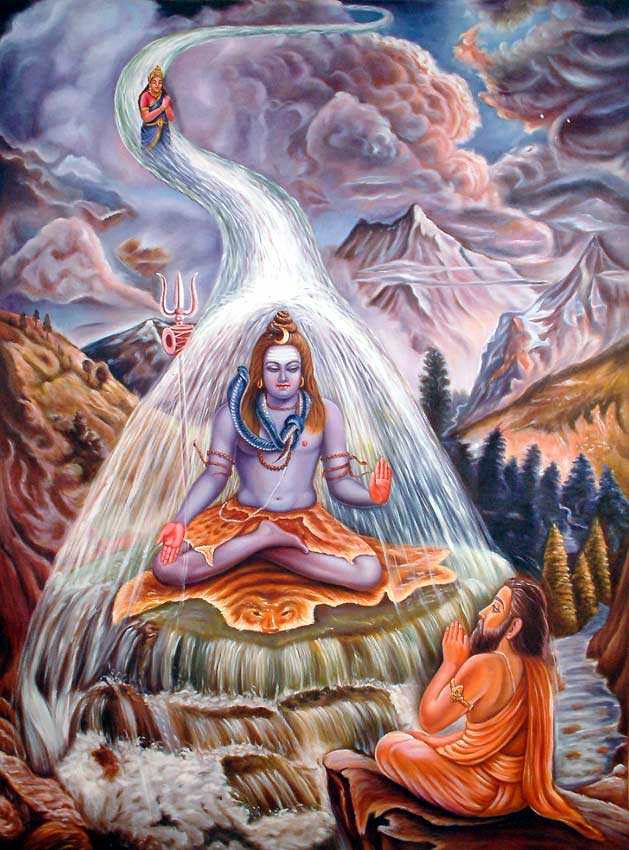
Lord Brahma asked Bhagiratha to propitiate Lord Shiva, for only he would be able to break the Ganga's fall. It was the largest river, and it would be impossible for anyone save Him to contain the destructive impact of this event. Bhagiratha performed a tapasya for Lord Shiva, living only on air. The compassionate Shiva appeared only after a year's penance, and told Bhagiratha he should not have to perform tapasya to accomplish a noble goal such as this. He assured Bhagiratha that he would break Ganga's fall.


After eons of being flattered and praised by the Devas, Ganga had become vain. She scoffed at Brahma when he asked her to flow down to earth, but could not disobey him as he was her father. But Ganga was sure, as much as Bhagiratha was afraid that no one could stop her fall, which would devastate the Earth for a long time. As she cascaded across and down from Swarga, Bhagiratha and celestial observers were terrified of the roar generated by the gallons of water as the Ganga descended down. But Lord Shiva appeared from out of nowhere and captured all of Ganga just as she launched herself onto Earth, in his jata (hair). Ganga struggled to set herself free, but Shiva could not be budged. Bhagiratha worshipped Shiva, who let Ganga free after crushing her vanity. She flowed, and is still believed to flow, from Shiva's jata down to Earth at a gentler pace. The touch of Shiva further sanctified Ganga. King Bhagiratha led the way for Ganga on his chariot, and she followed him across the north and east of Bharat and finally merging with the ocean. In her course she washed the ashes of Sagara's sixty thousand sons, who ascended to heaven while praising and blessing Bhagiratha.

As Ganga travelled to the nether-worlds, she created a different stream to remain on Earth to help purify unfortunate souls there. She is the only river to follow from all the three worlds - Swarga (Heaven), Prithvi (Earth) and, Patala (Hell). Thus is called "Tripathagā" (one who travels the three worlds) in Sanskrit language. Because of Bhagiratha’s efforts, Ganga descended on to Earth and hence the river is also known as Bhagirathi, and the term "Bhagirath Prayatna" is used to describe valiant efforts or difficult achievements.

Another name that Ganga is known by is Jahnavi. Story has it that once Ganga came down to Earth, on her way to Bhagiratha, her rushing waters created turbulence and destroyed the fields and the sadhana of a sage called Jahnu. He was angered by this and drank up all of Ganga's waters. Upon this, the Gods prayed to Jahnu to release Ganga so that she could proceed on her mission. Pleased with their prayers, Jahnu released Ganga from his ears. Hence Ganga is also mentioned as ‘Jhanavi’, which means ‘The Daughter of Jhanavi’.

The Amazon which is around 7000 km in length is three times as long as Ganges. Unlike the Nile, Hwang-ho, Tigris-Euphrates or even her own cousin, Indus (Sindhu), the Ganga is no one of the earliest cradles of human civilization. But Ganga holds a unique distinction, of being the holiest and most celebrated river ever known to man. This river is mentioned in all ancient Indian texts, with several hymns being dedicated to her and many festivals being celebrated in her honour, even today. In her 2500 odd km long journey from the snow capped peaks of the Himalayas to its sink in the Bay of Bengal, Ganga plays several roles in the lives of Indians. For a pious Hindu, she is a revered goddess and bathing in her waters causes the remission of all sins and facilitates the attainment of liberation from the cycle of life and birth. For a farmer who cultivates paddy on the banks, the river is a perennial source of water and a supplier of fertile soil. For the River Dolphins (Susu) and Gavial (Gharial) that inhabit it, she is a mother who sustains all their needs. And finally for India, Ganga is her lifeline, her soul, her eldest and most beloved daughter and a companion in good and bad times. Perhaps, the most fitting tribute to this great river is given by the veteran Bollywood lyricist Shailendra in the song ‘Hothon pe Sachhai’ where he pens down the following lines:-


Hothon pe sachhaee rehti hain
Jahaa dil mein safaee rehti hain
Hum us desh ke wassee hain
Jis desh mein Ganga behti hain

February 05, 2010

Karna and the Three Curses


The Mahabharat which is the longest epic in the world, speaks of a time in ancient India when the rulers of the sub continent's innumerable kingdoms allied themselves with the two warring factions that laid their claim over the throne of Hastinapur. The finest warriors of the day, namely, Arjuna - contemporary India's foremost archer, Bhima - the man with supreme physical prowess, Yudhistir - the defender of Dharma, Duryodhana - the adversary of Pandavas and Bhishma - the protector of the king of Hastinapur fought in a fierce battle that is said to have lasted for 18 days. However among the galaxy of stars that fought on the dusty grounds of Kurukshetra, there was one who shone more brighter than the rest on the horizon of Indian mythology. Although he ended up dying on the battlefield at the hands of his own brother Arjuna, Karna is widely considered by many, including Krishna and Bhishma as per Valmiki's Mahabharat, as a noble spirit who rarely appears in the human race. Inspite of devoting his services to evil Duryodhana, Karna remains an adulated figure for millions of Hindus and Indians. He is specially adored for his generosity and always considered as a formidable warrior, perhaps the greatest warrior of all time, a courageous spirit who braved impossible odds in his life, and died with unique courage, valour and honour.

While Karna remains to be one of the most celebrated personalities of Hindu mythology, very few people are aware of the fact that he had learnt the art of warfare and mastered deadly weapons under the able tutelage of Parashuram. Karna who was brought up by Adhirata, a charioteer of the king Dhritarashtra of Hastinapur, after being abandoned by his mother, Kunti, aimed to be a skillful fighter. As such he went to Dhronacharya, who was in-charge of training the princes of Hastinapur, both Kauravas and Pandavas, in the art of warfare and diplomacy. However, Dhrona refused to accept him as his disciple citing his low caste as the reason. Karna like he did so many times throughout his life, fought all odds and decided to be self-taught with his brother, Shrona's help. In accordance with the ancient tradition that one must learn any art form only under a guru, Karna decided to make Surya his teacher. Such was the dedication of this man that he gathered information about various ayudhas (weapons) during the day and then after sundown, he exercised them. Although he achieved expertize in handling many weapons, Karna became more interested in learning all the advanced skills of archery including the use of divine weapons.

In a bid to fulfill his dream of being among the best fighters of his generation, Karna decided to approach Parashuram. However, Parashuram was only known to accept Brahmins as his students. Disciples like Gangaputra Bhishma and Dhronacharya had made Parashuram proud earlier and Karna longed to make this great saint, his tutor. As such, he was not going to make his low social status the reason for being turned down by Parashuram. Karna appeared before the sage as a Brahmin. Parashuram accepted him and trained him to such a point, that he declared Karna to be equal to himself in the art of warfare and archery. Thus, Karna became a diligent student of Parashuram.

Legend has it that one day while his techer was resting on his lap, Karna was stung by a giant bee on his thigh. Despite the excruciating pain, Karna did not move so as not to disturb his guru's sleep. As the bee bored deeper into Karna's thigh, the wound began to bleed. Parashuram was woken up by the blood from Karna's thigh. He soon realized that Karna was a not a Brahmin as no one in the priestly class could bear the gruesome pain for such a long time. Thus, Parashuram, who had sworn vengeance against all Kshatriyas, concluded that Karna lied about being a Brahmin in order to learn from him. So, he cursed Karna that his martial skills including the use of Brahmastra would desert him when he needed them most. This in turn meant that Karna would forget all that he had learnt from Parashuram during his hour of crisis. Karna, who was unaware of his royal lineage, pleaded with his master that any student in his place would have acted the same way.

While he regretted cursing Karna in a moment of anger, Parashuram's curse was irrevocable. He, gifted Karna with a celestial weapon called Bhargavastra along with Parashuram's personal bow called Vijaya and blessed him that in the end, Karna would achieve what every mortal aspires the most - everlasting glory and immortal fame. In fact mythological sources say that it was the king of Gods - Indra who had stung Karna in the form of the bee so that he would be cursed by the great sage. The same Indra later exploited Karna's generosity and took away the the Kavacha (body armour) and Kundana (ear rings) that virtually made Karna invincible. It is beyond any doubt that had Indra, father of Karna's sworn enemy, Arjuna, not interfered in the matter, Arjuna would have never been able to beat Karna.


Dejected at being cursed by his own Guru, Karna is said to have wandered in the forests. While he was practising the 'Shabdavedi Vidhya' (art of hitting the target by detecting the source of sound), he mistook a Brahmin's cow for a wild animal and shot it. Enraged, the Brahmin cursed Karna that as he had killed a helpless animal, he too would be killed when he was the most helpless, when his concentration was diverted from his enemy.

However putting these things behind him, Karna went on to become the King of Ambha (modern Bhagalpur) after he impressed Duryodhana when he surpassed Arjuna's feat in a tournament held by Dhrona in Hastinapur to display the skills that he had given to the Kuru princes. This event established key relationships in the Mahabharat, namely, the strong bond between Duryodhana and Karna, the intense rivalry between Karna and Arjuna, and the enmity in general between the Pandavas as a whole and Karna.

Sometime later, when he was on a tour of his new kingdom, Karna is said to have encountered a girl who was crying out of fear of her step mother since her ghee had fallen to the ground. Being generous enough Karna told her that he would give her new ghee. But, the child insisted that she wanted only the ghee that was mixed with the soil and refused to take the new ghee. Taking pity on the girl, Karna took the soil mixed with ghee in his fist and squeezed it with all his might to extract the ghee and pour it back into the pot. However, Bhoomi Devi (Mother Earth) was furious at him for hurting her for the sake of a mere child. So, the Earth goddess cursed him that in a very crucial battle of his life, she would trap his chariot wheel in the same way that he held the fistful of soil, thereby making him vulnerable to his enemy.

Thus, Karna was cursed on three separate and independent occasions. Unfortunately, each of these curses became operational at the same crucial moment in the Kurukshetra war, later making him weaponless, left without a chariot and helpless.

On the sixteenth day of the great battle of Kurukshetra, Karna led the Kaurava army. He first defeated the might Bhima but spared his life saying that he was elder to Bhima. Later he went on to beat Yudhistir but left him alive saying that "It seems that you have forgotten all the teachings which your guru has taught you, so first go and practice those and then come to fight". Also he defeated the twins, Nakul and Sahadev but didn't kill them as he had promised Kunti that he would not kill any of the Pandavas except for Arjuna. Then Karna proceeded towards Arjuna and unleashed the deadly weapon, Nagastra at him. But Krishna, like he had done so many times in the past, saved him from what would have been sure death.

On the seventeenth day, the much anticipated contest between Arjuna and Karna took place. Though the duel was initially held at a stalemate, Karna was hampered when his chariot wheel sank into the ground in loose wet soil (Bhoomi Devi's curse thus came into effect). He also found himself unable to remember the incantations for divine weapons, as his teacher Parashuram had foretold. Descending from his chariot to remove the wheel, he requested Arjuna to wait until it is set right as per the rules of battle. Krishna told Arjuna that Karna has no right to refer to the rules at this point, after having violated the same himself while killing Abhimanyu. He urged Arjuna to kill Karna while he was helpless (Brahman's curse came into effect here). Lord Krishna told Arjuna that if he did not kill Karna at this critical juncture of the war, he might never be able to kill him and the Pandavas may never win the war. Thus, Arjuna fatally injured Karna using a divine arrow.

It is believed that on the night before his death, Karna's guru, Parashuram appeared to him in his dreams. He is said to have told Karna that he was well aware of Karna's caste when he had approached him to become his disciple. Yet, inspite of his vow, he agreed to teach Karna, a Kshatriya, as he was fully aware of Karna's capability and impeccable character. Besides, Parashuram went on further to explain the reasons for him cursing his own disciple. Parashuram said that if Karna would not die then the Kauravas would have won the battle and the Earth would be ruled by Duryodhana. As such, Adharma would prevail and people would have suffered in his reign.

Though the three curses and interventions from Indra and Kunti led to his death on the battlefield, Karna achieved the feat of immortality as foretold by his guru, Parashuram. His generosity and the manner in which he carried himself throughout his life is praised several times in mythology and literature. Thus though he allied with evil out of gratitude towards his friend Duryodhana, he is even today, revered to as one of the greatest mn to have participated in the Great War. In fact, Karna, more than anyone else, is the true hero of the Mahabharat.

Special Thanks to : Mr. Ambarish Kulkarni