Showing posts with label Photography. Show all posts

May 24, 2015

BIRDS OF GOA: APRIL'15 - PART 3

PURPLE SUNBIRD

Another lovely bird that came across while I was getting down the Chapora Fort was this Purple Sunbird. Considering that these birds seem to be always in a hurry, the time for any photographer to get their snaps is extremely limited. Luckily, I did manage to get a few good snaps.

Click on the below snaps to see them in better quality.


More from the series: THE BIRDS OF GOA: APRIL'15

(1) Sparrow (Link)

(2) Jungle Babbler (Link)

(3) Purple Sunbird (Link)

(4) Brahminy Kite (Link)

(5) Black Headed Oriole (Link)

(6) Indian Koel (Link)


BIRDS OF GOA: APRIL'15 - PART 2

JUNGLE BABBLER

Popularly known as the 'Seven Sisters', the Jungle Babblers are medium sized gregarious birds that are common to the country. Extremely noisy yet adorably cute, they can be easily found in the countryside, foraging for grains and worms.

The below pictures were clicked at the back-side of the Chapora fort i.e. the side facing the Chapora river which is in fact a heaven for bird lovers as I discovered during my last trip. I will post more pictures of the avians that I encountered here in the later posts in this series.

Click on the below snaps to see them in better quality.


More from the series: THE BIRDS OF GOA: APRIL'15

(1) Sparrow (Link)

(2) Jungle Babbler (Link)

(3) Purple Sunbird (Link)

(4) Brahminy Kite (Link)

(5) Black Headed Oriole (Link)

(6) Indian Koel (Link)


May 23, 2015

FACES OF GOA: APRIL'15 - Part 1

FLOWER VENDORS AT PANJIM BUS STAND

Religion plays an important role in the life of ordinary Goan irrespective of the faith he/she follows. As such, offerings to Gods and deities in the form of garlands is very common. One can easily spot flower vendors outside temples and churches with colorful garlands made of flowers that are grown in the vicinity.

The below pictures were taken at the small market inside the KTC Bus Stand in Panjim. The flowers that are generally sold here are brought from places like Belgaum and Bangalore and then are strung into garlands. In the interiors though, you will find garlands made up of local flowers like hibiscus and white jasmines which are far more prettier and have a local feel to it.


THE FACES OF GOA: APRIL'15

(1) The Flower Vendors of Panjim Bus Stand (Link)

(2) The Old Goa - Divar Ferry (Link)


May 17, 2015

GOA DIARIES: APRIL'15 - Part 2

THE SUNSET AT MIRAMAR

Located three kilometers from Panjim, the Miramar Beach is situated at the mouth of the Mandovi River and is the closest beach to Goa's capital city. No wonder, it is one of the most popular destination for Panjimites to head towards to spend an evening; the stalls around the place and the children's play area only add to its popularity.

On the first day of the Goa trip, I and a school friend of mine - Neeket met here to watch the spectacular sunset. We sat on the steps of the Samadhi of late Dayanand Bandokar - Goa's first CM and witnessed the Sun slowly going down the Arabian Sea through the trunks of the coconuts trees while recollecting the beautiful memories of our school and college days.


For more posts in the series: Goa Diaries - April 2015, click here (Link)

May 02, 2015

BIRDS OF GOA: APRIL'15 - PART 1

COMMON SPARROW

Bordering the Rua de Ourem, the wards of Fontainhas and Sao Tome are amongst the oldest residential areas of Panjim. The best part of these localities is that they have still retained the old world charm; a walk through the narrow by-lanes lined by bungalows painted in vivid colors here is such a pleasure.

Apart from the beautiful Indo-Portuguese villas, one of the highlights of such a walk are the numerous Sparrows that inhabit these wards; watching these passerine birds flying by, chasing each other or feeding on grains is a treat to the eyes, especially for those of who live in urban centres devoid of these beautiful birds. In fact, here, it is very easy to see these wonderful creatures engaged in their daily activities at a very close range.


More from the series: THE BIRDS OF GOA: APRIL'15

(1) Sparrow (Link)

(2) Jungle Babbler (Link)

(3) Purple Sunbird (Link)

(4) Brahminy Kite (Link)

(5) Black Headed Oriole (Link)

(6) Indian Koel (Link)


For more posts on Sparrows, click here (Link)

March 01, 2015

THE ORANGE HIBISCUS

FLOWERS FROM MOM'S GARDEN

Gardening is my mom's latest passion; in fact, she always loved it. However, after we shifted into our new house about eight months ago, she seems to be spending a lot of time in her garden consisting of about 30 potted plants kept in the balcony adjoining our living area. The pride of her garden is this plant of Orange Hibiscus which she is particularly fond of.

And the plant seems to be returning all the love that my mom showers on it in form of big and beautiful flowers, like the ones that in these pictures that I have posted below. Hope you like it!


November 30, 2014

OFFICE DIARIES: NOV'14 - Part II

THE SPOTTED DOVE

Another bird that I and Sunny clicked on the trip was the Spotted Dove. Initially, it was wary and tried avoiding us. However, once it realized that we meant no harm, it stood its ground and 'posed' for us like a celebrity on the red carpet. We were hardly 10 feet away from it and the bird gave us some superb frames. Native to the Sub-continent, this avain derives its name from the tiny black and white spots predominantly on its neck and feathers.


This is the first in a series of three posts that were clicked on 21st November, 2014 at my office premises.
The complete series can be found here (Link).

November 01, 2014

TERRACOTTA WALL FRAMES @ AJMER

PRITHVIRAJ RASO ON TERRACOTTA

It is evident that in Rajasthan, there is a conscious attempt to display the state's rich past and cultural heritage in as many ways as possible. Take the example of the railway stations. From Jaipur to Jaisalmer and Udaipur, the stations are modeled on the state's magnificent palaces, though on a much smaller scale. Some of them even have paintings displaying scenes from mythology and Rajput history. We traveled extensively by rail during our trip while travelling from one city to another. Perhaps, the one station that impressed me the most was Ajmer which is filled with terracotta wall frames on its front side. The holy city of Ajmer was the twin capital of the Chauhan dynasty prior to the twelfth century. Prithviraj - the last Hindu ruler of Delhi who was defeated by Ghori in the Second Battle of Tarain (AD 1192) is a celebrated figure here.

The station has lots of scenes from Prithviraj Raso - the epic ballad written by Chand Bardai who served as the royal poet at the court of the Chauhan Kings. It 'romanticizes' the life of Prithviraj, giving us exaggerated tales of his bravery, both on the battlefield and in love. There is one figure of the king Prthivraj III Chauhan and his queen Sanyogita, the princess of Kannauj whom he is said to have eloped with during the latter's Sayamwara. And then there is the image of a blind Chauhan ruler killing his adversary. Chand writes that after being beaten in Tarain, the King of Delhi was blinded and taken to the court of the Sultan Mohammed of Ghori in Afghanistan along with his friend, the royal poet. Ghori is believed to have expressed his desire to witness the Shabdbhedi Baan Vidya (Sonic Archery) wherein an archer with blindfold relies on the source of sound to shoot arrows at his foe, an art form which Chauhan is supposed to have mastered. As he got ready to shoot the arrow, Chand is believed to have uttered his famous lines, helping his master to strike the enemy in his own court:

Char Baas, Chaubees Gaj
Angul Ashta Praman,
Ta Upaar Sultan Hain
Mat Chuko Chauhan.

With these clues, Prithvi is supposed to have killed the Sultan and thus avenged his defeat. As the guards closed in on them, Chauhan and Chand are said to have killed themselves. Luckily, Persian and other contemporary Indian records help us unearth the real history the unfolded after the Chauhans were beaten at Tarain in 1192. It is generally believed that the Prithviraj was captured after the battle, brought before the Sultan and then executed. It is highly likely that he was given an option to convert to Islam which he would have rejected. Ghori then went on to capture Delhi and other parts in northern and central India. He nominated his slave Qutub-ud-din Aibak as his Viceroy, bringing an end to the Rajput dominance of North Indian that began with the death of King Harshavardhan. Ghori was assassinated by local tribals in western Punjab while offering prayers about 15 years later. In 1210, Aibak would crown himself the Sultan of Delhi, thereby laying the foundation of Islamic rule in the country.

Meanwhile, even episodes from mythology and rural life are also portrayed here. What I did not like was the conspicuous absence of any reference to the shrine of Gahrib Nawaz. Probably, eight out of every ten people who come to Ajmer pay their obeisance to the great Sufi saint who has been buried here. From great emperors like Akbar to politicians and film personalities, people descend to this city in thousands to seek the blessings of Moinuddin Chishti. As such, a terracotta depiction of Emperor Akbar walking towards the Dargah or something of this sort would have been fantastic. In many ways, it along with the story of Chauhan would have truly reflected the social harmony of the historic city of Ajmer.

Prithviraj Chauhan takes aim at Sultan Ghori with Chand by his side
Scenes from Rural Rajasthan


Radhe-Krishna (Left) and Shrinathji (Right)

Even the sparrows seem to love the Terracotta work

MORE POSTS RELATED TO AJMER

(1) Akbar's Palace or the Magazine or the ASI Museum (Link)

(2) Khwaja Moinuddin Chisti's Dargah (Link)

(3) Adhai Din ka Jhopra or Jama Altamash (Link)

(4) Anasagar Lake (Link)

September 27, 2014

VARTHUR DIARIES: SEPT'14 - Part III

THE GEN-NEXT WEAVERS


After clicking the Munias, as I was walking towards the bus stand, noises coming from the bushes nearby caught my attention. As I went to have a closer look, what I saw was probably the best part of the entire birding trip. Wikipedia mentions that juvenile Baya Weavers are known to leave their nests and disperse to newer locations in the vicinity. What I had come across was in opinion, one such 'Baya Weaver Play School'. I found about six little Weavers there; in fact, the Gen Next was much more approachable than the adults. I was able to get some very good captures; yeah, I love some of the clicks that I have posted here. At the same time, I was careful enough not to attract the attention of predators like Crows and Eagles. After all, the young Weaver can be easy picking for these predators.


For more posts in the series VARTHUR DIARIES: SEPT'14, click here (Link)

VARTHUR DIARIES: SEPT'14 - Part II

THE SCALY-BREASTED MUNIA


After spending about 30 minutes with the weavers, I spotted this pair of Scaly-Breasted Munia as I was heading back to the bus stand. This small yet beautiful bird is native to the Sub-Continent, South-Eastern Asia and Eastern parts of Australia. It seems that Mother Nature has been extremely kind to this little bird; the color combinations and the patterns are brilliant. The head is darker brown while the feathers are much lighter. The underside has a unique pattern in the form of scales that have a black border. The pair that I saw on that day were quite comfortable sharing space with the weavers.


For more posts in the series VARTHUR DIARIES: SEPT'14, click here (Link)

September 21, 2014

GOKARNA DIARIES: AUG'14 - Part XX

EXPLORING THE TEMPLES AND THE TOWN


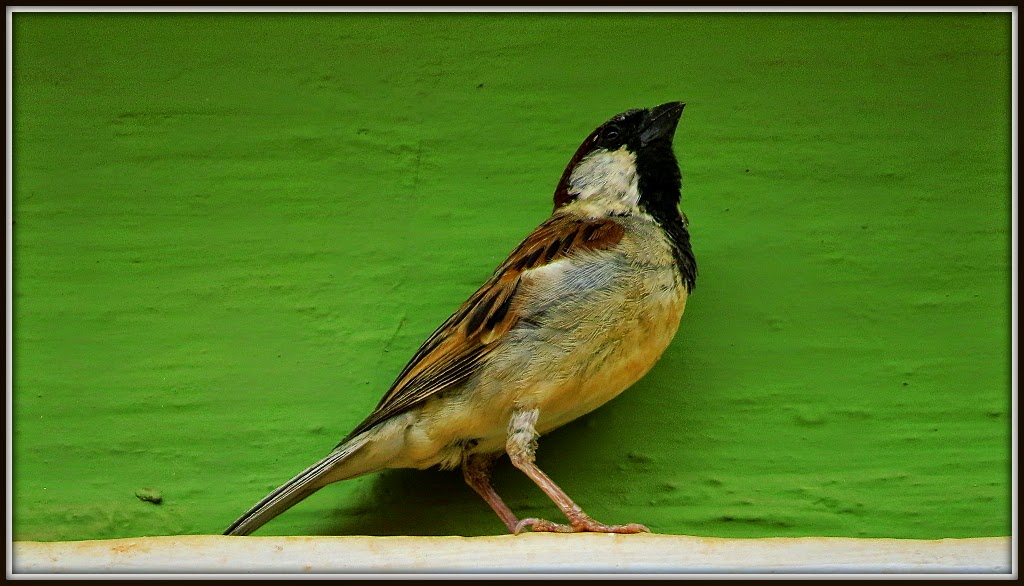
We spent the last two hours in Gokarna visiting the various places of religious importance. We began with Koti Teerth, which is a small sacred tank, about 500 metres from the main temple and is believed to have been formed by the confluence of over a crore fresh water springs. Bathing in the rectangular pond, is said to cleanse you off all the sins and is the primary reason that some rituals of the last rites are performed on its ghats. The medium sized water body is surrounded by several temples and houses with sloping roofs that are peculiar to the coastal plains. Here you can spot House Sparrows too which is such a delight. As you walk towards the Teerth from the Car street, watch out for the houses of the temple priests. While some have been rebuilt in modern style, many still retain their old world elegance and style. The simple two storied houses with verandah that have sitting platforms on either side of the small in addition to the main narrow main door are worth a watch. The closely spaced homes and the narrow streets shared by men, cows, bikes and rickshaws will definitely remind you of another holy city in the north dedicated to Lord Shankar - Benares. Moreover, we also came across this huge Baniyan tree under which are several idols of Nag Devta (Cobra God) which were stunning.
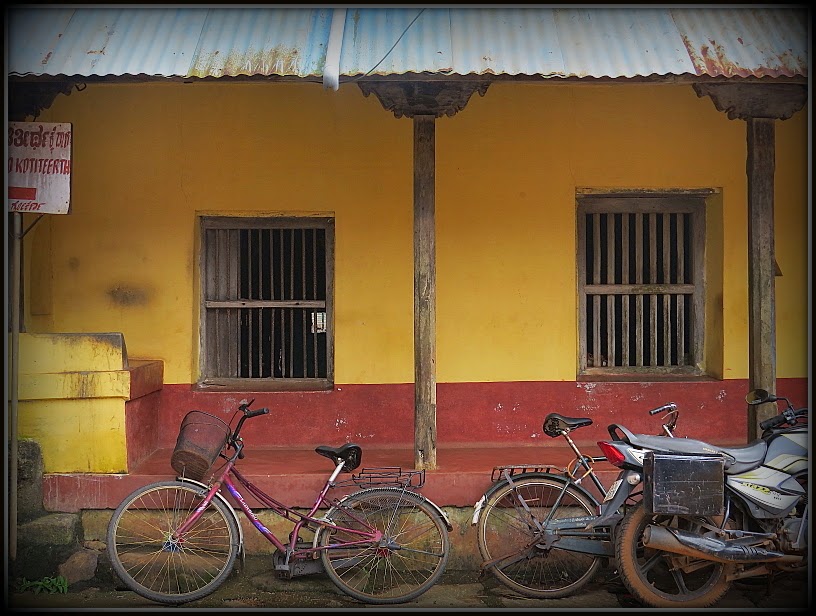

The Houses of the Priests

Our next stop were the temples of the town. Before I write about it, here is the story behind it for all those who are interested in Indian Mythology. The tale of the picturesque town is woven around the legend of Lord Shiva's most powerful manifestation - the Atma Lingam. It was believed that God Shankar's cosmic powers and infinite energy were derived from it. The Puranas mention that these powers would automatically be transferred to anyone who possessed this divine insignia. In his bid to become invincible, Ravana - the chief antagonist of the Ramayana underwent a rigorous penance lasting several years to get the Lingam as a boon. However, he was tricked by Narada Muni and ended up asking for Goddess Parvati instead. As he was returning back to his kingdom from Mount Kailasha, the half Brahmin, half demonic king was shocked to see that the lady who was accompanying him was not beautiful consort of Shiva but her ruthless and fearsome incarnation - Goddess Bhadrakali. Realizing that he had been fooled by the Gods, Ravana abandoned the Devi at modern day Gokarna and is said to have fled back to Lanka. Not the one to give up though, he returned back to the Himalayas some years late and performed yet another penance, this time with renewed vigor and complete dedication. Impressed by his unflinching devotion towards Him, Lord Shiva had no choice but to fulfill the wishes of his foremost devotee.

Aware that an unconquerable Ravana could endanger Dharma on Earth and threaten the lives of its inhabitants, the Devas came up with a 'sinister' plan to disarm him. The demonic ruler was a devout Brahmin and would never miss his evening prayers. On his way back, with the Sun setting over the Arabian, the he stopped over, again at Gokarna so that he could perform his rather elaborate ablutions. However, there was a problem; Lord Shankar had cautioned the Lankan King not to keep the Lingam on the ground under any circumstances since that would make it powerless. As such, he handed over his 'priced possession' to a cowherd who was grazing his cattle nearby, asking him to hold it till he completed his prayers. The young boy was none other than Lord Ganesh; No sooner did Ravana leave, the elephant God kept Siva's emblem on the ground and all its powers were immediately transferred back to the Lord. On returning back, Ravana was stunned. He used all his power and might to pull the Lingam off the ground. After numerous failed attempts, the enraged demon pulled out parts of the divine symbol and threw it at different places. The four remnants as well as the base of the Atma Linga, are believed to be worshiped today in five different shrines in the Uttara Kanara (Karwar) district of Karnataka, namely Sajjeshwara, Dhareshwara, Gunwanteshwara, Murdeshwara and the most important - Gokarna.


The Nag Devta (Cobra God)

The main temple here is the Mahabaleshwar Temple located on the shore which contains the remnants of the holy Linga. It is believed to have been constructed by the King Mayurasharma of the Kadamba dynasty and renovated by later rulers. Maratha King Chhatrapati Shivaji is said to have come here to pray to the Lord. The temple is big and I could not spend much time there. Close to it is the Mahaganpati Temple, which commemorates Ganesha's role in the story; the black standing idol of the Elephant God is simply stunning. The Bhadrakali Temple is located around a kilometer away. However, we could not go there. Other places that are frequented by the tourists include the Ram Teerth, the Jatayu Teerth which according to legend is the place where the great bird fell after it was killed by Ravana, the Hanuman Janmabhoomi which is supposed to be the birthplace of Lord Hanuman and the Go-Garbha - a cave on way to the Om beach which is believed to stretch all the way to Gokarna's 'twin city' of Varanasi in the north. We had seen it on the way to the Kudle Beach.

Male House Sparrow
The Madropadarcharya Mutt (Left) and the Gokarna Partagali Jevottam Mutt (Right)

Next, we went to a local hotel for snacks. We could not get either Masala Puri or Missal Bhaji, which we had eaten the day before. I and Da ate Idlis which were not tasty at all. We had one last thing on our agenda - a visit to the house where we had stayed in Gokarna during the late 80s. Dad was posted here as a clerk in Syndicate Bank immediately after his wedding and one of the houses where my parents stayed back then is located close to our hotel. To be frank, I do not have any memories of this place; we left for Haryana when I was one. Pavan Da does remember a few things. We walked all the way to the house we had rented which is hardly 5 minutes from the bank. We spent some time standing there, contemplating how things had changed over the last two and half decades. At 6:30 pm, we headed back to our room, packed our bags and hired an auto to the boarding point. We boarded our bus sometime later and reached Bangalore the following morning. All in all, it was a superb trip, something that we all will remember for a long time.

Syndicate Bank, Gokarna


For more posts in the series: GOKARNA DIARIES: AUG'14, click here (Link)