Showing posts with label Panjim. Show all posts

June 14, 2015

THE GOA STATE MUSEUM - PART 4

THE CULT OF MAHISASURA MARDINI

Goa was an important center of the Shakti cult in the medieval times and the Goddess was worshiped in the form of the Bhagavati or Mahishasura-Mardini. The cult still has a large number of followers who believe that the Goddess is the Supreme Power unlike popular Hindu belief that it is the Trimurti consisting of Brahma the Creator, Vishnu the Protector and Shiva the Destroyer which controls the cosmos. In this form, the Devi is seen slaying the fierce demon - Mahishasura or the Buffalo Demon with her trishul.

The most beautiful of the three Mahishasura Mardini sculptures displayed in the Gooa State Museum is the one from Surla-Tar in Bicholim belonging to the 14 th century. The four armed Goddess carved out of Compact Soap Stone is standing with the demon in the form of a buffalo below Her left feet. A well embellished 'prabhavali' has a 'kirti mukha' (Victory Face) at the centre is carved behind her. The Devi is grabbing the demon with Her left hand whereas Her right arm is broken; She holds a trishul in Her upper right hand and a 'Shank' (Conch) in the upper left hand. A lion - the vahana of the Goddess is seen attacking the demon from behind. A look at this image and you realize that certainly the contemporary Goan sculptors were masters of their trade.

Mahishasura Mardini - 14th century AD
The 14th century Talc Chlorite Schist sculpture of the Goddess found at Torxem in Pernem taluka is in fact a 'true' Mahishasura Mardini image for the fact that here, She is seen goring the buffalo with the trishul in Her right hand. Like the revious image, she is seen holding the demon's tongue with Her left hand; she holds a sword in Her upper right hand and a shield in the upper left hand like a medieval warrior. A well-decorated 'prabhavali' in the back ground lacks a 'kirti mukha'. Now that is strange and so is the absence of the lion!

Mahishasura Mardini - 14th century AD
The much older Talcose Chlorite Schist stone sculpture of the Devi was found at Assoledem in Quepem taluka of Goa and belongs to the 12th century AD. The four armed Goddess holds a broken sword in Her upper left hand and a shield in the upper right hand. She is seen crushing the demon Mahishasura with Her right hand and simultaneously thrusting her trishul into him. Unlike the previous two idols, the demon is shown here in a human form, sitting upon a buffalo. He is holding a sword and a shield in his hand. The idol has a beautiful 'prabhavali' and a 'kirti mukha' on the top. A lion and a 'chauri' (fly whisk) bearer are seen on the bottom left and right of the image respectively.

Mahishasura Mardini - 12th century AD


More from the series: GOA STATE MUSEUM

(1) An Introduction (Link)

(2) The Hero Stones (Link)

(3) The Sati Stones (Link)

(4) The Gajalaxmi Stones (Link)

(5) The Cult of Mahishasura Mardini (Link)


Reference: Catalogue of the Remarkable Sculptures in the Goa State Museum

THE GOA STATE MUSEUM - PART 3

THE GAJALAXMI PANEL

The third of my many posts on the Goa State Museum is the Gajalaxmi panel that are displayed on the ground floor. As the name suggests, the stone slabs were commissioned in the honor of Laxmi - the Hindu Goddess of Wealth.

Gajalaxmi - 14th-15th century AD
The first of the two slabs, the one displayed in the above picture belongs to the 14 th - 15 the century and was found at Gulle in Sattari taluka in the north-east part of the state. This rectangular structure has an image of the Goddess in the centre, flanked by attendants and a pair of elephants with mahouts. The image of Laxmi is separated from rest of the slab by two small pillars. The lowest panel has people praying to the goddess with two mythical, yali like creatures in the middle, facing each other. In the two sections that make up the middle panel, one can see people playing instruments in the honor of the Goddess whereas the topmost panel has horses at the extreme ends.

Gajalaxmi - 17th century AD
The other basalt stone slab, belonging to the 17th century found at Dharbandoda in Sanguem consists of the Goddess sitting atop a pedestal, holding lotus buds in her hand. She is flanked by attendants fanning her, two ornate elephants and two warriors in full military gear who are bowing before Her. The middle panel depicts cavalrymen whereas the panel at the bottom shows people dancing and singing hymns in the praise of the goddess. On a closer inspection, one can see two strangely dressed men, perhaps in Persian attire in the lower section.


More from the series: GOA STATE MUSEUM

(1) An Introduction (Link)

(2) The Hero Stones (Link)

(3) The Sati Stones (Link)

(4) The Gajalaxmi Stones (Link)

(5) The Cult of Mahishasura Mardini (Link)


Reference: Catalogue of the Remarkable Sculptures in the Goa State Museum

THE GOA STATE MUSEUM - PART 2

THE SATI STONES

Sati as a practice was prevalent in most parts of medieval India and Goa certainly was not an exception. This brutal act of the wife killing herself by plunging into the funeral pyre of her late husband was widely popular and the women who adhered to this custom were celebrated as deities with their blessings being sought by the womenfolk in times of need. Much like the hero stones, Sati Stones commemorate the supreme 'sacrifice' of the brave ladies who chose to end their own lives after the death of their husbands, thereby upholding their chastity and loyalty towards their companion, at least that is what the general view of the society was.

The Sati cum Hero Stone - 14th century AD (left) and Sati Stone - 13th century (right)

Of the four Sati Stones in the Goa State Museum, the most impressive is the one that was found in Majorda in Salcette taluka which belongs to the 14 th century. This weathered exhibit made of Talc Chlorite Schist is in fact, a Sati cum hero stone and such combinations are not very common. Belonging to the Vijaynagara - Adil Shahi period, it depicts a man in 'Anjalimudra' (gesture of adoration) in the middle with one woman, probably his wife in 'Abhayamudra' (gesture of reassurance) on his left and an attendant to his right. In the next section, the hero is seen committing self-sacrifice as the musicians perform whereas the topmost panel depicts a couple worshiping a Shiv Linga. A 'Shikara' crowns the stone slab and on either side of it, one can see carvings of the Sun and the crescent Moon.

Then there is another one made of Meta Basalt stone which has a rather peculiar shape. It consists of a pillar out of which emerges the right hand of a woman, decorated with bangles. Between the hand and the pillar is a couple whereas a motif of lotus is carved on to the pillar which is the symbol of purity. This exhibit belongs to the thirteenth century and was found at Rivona in Sanguem taluka.

A more elaborately carved Sati stone, similar to the one mentioned above which belongs to the sixteenth century is also displayed. Unlike the above mentioned exhibit, this depicts a couple below the hand. Then there is another sculpture which captures a lady with long flowing air, all set to jump into the fire and commit Sati.


More from the series: GOA STATE MUSEUM

(1) An Introduction (Link)

(2) The Hero Stones (Link)

(3) The Sati Stones (Link)

(4) The Gajalaxmi Stones (Link)

(5) The Cult of Mahishasura Mardini (Link)


Reference: Catalogue of the Remarkable Sculptures in the Goa State Museum

THE GOA STATE MUSEUM - PART 1

THE HERO STONES

The first of the many posts I intend to write on the exhibits in the Goa State Museum, as the name suggests, is on the Hero Stones which are common in this part of the country. These are carved stone slabs that commemorate the death of those brave men who laid down their lives on the battlefield fighting to either protect or uphold the honor of their kingdom or its people from adversaries. Alternatively known as Virgal, they are generally divided into three panels, though in rare instances as many as five panels are seen. Of these, the lowest shows the hero decked up in full military armour, vanquishing the opponents before falling on the ground himself. In the middle panel, he is shown being lifted towards the heavens, accompanied by nymphs and other mythical figures celebrating his ascent whereas the topmost panel shows him seated in the Swarga Lok (Heaven) worshiping the Gods, a fitting tribute to a person who had perished for the 'larger cause'. Besides, accompanying inscriptions, either in Devnagari or Kannada give the name of the hero, sometimes the year of his death and the battle in which he met his ultimate end.

Goa being an important trading centre along the western coast was always the bone of contention amongst the various dynasties vying for power in northern and central Deccan. As such, battles were frequently fought for the control of the rich port and these would have resulted in casualties running into hundreds and thousands, each time the opposing armies met on the battle field. The valor displayed by some of these brave men was 'immortalized' in this unique form. Perhaps, this is the most probable explanation for the large number of hero stones to be found in this region.

Hero Stones or Virgal - 12th century AD

There are two Hero Stones in the State Museum, both of these dating back to the 12th century AD which corresponds to the time when Goa was ruled by the Kadambas from their base at Chandrapur (modern Candor). The one on the left made of Compact Chlorite Schist was found at Khandepar in Ponda taluka whereas the one on right was found at Malkarne in Sanguem taluka and is made of Talc Chlorite Schist stone.

The one one the left is particularly interesting. The lowest panel of this memorial shows the hero being slayed by a person with a sword. However, the interesting bit about this panel is that there is a person on the extreme left who is playing a musical instrument as the hero is being killed as if it was some kind of a ritual and not a regular battle scene. Could this be the depiction of an instance of human sacrifice, perhaps the stone was commissioned to recount the bravery of a villager who volunteered to be killed for the betterment of entire society as a whole; if yes, what was the reason for this gory ritual and whom are the contemporary people who inhabited Khandepar aiming to please by this act. The middle section show the celebrations in the honour of the hero whereas the topmost panel depicts him merging into a Shiv Linga and being worshipped by a priest and an attendant.


More from the series: GOA STATE MUSEUM

(1) An Introduction (Link)

(2) The Hero Stones (Link)

(3) The Sati Stones (Link)

(4) The Gajalaxmi Stones (Link)

(5) The Cult of Mahishasura Mardini (Link)


Reference: Catalogue of the Remarkable Sculptures in the Goa State Museum

THE GOA STATE MUSEUM - AN INTRO

AN INTRODUCTION

Though the Goa State Museum is dwarfed in size by the neighboring Goa State Central Library (now known as Kishan Das Shamal State Library), it is an excellent place to explore the state's rich heritage and witness some of the glimpses from its glorious past. For what it lacks in size, it more than makes up with some of the artifacts showcased here being priceless gems for people like me who are eternally in love with the beach state and its history. Situated in Patto - the industrial hub of Panjim, sadly, it is not amongst the top tourists attractions in the capital city and hosts relatively few visitors in spite of the fact that in comparison to other government museums in cities across the country, it is well maintained.

As per the brochure, the Goa State Museum was established in 1977 and was initially set up in St. Inez locality of Panjim before being shifted to its present location in June 1996. It is managed by the Directorate of Museum - Government of Goa. The entry to the museum is free, photography is allowed and there is also a guide available for those who are interested in the details. A book titled - 'The Remarkable Sculptures of the Goa State Museum' which available at the counter for Rs. 300/- gives a much detailed overview of the approximately 50 odd sculptures displayed here and is worth the money.

Name
               The Goa State Museum               
Location
      EDC Complex, Patto - Panjim      
Timings
                    Monday to Saturday - 9:30 am to 5:30 am                     
Entry Fee
Free
Camera
Allowed (Not Additional Camera Fee)
          Approximate Time          
1 - 3.5 hours

The one storied building has as many as thirteen different galleries of which the first and in my opinion, the most impressive is the Sculpture Gallery. Amongst the exhibits displayed here include Hero memorials, Sati Stones, Gajalaxmi panels as well as a few inscriptions discovered in the state. An equally beautiful second gallery showcases beautiful wooden carvings of various Christian saints, portraits of a few Portuguese Governor Generals and a flag commemorating the Portuguese naval victory over the Dutch. The theme for the third section is the 'History of Printing Press in Goa' which is also the first of its kind in the whole of Asia whereas the next gallery manifests the collection donated by S K Bannerji, the ex Lt. Governor of Goa and is named after him. The fifth section depicts the religious expressions of Goa; objects relating to daily life are exhibited in the sixth whereas paintings and sculptures of several Indian artists are shown in the next gallery. The eight section is the Numismatics gallery whereas the ninth is a photo walk through Goa's independence struggle. The tenth gallery houses objects from the Menezes Braganza Institute; the Furniture section showcases amongst others the chair of the Governor General and the 'Table of the Inquisition'. The last two sections developed with the help of the WWF showcase the natural heritage of Goa.

In the next few posts, I will be posting about the beautiful artifacts in the Goa State Museum that left me spellbound.


More from the series: GOA STATE MUSEUM

(1) An Introduction (Link)

(2) The Hero Stones (Link)

(3) The Sati Stones (Link)

(4) The Gajalaxmi Stones (Link)

(5) The Cult of Mahishasura Mardini (Link)


May 23, 2015

FACES OF GOA: APRIL'15 - Part 1

FLOWER VENDORS AT PANJIM BUS STAND

Religion plays an important role in the life of ordinary Goan irrespective of the faith he/she follows. As such, offerings to Gods and deities in the form of garlands is very common. One can easily spot flower vendors outside temples and churches with colorful garlands made of flowers that are grown in the vicinity.

The below pictures were taken at the small market inside the KTC Bus Stand in Panjim. The flowers that are generally sold here are brought from places like Belgaum and Bangalore and then are strung into garlands. In the interiors though, you will find garlands made up of local flowers like hibiscus and white jasmines which are far more prettier and have a local feel to it.


THE FACES OF GOA: APRIL'15

(1) The Flower Vendors of Panjim Bus Stand (Link)

(2) The Old Goa - Divar Ferry (Link)


May 17, 2015

GOA DIARIES: APRIL'15 - Part 2

THE SUNSET AT MIRAMAR

Located three kilometers from Panjim, the Miramar Beach is situated at the mouth of the Mandovi River and is the closest beach to Goa's capital city. No wonder, it is one of the most popular destination for Panjimites to head towards to spend an evening; the stalls around the place and the children's play area only add to its popularity.

On the first day of the Goa trip, I and a school friend of mine - Neeket met here to watch the spectacular sunset. We sat on the steps of the Samadhi of late Dayanand Bandokar - Goa's first CM and witnessed the Sun slowly going down the Arabian Sea through the trunks of the coconuts trees while recollecting the beautiful memories of our school and college days.


For more posts in the series: Goa Diaries - April 2015, click here (Link)

May 02, 2015

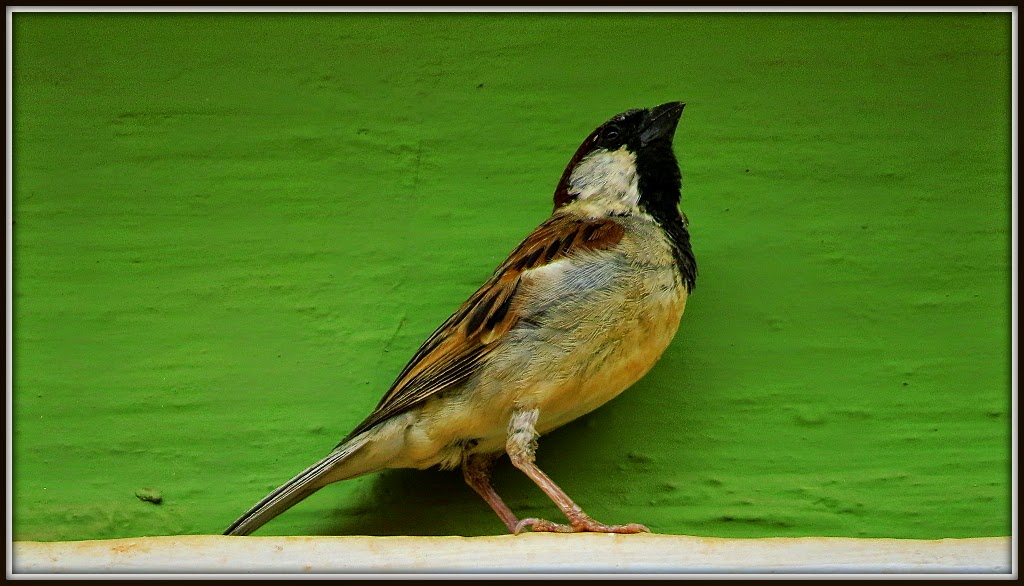
BIRDS OF GOA: APRIL'15 - PART 1

COMMON SPARROW

Bordering the Rua de Ourem, the wards of Fontainhas and Sao Tome are amongst the oldest residential areas of Panjim. The best part of these localities is that they have still retained the old world charm; a walk through the narrow by-lanes lined by bungalows painted in vivid colors here is such a pleasure.

Apart from the beautiful Indo-Portuguese villas, one of the highlights of such a walk are the numerous Sparrows that inhabit these wards; watching these passerine birds flying by, chasing each other or feeding on grains is a treat to the eyes, especially for those of who live in urban centres devoid of these beautiful birds. In fact, here, it is very easy to see these wonderful creatures engaged in their daily activities at a very close range.


More from the series: THE BIRDS OF GOA: APRIL'15

(1) Sparrow (Link)

(2) Jungle Babbler (Link)

(3) Purple Sunbird (Link)

(4) Brahminy Kite (Link)

(5) Black Headed Oriole (Link)

(6) Indian Koel (Link)


For more posts on Sparrows, click here (Link)

January 24, 2014

THE MANDOVI MEMORIAL CROSS


REMEMBERING THE SOULS OF MANDOVI


Located on the southern bank of the River Mandovi, the town of Panjim is one of the most scenic urban centres in the country. Dubbed as the 'Queen of the Arabian', it was made the capital of Goa in the mid 19th century after the Portuguese abandoned Goa Velha, the former seat of administration. The cobbled streets with grand villas painted in bright shades of blue, yellow and red - hallmarks of the colonial era, the sprawling promenade overlooking the serene Mandovi and the Goan brand of hospitality make Panjim a magnet for tourists. In fact, the city or as I like to call it - the town is petite, similar to those in Europe which I had the good fortune of visiting last December. While it may be small in size, one has to admit that there are numerous secrets that it holds deep within and numerous mysteries surrounding it. Though I have stayed in the Goan capital and in its vicinity for eight years, I am myself unaware of the many stories that the city has to tell. In fact, about two years after we shifted to Bangalore, I came across this article (Link) regarding a tragedy in Goa that took place at the turn of the 20th century. What caught my attention was the picture at the centre -  a white cross erected on a pedestal about 8 feet high, along the Riviera. It looked familiar and it took me less than a minute to recognize it. While I have walked past the Mandovi Memorial Cross a hundred times, I had never known the sad story it commemorates.


The tragedy, the worst ferry disaster in the history of Goa dates back to 3rd December in the year 1901. It is indeed an irony that so many lives were lost on a day when Goans celebrate the Feast of our patron saint - Francis Xavier. It was on that fateful day that a launch 'Goa' going from Verem to Panjim, carrying about 160 people, most of them on their way to Old Goa, capsized and sank into the river, with nearly half of the passengers reported missing. The city police chief Manuel Pedro Rodrigues led the rescue operation which lasted for four days. Seventy five bodies were recovered; the bodies of six unfortunate people were never found. A majority of the victims were form the villages of Bardez namely Saligao, Calangute, Reis Magos and Candolim. The launch was later pulled out of the waters in the following days. A report in the Times of India attributed the tragedy to the fact that the ferry was filled beyond its capacity. The Goan diaspora in Aden collected funds and built a memorial to honor the dead in 1904 after getting the necessary permission from the local government. The modest landmark has two plaques, one facing Panjim and the other facing the Mandovi.


The English translation of the southern plaque is as follows: "In the memory of the 81 victims of the tragedy of the launch Goa that occurred on 3-13-1901.  The landmark is dedicated by Goans in Aden requesting all those who pass by to say a pray for their eternal rest. Dated: 3-12-1904." The other plaque reads: "In memory of the 81 victims of the tragedy of the launch Goa on December 3, 1901 - dedicated by the Goan diaspora of Aden." 

The article which I mentioned earlier was a revelation. Having seen this cross so many times, I wondered as to how could I have missed the story behind it. Isn't it true that in our 'busy' lives, we end up over looking so many things. Meanwhile, I was determined to go to the memorial and pay my homage to the Souls of Mandovi the next time I went to Goa. In fact, after having visited the Reis Magos fort with my friend Niketh on December 22 last year, I insisted on taking the Betim - Panjim ferry on the way back. Although it would have been more convenient for him had we taken the bus to the Patto bus stand, Niketh agreed to accompany me. Thanks Nikz, you are awesome! In fact, our ferry took more or less the same route that the fateful launch 'Goa' would have taken on its final journey. Looking at the Mandovi Memorial as we approached the capital city, I wondered what the scene would have been on that day, 113 years ago. Once we reached our destination after a journey of about 15 minutes, Nikz boarded the bus at the Ferry Boat stop and I headed to the cross. After clicking some pictures, I said a silent prayer for the people who lost their lives in that tragedy. At the same time, I also prayed for something else... I prayed to the souls of Mandovi to protect Panjim, the town which is extremely close to my heart from unplanned growth and commercialization. While I am not against development, there is an old world charm about the capital and I hope it remains to hold on to it forever. I spent the rest of the evening roaming around the streets of the city and then returned to Bhabi's place.

May 26, 2013

DIL DOSTI ETC

GOA DIARIES: MEETING THE ENGIGOS


From Left: Sai, Pri, Niks, DD & Sav

Almost two years... or to be precise, nineteen long months had passed since June 2011 when we had graduated from GEC (Goa Engineering College). With me leaving for Bengaluru in July, few others going to Pune and the rest staying back in Goa, it had been a long time since we friends had a reunion. I am pretty sure that like me, the rest of the gang was looking ahead to a get-together. The preparations for this day had already begun about a month back at around the third week of March. Once my trip to Goa was confirmed, I immediately called up the guys in Pune - Niks, Sav & DD to check if they could make it and they were more than happy to come down over the weekend (April 27 - 28). Pri was reluctant initially. However, constant persuasion on WhatsApp paid off as she finally gave a green signal. Actually, we had made it clear that we were not going to listen to any of her natkas and I don't think she had any other options.

Though Rach was a little disappointed as we had declined her invitation to come to her new house (Next time pakka ayenge), she was sporting enough to adjust her tight schedule to make some time for us. This was inspite of the fact that she was expecting guests at home on the same day. And finally, one phone call was enough to convince His Majesty - Sai to 'grace the occasion with his auspicious presence'. While this will certainly be one of the most memorable days of this year, atleast for me, I am pretty sure that everyone present there will agree that it would have been much more fun had Amba joined us. The group seems to be incomplete without him. Amba, if you ever read this then remember one thing - you have to be there for the next reunion irrespective of whether it is held in the frozen caverns of Antarctica or the hot sand dunes of the Sahara desert.

The Fantastic Four

Now continuing from my last post (Link), I joined Niks and DD in the latter's car at the Goa Velha bypass road. In the many months since we had not met, the two guys occupying the front seat of the Wagon R had not changed at all, well... except for DD's new hair style. Though he may be more famous in the gang for his 'classic jokes' aka PJs, one cannot deny the fact that DD is one of the best brains in Goa. After all, not all of us can crack the tricky NTSE (National Talent Search Examination) tests. Besides this, what sets him apart from the rest is that he is a 'good boy', firmly entrenched in the values that his parents have imbibed in him. Actually, his decision to come by his car on that day proved to be a masterstroke as it allowed us the liberty to even go to Vagator beach in the evening, thereby doubling the fun and on a personal note, fulfilling my desire of visiting my favourite beach in the state (Link). Thanks DD... mein tera yeh eshaan kabhi nahi bhoolunga.

The other guy occupying the front seat was Niks - arguably the most bankable of all my friends. A non-Goan like me, he is undoubtedly the 'soul' of our group. From collecting notes and question papers prior to semester exams to printing our projects and assignments to organizing group picnics, you can give any kind of work to him, no matter how mundane, yet he will do it with complete dedication. Actually, even this reunion was largely arranged by him. Niks belongs to the rare breed of people who treasure friendship above everything. Many a times, I have seen people exploit this quality of his but he still continues to go that extra mile even for the guys who do not deserve it. Apart from this, he is a complete techno-freak who (according to his own CV) enjoys exploring new softwares and repairing computer hardware. Itle bhopke purro dista re.

Clockwise: Sai, DD, Niks and Sav

DD seems to be pretty good behind the steering wheel and he raced along the Margao-Panjim road. As our Wagon R zoomed ahead, I remember seeing paddy fields along the way. Since it was summer, the fields had turned wheatish brown. I was enthralled at the sight of cattle grazing in one such field which had a Khuris (Cross) at the centre against the backdrop of the clear blue sky. Sights like this that make this state so special to me. Some time later we rode along the winding uphill road at Bambolim which is dotted with advertising boards of various telecom subscribers, alcoholic beverages, banks and what not. The view down below from this road is enchanting as the Zuari river meanders across the plains covered with dense vegetation. Next, we went past the famous Phulancho Khuris (Shrine of Holy Cross), the brightly painted Shiv Krishna temple and the Goa Medical College (GMC) - Asia's first medical college which was bustling with activity as usual, all in quick succession. Seeing all these places which I would often google on the internet in Bengaluru was very satisfying. As we descended along the slopes of Bambolim towards the north, I got my first glimpse of beautiful town of Panjim on this trip.

In the next five minutes we reached the Hanuman temple at the Kadamba bus stand where Sav was waiting for us. If you ask me or my batch mates who was the best programmer amongst us, I guess the answer would be pretty easy and unanimous. Be it pointers, data structures or performance optimization, Sav was at ease working with even the most complex aspects of computer programming while the rest of us would struggle. His grasping power is brilliant; he would study just for a few hours prior to the semester exams and still manage to pass with more than good marks. Wow! However, what I have admired the most about him is his simplicity and sincerity. Inspite of the fact that he was brilliant academically, his feet were always planted in the ground and he was always ready to explain different coding concepts to dumbos like me in college days. Besides, in the four years we spent together, I do not remember even a single instance of him not completing a program or an assignment on time. And finally, the best part is that he loves cricket in general and Sachin Tendulkar in particular. Actually, he is a chalta-phirta encyclopedia of the game and knows all the stats since the mid-1990s.


Striking a Pose

Once in Panjim, DD asked to me for directions to Hotel Texas. We took the road encircling the Ambedkar garden at Patto and then took a right near the beautiful traffic island dedicated to Divja and then passed by the new Patto bridge. The drive through the road with the Mandovi river on the left and city on the right was amazing and has always been something that I look up to, no matter how many times I have done this before. Passing by those places that are so dear to my heart - the Post Office which looks like a spatial Portuguese styled villa coloured in red and white; the Mermaid Garden; the Adil Shah's Palace which also served as the Secretariat till it was shifted to Porvorim in early 2000s; the Jetty which was getting a face-lift; the Quarter deck restaurant where he had our Std X farewell and so on felt very good. The girls who had who had already reached the city some time back were waiting for us at the Ferry Boat bus stop which Niks confused for Jetty - the most hilarious part of the day. Finally, after searching them for about 5 minutes, we picked them and headed towards our destination - Hotel Texas.

As we reached there and were finding space to park our car, I saw a guy of shorter stature coming towards us on a Honda Dio, flashing a perfect 'Coalgate smile'. In his trademark style, he managed to park his bike in between two cars and sprinted towards us. Flamboyant, charismatic, out-going, argumentative, confident, friendly, street-smart and Mr. Popular are just a few of the many words that one can describe Sai with. Always a delight to be with, his ability to get along with all and his positive attitude make him unique. If I am not wrong, I remember him being friends with everybody - with people across the myriad groups that our class was split into, with our seniors and juniors, with our batch mates from other sections of the college, with guys from other engineering colleges, GMC, GPP, Pharmacy and so on. Though he was the butt of most jokes we cracked amongst us, he would never take anything to his heart. I seriously respect him for this but that doesn't mean that I will stop making fun of him anywhere in the near future.


The Sun, Sand, Sea and Friends

All the seven of us then walked to Hotel Texas where we had decided to have our lunch. Situated close to the National theatre, this restaurant aims to re-create the ambiance of the southern American state after which it is named courtesy PoP (Plaster of Paris) sculptures depicting cowboys chasing bulls, waiters dressed in typical hats and leather jeans, guns hanging from the walls and so on. Though it hopelessly fails in this endeavour, the food served here is excellent, probably the best I have had in Goa. It looks like Lady Luck too was on our side as we got a table the moment we entered in which is extremely rare, especially on a Saturday. DD had just turned 23 on the previous day (April 26) and we had decided to celebrate his birthday. The girls had already got a cake from Monginis - Goa's favourite cake shop. Though we didn't give him Birthday bumps, we made sure that we had smeared chocolate all over DD's face, much to the distress of the hotel staff. In fact, like him all the guys ended up having their faces coloured in dark brown.


After spending some twenty-five minutes there on the birthday celebration, we ordered some starters and drinks to begin with. Just having finished her beverage, Rach who was already getting late left soon after with Sai doing the honours of dropping her to the bus stand. Once he was back, we ordered the main course and were done by 3:30 pm. We had the whole evening and of course, DD's car at our disposal. As such, we decided to go to the Vagator beach. After dropping Pri at the KTC, we waited for Sai near the Divja statue as he had gone to Altinho to complete some unfinished business. Once he was back, he parked his Dio at a parking lot in the vicinity (below the bridge) and the five of us left for the beach.


For more on the Goa Trip:
(1) A Trip to Goa... Finally (Link)
(2) The Chance Encounter (Link)
(3) An Evening in Vagator - Part 1 (Link)
(4) An Evening in Vagator - Part 2 (Link)
(5) Life is a Beach (Link)

May 12, 2013

A TRIP TO GOA... FINALLY


GOA DIARIES: THE JOURNEY TO GOA


It had been around one and a half year since I had last been to Goa and all this while, I was dying to be there. After all, if you have spent a decade at such a beautiful place, it becomes an integral part of your life and the emotional bond that you develop with it runs quite deep. I had come to Goy (as we Konkanis call it) in June 2001 as a twelve year old boy who was just about to step into the teenages and walked out, little over 10 years later as a computer engineer recruited by an IT company from campus.
The Kali Bridge, Karwar
Though, I have hundred and one reasons to like Bengaluru, there are times, specially when I am struck in lengthy traffic jams on a Friday evening at the Silk Board junction that I get reminded of the many magical moments spent in the beach state - the evening walk at the sprawling promenade along the Mandovi river in Panjim; searching for rare books on Indian history in the Central Library at the Menezes Braganza Institute; playing cricket outside the Maha Lakshmi Temple after school; spending time with friends in the GEC campus after bunking a monotonous lecture; watching the sun go down amongst wilted coconut trees at Bhoma, just before the Banastarim bridge; the simple yet captivating architecture of the temples around Ponda; the tourists flocking to the 16th century Basilica of Bom Jesus at Old Goa, housing the mortal remains of the patron saint - St Xavier; munching on delicious Squid battered fry in Hotel Texas and so on. Though I may not visit Goa often, my affair with the state is still strong - I make it a point to speak to my friends on the weekends, read the local news on the Goa News website (which figures on the 'Most Visited' page of my browser), listen to Konkani songs on Youtube - Lorna's Yo Baile Yo, Manoharai Sardesai's Shobhit Amche Goem and my favourite - Reinaldo Fernandes' Adeus Korcha Vellar and keenly follow Rajan Parrikar's photo blog which has some breath taking images of the Goan countryside (Link). 


While Da and Bhabi have been kind enough to invite me to Goa each time the two of them go there to spend time with the latter's parents, I could never accompany them as I was preoccupied with some or the other stuff. However, when mom asked me if I could take her for the wedding of her friend's daughter in the last week of April at Bicholim - some 30 km from Panjim, I simply couldn't say 'No'. The timing was perfect since May 1 (Wednesday) was a public holiday. My application for two days leave was approved instantly and the two of us - me and mom went on a five day trip to Goa; 5 days of revisiting those places that we so dearly miss; 5 days of catching up with our friends and a few relatives and most importantly, 5 days of a much needed break from our daily schedule so as to rejuvenate our minds. 

We were to board the bus from BTM 2nd Stage at 7:00 pm in the evening on 26th April. Not so surprisingly, some urgent work came in at the last moment and I left office at 4:00 pm (exactly one hour later than what I had promised Mom) and reached home at about 5:45 pm. Though she was fuming, she had already packed my bag and surprisingly, still found time to prepare Palak Paneer and rice for Pappa, Da and Bhabi. To be frank, I find it difficult to believe how she makes so many sacrifices 
Fire in the Sky: Morning sky at Ankola
for the  family, going through so much trouble each day just to make sure that all of us are happy. Coming back to the topic, we hired a rickshaw to reach the pick up point which is around 4 km from our home at Devarachikanahalli via the Madivala lake road. The notorious Bengalauru traffic lived up to its reputation and it took about 35 minutes to travel this small distance. The bus - VRL Non A/C Sleeper was not well maintained and was late by 15 minutes. However, we were not complaining because for us, the destination was clearly more important than the journey. After occupying our seats, I messaged my friends, fine tuning the plans for the coming days. In fact, few of my friends - batch mates from GEC (that is Goa Engineering College for all of you who don't know) were to come down over the weekend from Pune, just to meet me. Some other had either cancelled or adjusted their preplanned schedules to make time for me. After all we all were dying for a reunion since a long time so as to relive those precious moments that we had spent in the past, those Gazalis (Goan Konkani word for 'Incidents') and Fokana (Goan Konkani word for 'Leg-pulling'). I hardly slept for about 4 hours that night, clinging to my laptop bag in which I had kept my camera, looking forward to enjoy the upcoming five days to the fullest and hoping to return to Bengaluru with a bucketful of memories and of course, lots and lots of photos.


The next morning I woke up at about 6:00 am, only to find that we were still at Ankola - a coastal town in Karnataka, nearly 130 km from the Goan capital. We had our breakfast - Idli Sambar at a road  side eatery. I spotted a Cormorant perched on a leafless tree at a distance while peeing and took few
In Deep Thought: Cormorant at Ankola
snaps - the first ones on this trip, once I was done answering the call of nature. Though the destination was quite far, I was happy to be along the Arabian coast, where I have spent a majority of my life. This place is typically characterized by unspoiled beaches, sleepy villages, paddy fields, towering coconut trees, fresh fish and hot and humid climate. Our bus breezed through NH 66 (formerly known as NH 17), arguably one of the scenic roads in this part of the country which is sandwiched between the Arabian Sea and the Western Ghats, cut into several segments by fast flowing rivulets. In fact, we used to travel through the same road while going to Murdeshwar - our native village to spend time with my grand parents during holidays from Goa. At one point of time, I even wanted to get down and head there, which is 80 km from Ankola and spend some time with Dada (my maternal grand father). Soon, we crossed Karwar, famous for the naval base - Project Seabird and entered Goa at Pollem. DRS who is my friend since Std IX, sent me this message, borrowed from a popular Ajay Devgn movie shot primarily in the beach state: 


"Welcome to Goa, Singham!"

They say that 'Change is constant'. However, Goa continues to defy this to a large extent; while cities like Panjim, Margao and Vasco are fast turning into concrete jungles, the villages and the countryside still hold on to their old charm. I was happy to see that nothing had changed in the last one and half year, at least in this part of the world. Some of the places that I distinctly remember seeing en route include the elegant Nirakar Lakshmi Narsimha temple at Mashem and the MCC building (which stands for Mashem Cricket Club and not Marylebone Cricket Club) in the vicinity, the entrance to the Partagalli Mutt and the Cotigao Wildlife Sanctuary, the blacksmith's workshop near the Canacona bus stand, the majestic church dedicated to Our Lady of Rosary at Navelim, the well maintained Municipal Garden at Margao and the Padre Conceicao College of Engineering (PCCE) at Verna where Da & Bhabi had studied. Since we had decided to stay mostly at Bhabi's place at Goa Velha while on the trip, we had to get down at the fag end of the bypass road between Panjim and Margoa, immediately after the Agacaim bridge. While Da and Bhabi's mom gave us the directions, it was Bhabhi's dad who picked us up at the designated spot and took us home, one person at a time on his Honda Activa. After a wait spanning 18 months which felt like ages, I finally set foot on Goan soil. The journey had ended but the trip had just begun.

Cormorant with the Western Ghats in the backdrop


For more on the Goa Trip:
(1) The Chance Encounter (Link)
(2) Dil Dosti Etc (Link)
(3) An Evening in Vagator - Part 1 (Link
(4) An Evening in Vagator - Part 2 (Link)
(5) Life is a Beach (Link)