Showing posts with label Murdeshwar. Show all posts

September 06, 2014

GOKARNA DIARIES: AUG'14 - Part I

KONKAN RAILWAY: EPITOME OF INDIAN ENGINEERING


After attending Vaini's Śrāddha (death anniversary) on Friday - August 1, the Chillar Party i.e. Da, Bhabi and me decided to head to Gokarna to spend the rest of the weekend. After our four day trip to Chikmaglur in February earlier this year, the excursion to the temple town along the Arabian coast was a much needed break for all of us. Besides, its proximity to our native place Murdeshwar made it an ideal choice for such a short trip. Considering the fact that Dad was posted here in Gokarna in the late 80s, this place is close to our hearts and going there has always been exciting.

We left for Gokarna from Murdeshwar at about 10:00 in the morning. Though there are many buses plying between the two pilgrim towns along the Karavalli coast, the best option is the Konkan Railway (KR). Not only is it faster when compared to buses, the one hour journey through the heart of the Western Ghats is arguably, one of the most scenic rail lines in the country. An idea conceived in the mid 80s and completed in late 90s after multiple delays, KR is widely regarded as the epitome of Indian engineering. Connecting the port of Mangalore to the country's financial capital Mumbai, the line runs between the narrow strip of the western coastal plan which is sandwiched between the mighty Ghats on the one side and the vast Arabian on the other. As the dark blue colored train crawls through the hills, travelling via an intricate network of creepy tunnels and narrow bridges built over several swift flowing rivers, the view from the window of farmers working in their rice fields and of villagers going about their daily business is breath taking, more so during the monsoon when the entire region is covered by a lush green carpet. Believe it or not, for all this, you just need to buy a ticket worth Rs. 25/-.

We boarded the Mangalore-Margao local train at 10:30 am and reached Gokarna Road station at 11:30 am; the stations on the way include Manki and the towns of Honnavar and Kumta. Gokarna is about 8 km from the railway station and you can cover this distance either in a rickshaw costing about Rs 250 or in a tempo - the local name for the crowded mini-buses which are much cheaper though slower as compared to autos. We choose the latter since it was cheaper and we had all the time in the world. On the way, I was delighted to see people engaged in various farming related activities along the Agnashini river which was was in fury; its brownish waters filled with alluvial soil brought down from the Ghats contrasting beautifully with the green farms. Next, we also came across the salt pans of Sanikatta which are known to attract several species of aquatic birds. The heavy mist hanging over the pans that had been inundated due to constant downpour over the last few months gave the whole place a mystical feeling. After a journey stretching for about 40 minutes, the tempo which by now was carrying people and goods nearly twice its permissible limits, dropped us at the main bus stand, right in the heart of the town.

The Coconut Palms - a common sight along the Western Coast
The Bridge over the River Sharavati - Honnavar
On way between Honnavar and Kumta
Reflections... under overcast conditions 


For more posts in the series: GOKARNA DIARIES: AUG'14, click here (Link)

August 29, 2014

MURDESHWAR DIARIES: AUG'14 - Part IV

BLACK RUMPED FLAMEBACK WOODPECKER


Remember Paulo Coelho's famous lines from the book The Alchemist - "And, when you want something, all the universe conspires in helping you to achieve it". These lines sum up the story behind the two pictures posted below.

Black Rumped Flameback Woodpeckers (Wiki Link) are perhaps, one of the most colorful amongst the common birds of the Western Ghats. The ochre back with dark black borders, white underparts and that adorable and distinct red crown makes them such a pleasure to watch. I would spot them commonly while we lived in Goa, especially in the hinterland. One such spotting was at Goa Velha in May 2013 while I was staying at Bhabi's place (Link). The best way to see them is to wait for that peculiar 'rattling-whinnying' call that they make.

That precisely is how I spotted this individual, which I presume is a male from its colors. I was busy clicking the Little Cormorant when woodpecker calls caught my attention. While I could see the bird on a coconut tree, it was too far to get a good shot; far, even for the 50X optical zoom of my Cannon SX50HS. As I stood there watching it, I was praying that it would somehow come closer so that I could get a decent click. Surprisingly, the bird flew off and after its characteristic undulating flight, landed on the coconut tree just few meters away from where I was standing. As the woodpecker hopped on the trunk of the tree, I got a couple of shots. Though I could not get a head shot, I still like the angle in the pictures. Within a matter of seconds though, it hid inside the leaves and I could not track it any further.


This is the last post in the series about my birding in Murdeshwar this August. For previous posts, please click on the link below. Besides, do share your comments and feedback!

Other posts in this series: 
Murdeshwar Diaries: Aug'14 - Part I - Part IV (Link)

MURDESHWAR DIARIES: AUG'14 - Part III

INDIAN POND HERON & LITTLE CORMORANT

At my native place, we have a small piece of vacant land which was formerly under cultivation. My mother tells me that in the past, different kinds of vegetables used to be grown here. Though it may seem to be a waste land for most parts of the year, come monsoon and it becomes a heaven for several varieties of fauna including a host of insects, fishes, frogs, snakes and birds. For five months, from early June to late October as the South-west monsoon hits the Arabian coast, it is transformed into a pond that supports a thriving eco-system, pretty evident from the sheer number of birds seen here. With most of the farmland making way for hotels, lodges and other commercial enterprises that have come up to cash in on the tourism boom, this 'wasteland' is automatically a magnet for the birds.

Below are pictures of two avian species that are extremely common here - the Indian Pond Heron (Wiki Link) and the Little Cormorant (Wiki Link).
Indian Pond Heron

Little Cormorant


Other posts in this series: 
Murdeshwar Diaries: Aug'14 - Part I - Part IV (Link)

August 16, 2014

MURDESHWAR DIARIES: AUG'14 - Part II

GREATER COUCAL or CROW PHEASANT


One of the birds that I look forward to on all my trips to Murdeshwar is the Greater Coucal or the Crow Pheasant (Wiki Link). Last year when I had been there at this time of the year, I remember seeing three of these, foraging in our backyard for worms and frogs. While they may look fiery in their black and brown coat, especially with those bright red eyes, they are extremely shy and will fly away whenever you close in on them to get a good shot. On this trip, I found one coucal who had just caught a frog. Later, in the evening, I saw it again, this time with a worm in its beak. As it flew into the trees with its prey, I spotted a juvenile which she was rearing. While the little coucal was perched, mummy went about getting food for it. This was the first time that I had seen a mother coucal with her chick. Though I could not get both of them in one frame, just watching the mother taking pains to rear her young was in itself such a pleasure.


Other posts in this series: 
Murdeshwar Diaries: Aug'14 - Part I - Part IV (Link)

MURDESHWAR DIARIES: AUG'14 - Part I

THE HOUSE SPARROW


August began on a good note as all of us, except Pappa headed to our native town of Murdeshwar. We were there primarily to attend Vaini's (my maternal grand-mom's) third death anniversary, which happened to fall on the first day of the month - a Friday. The plan was to leave for Gokarna (Link) the next morning and spend the weekend on the Om Beach, even as Mom and my cousin Poonam headed back to Bengaluru. Not so surprisingly, I was thrilled to be back on the coast in spite of the fact that it was raining cats and dogs. Another reason for all the excitement was that I was dying to use my Canon SX50HS after a very long time. It had been months since I had not gone out on any birding sessions with our new house, election coverage on the blog and official work occupying much of my time. Monsoon is a good time to spot birds in this part of the world; actually you will find several different kinds of Aves on the Arabian coast throughout the year, however the probability of finding rare ones during rains is high.

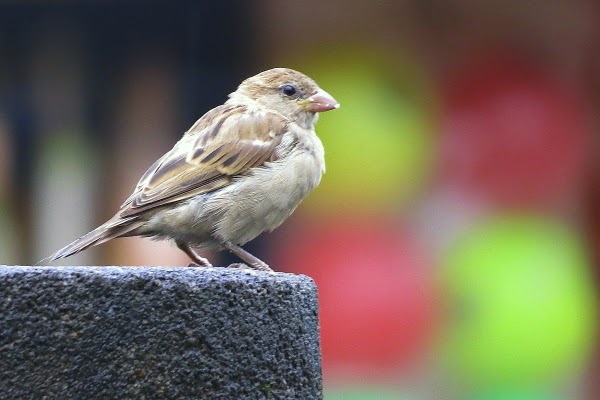
I will begin this series with one of my favorite birds - the House Sparrow (Wiki Link). Though they have become extremely difficult to find in our cities, these 'small packets of joys' can still be found in sizable numbers in our towns and villages. In Murdeshwar, they are generally seen in groups of up to 5 individuals on wires, compound walls and most commonly near shutter boxes of shops where they breed their young. While they may not be attractive to the eyes, watching them go about their daily routine is such a pleasure. And yes, there is no better way to start your day than listening to the chirping sounds of these little creatures. Isn't it sad, that sparrow - a bird that has been so closely associated with human culture across the world has declined so dramatically over the years... While ornithologists and experts may still be analyzing the root cause of the problem, I hope that the sparrows make a grand come back in our cities too.


Other posts in this series:
Murdeshwar Diaries: Aug'14 - Part I - Part IV (Link)

May 12, 2013

A TRIP TO GOA... FINALLY


GOA DIARIES: THE JOURNEY TO GOA


It had been around one and a half year since I had last been to Goa and all this while, I was dying to be there. After all, if you have spent a decade at such a beautiful place, it becomes an integral part of your life and the emotional bond that you develop with it runs quite deep. I had come to Goy (as we Konkanis call it) in June 2001 as a twelve year old boy who was just about to step into the teenages and walked out, little over 10 years later as a computer engineer recruited by an IT company from campus.
The Kali Bridge, Karwar
Though, I have hundred and one reasons to like Bengaluru, there are times, specially when I am struck in lengthy traffic jams on a Friday evening at the Silk Board junction that I get reminded of the many magical moments spent in the beach state - the evening walk at the sprawling promenade along the Mandovi river in Panjim; searching for rare books on Indian history in the Central Library at the Menezes Braganza Institute; playing cricket outside the Maha Lakshmi Temple after school; spending time with friends in the GEC campus after bunking a monotonous lecture; watching the sun go down amongst wilted coconut trees at Bhoma, just before the Banastarim bridge; the simple yet captivating architecture of the temples around Ponda; the tourists flocking to the 16th century Basilica of Bom Jesus at Old Goa, housing the mortal remains of the patron saint - St Xavier; munching on delicious Squid battered fry in Hotel Texas and so on. Though I may not visit Goa often, my affair with the state is still strong - I make it a point to speak to my friends on the weekends, read the local news on the Goa News website (which figures on the 'Most Visited' page of my browser), listen to Konkani songs on Youtube - Lorna's Yo Baile Yo, Manoharai Sardesai's Shobhit Amche Goem and my favourite - Reinaldo Fernandes' Adeus Korcha Vellar and keenly follow Rajan Parrikar's photo blog which has some breath taking images of the Goan countryside (Link). 


While Da and Bhabi have been kind enough to invite me to Goa each time the two of them go there to spend time with the latter's parents, I could never accompany them as I was preoccupied with some or the other stuff. However, when mom asked me if I could take her for the wedding of her friend's daughter in the last week of April at Bicholim - some 30 km from Panjim, I simply couldn't say 'No'. The timing was perfect since May 1 (Wednesday) was a public holiday. My application for two days leave was approved instantly and the two of us - me and mom went on a five day trip to Goa; 5 days of revisiting those places that we so dearly miss; 5 days of catching up with our friends and a few relatives and most importantly, 5 days of a much needed break from our daily schedule so as to rejuvenate our minds. 

We were to board the bus from BTM 2nd Stage at 7:00 pm in the evening on 26th April. Not so surprisingly, some urgent work came in at the last moment and I left office at 4:00 pm (exactly one hour later than what I had promised Mom) and reached home at about 5:45 pm. Though she was fuming, she had already packed my bag and surprisingly, still found time to prepare Palak Paneer and rice for Pappa, Da and Bhabi. To be frank, I find it difficult to believe how she makes so many sacrifices 
Fire in the Sky: Morning sky at Ankola
for the  family, going through so much trouble each day just to make sure that all of us are happy. Coming back to the topic, we hired a rickshaw to reach the pick up point which is around 4 km from our home at Devarachikanahalli via the Madivala lake road. The notorious Bengalauru traffic lived up to its reputation and it took about 35 minutes to travel this small distance. The bus - VRL Non A/C Sleeper was not well maintained and was late by 15 minutes. However, we were not complaining because for us, the destination was clearly more important than the journey. After occupying our seats, I messaged my friends, fine tuning the plans for the coming days. In fact, few of my friends - batch mates from GEC (that is Goa Engineering College for all of you who don't know) were to come down over the weekend from Pune, just to meet me. Some other had either cancelled or adjusted their preplanned schedules to make time for me. After all we all were dying for a reunion since a long time so as to relive those precious moments that we had spent in the past, those Gazalis (Goan Konkani word for 'Incidents') and Fokana (Goan Konkani word for 'Leg-pulling'). I hardly slept for about 4 hours that night, clinging to my laptop bag in which I had kept my camera, looking forward to enjoy the upcoming five days to the fullest and hoping to return to Bengaluru with a bucketful of memories and of course, lots and lots of photos.


The next morning I woke up at about 6:00 am, only to find that we were still at Ankola - a coastal town in Karnataka, nearly 130 km from the Goan capital. We had our breakfast - Idli Sambar at a road  side eatery. I spotted a Cormorant perched on a leafless tree at a distance while peeing and took few
In Deep Thought: Cormorant at Ankola
snaps - the first ones on this trip, once I was done answering the call of nature. Though the destination was quite far, I was happy to be along the Arabian coast, where I have spent a majority of my life. This place is typically characterized by unspoiled beaches, sleepy villages, paddy fields, towering coconut trees, fresh fish and hot and humid climate. Our bus breezed through NH 66 (formerly known as NH 17), arguably one of the scenic roads in this part of the country which is sandwiched between the Arabian Sea and the Western Ghats, cut into several segments by fast flowing rivulets. In fact, we used to travel through the same road while going to Murdeshwar - our native village to spend time with my grand parents during holidays from Goa. At one point of time, I even wanted to get down and head there, which is 80 km from Ankola and spend some time with Dada (my maternal grand father). Soon, we crossed Karwar, famous for the naval base - Project Seabird and entered Goa at Pollem. DRS who is my friend since Std IX, sent me this message, borrowed from a popular Ajay Devgn movie shot primarily in the beach state: 


"Welcome to Goa, Singham!"

They say that 'Change is constant'. However, Goa continues to defy this to a large extent; while cities like Panjim, Margao and Vasco are fast turning into concrete jungles, the villages and the countryside still hold on to their old charm. I was happy to see that nothing had changed in the last one and half year, at least in this part of the world. Some of the places that I distinctly remember seeing en route include the elegant Nirakar Lakshmi Narsimha temple at Mashem and the MCC building (which stands for Mashem Cricket Club and not Marylebone Cricket Club) in the vicinity, the entrance to the Partagalli Mutt and the Cotigao Wildlife Sanctuary, the blacksmith's workshop near the Canacona bus stand, the majestic church dedicated to Our Lady of Rosary at Navelim, the well maintained Municipal Garden at Margao and the Padre Conceicao College of Engineering (PCCE) at Verna where Da & Bhabi had studied. Since we had decided to stay mostly at Bhabi's place at Goa Velha while on the trip, we had to get down at the fag end of the bypass road between Panjim and Margoa, immediately after the Agacaim bridge. While Da and Bhabi's mom gave us the directions, it was Bhabhi's dad who picked us up at the designated spot and took us home, one person at a time on his Honda Activa. After a wait spanning 18 months which felt like ages, I finally set foot on Goan soil. The journey had ended but the trip had just begun.

Cormorant with the Western Ghats in the backdrop


For more on the Goa Trip:
(1) The Chance Encounter (Link)
(2) Dil Dosti Etc (Link)
(3) An Evening in Vagator - Part 1 (Link
(4) An Evening in Vagator - Part 2 (Link)
(5) Life is a Beach (Link)