Showing posts with label Indian Tourism. Show all posts

June 29, 2014

BYLAKUPPE DIARIES


KARNATAKA'S VERY OWN 'LITTLE TIBET'

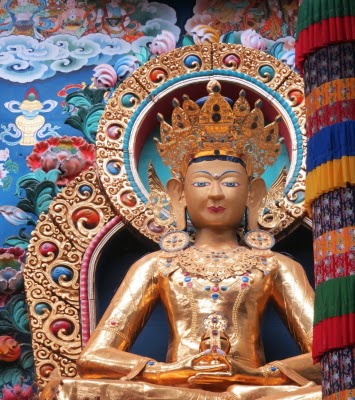
Lord Padmasambava (left), Lord Buddha (centre) and Lord Amitayus (right) inside the Golden Buddha Temple
Nestled amidst the lush green hills of the Western Ghats in the Kodagu district of Karnataka, the petite town of Bylakuppe is the largest Tibetan settlement in the country after Dharmasala which is the capital of the Dalai Lama's government-in-exile. Established two years after the Chinese invasion of Tibet, the town is home to over 10000 Tibetans today, apart from hundreds of visitors who come here to witness the several beautiful Buddhist monasteries dotting this part of the country. I had the pleasure of visiting this spiritual town cum center of Buddhist learning last week while on an outing with my team - one of the many perks of working for a big multi-national firm, you see. In fact, this was my first visit to Coorg and at least in my opinion, we could not have chosen a better time to visit one of Karnataka's premiere tourist destinations. After a spell of heavy rains in the first two weeks of June, much of the western half of the peninsula turns green and Kodagu is certainly not an exception. While the water gods did play spoil sport, preventing us from doing several outdoor activities that our resort - Club Mahindra Kodagu Valley had to offer, it did not bother me much. I love the rains; that sweet aroma of the wet soil that fills the air as the rains pick up pace; the rhythm of the water hitting the ground hardened by a long dry season; the occasional rainbow that graces the skyline as the Sun makes his way through the dark clouds and so on.

The Main Entrance (left) and the Zangdogpalri Monastery (right)

Meanwhile, with our team building exercises getting over on the first day itself, we had the entire second day for sight seeing and the Namdroling Monastery was high on our agenda. As we approached Bylakuppe, covering a distance of about 30 km, we got acquainted with the Tibetan soul of the town via the hundreds of Tibetan flags hung across electric poles and Buddhist monks in their traditional maroon garbs going about their usual business. The last time I had been to a Buddhist place of worship was Bodh Gaya as a part of our Kashi trip, way back in 1997. We made our way from the parking lot to the temple complex, passing by many shops selling a host of memorabilia from Buddha statues to traditional chimes to miniature version of prayer rolls and so on, we reached the simple yet distinct main gate. Once inside the central part of the complex, we came across the pathway that leads straight to the Zangdogpalri Monastery built in true Tibetan style. The three storeyed roof has a huge portrait of Rinpoche Lama - the founder of the monastery besides several elegant images of mythological creatures from Buddhist texts that add to its beauty. Unfortunately for us, we could not have a look inside since the door was shut.


The Golden Statues

To the right of the Zangdogpalri Monastery lies the Golden Buddha Temple which is the biggest attraction here. As you climb the stairs and make your way through the chain of beads at the door, the sight before your eyes is one that you are surely going to remember for a long time in your life. The 18 meter long gold plated statues of Lord Buddha flanked by Lord Padmasambava and Lord Amitayus on either side is truly a sight to behold. The bliss on the face of the 'Enlightened One' is unmistakable and the depth in those half closed eyes speaks volumes about the people who made that statue. I will definitely not blame you if you tend to overlook everything else inside the building in the awe of those towering idols. However, it is worthwhile spending some time looking at the paintings on the walls recounting tales from the lives of the Buddha in his numerous births before attaining 'Nirvana'. The intricate paintings with attention to even minute details enhances the aura of the entire place. With so much peace and serenity, it is not uncommon to find a large number of people mediating here in the company of the man turned God who taught humankind the real reason for sorrow that exists in the world.


Paintings inside the Golden Buddha Temple


Paintings outside the Golden Buddha Temple

Young Turks

June 08, 2013

AN EVENING IN VAGATOR - PART 2


THE GOA DIARIES: SUNSET AT VAGATOR


Sunset at Vagator
If playing in the sea is not something that you enjoy, then the best thing to do at a beach in the evening is to sit down and watch the sun going down. As the temperatures dip and the cool winds start blowing from the sea, the sky is transformed into a canvas changing shades from blue to yellow to golden, sometimes strewn with shades of pink as the lone star in our solar system - now resembling a bright orange ball, disappears into the waters in the distant horizon with its reflections shimmering on the waves. Having spent about an hour and a half at Vagator, we got the 'golden' opportunity to witness this spectacle while we were walking back from the Orzan beach towards DD's car, covering all the three segments of the shore. We walked along the edge of the shore enjoying the marvelous view in front of our eyes as the sun went about its business to illuminate the other half of the world, providing some wonderful photo-ops.

The descent of the sun

We had parked our car in an open place, close to the entrance of the Big Vagator beach and not in the parking area around the headland. As this was not an organized parking, some 'irresponsible' fellow had ended up parking his vehicle right in front of ours leaving us stranded. This is quite common as domestic tourists, in their hurry to hit the beach, end up acting like 'idiots', with least concern for the the inconvenience that they cause to others. It is true that one is here on a vacation but so are many of us and it would be great if all of us act sensibly. However, the blessing in disguise was that from here, the view of the sun descending in the background with coconut palms in the front was amazingly beautiful.

Sun setting amongst the palms

As we waited at the parking area, cursing the guys who had left their car right in front, thirst got the better of us and we headed to a nearby shack for some refreshments. The humidity levels was extremely high and we were soaked in sweat. With the climate in Bengaluru staying pleasant throughout the year, I do not remember when was the last time I had perspired so much. Some time later as we headed back, we were relieved to see a group of visitors, I guess they were Keralites from their peculiar accent, going back in their Indica which was parked in the front row. While this was not the four wheeler that was left in front of our car, we got just about enough space to move out of the parking lot. Though the space was less, DD managed to maneuver his brand new Wagon-R like a skilled captain negotiating his ship along a rocky coastline in rough weather. With Sav's GPS showing the way, we left for Panjim, bidding farewell to Vagator and planning for our next get-together.

A painting of the Buddha at a shack in Vagator
PS: The images posted here were clicked by me and my friends Sai and Sav.


For more on the Goa trip:
(1) The Chance Encounter (Link)
(2) Dil Dosti Etc (Link)
(3) An Evening in Vagator - Part 1 (Link
(4) Life is a Beach (Link)
(5) Birds at Goa Velha (Link

June 05, 2013

AN EVENING IN VAGATOR - PART 1


THE GOA DIARIES: VAGATOR BEACH - A PROFILE


Vagator in the evening

Having spent most of the first two decades of my life along the Arabian coast, it should hardly be surprising that I do not have any fascination for beaches, because for me, the sea has always been in the proximity and unlike hill stations or forests, it is not something that we have looked forward to while planning our holidays. However, there is one beach in North Goa which has been my favorite, so much so that in the 10 years that I have spent in Goa, I have never missed any opportunity to go there, be it with friends, relatives or on class picnics. As such, during my trip to the state in the last week of May, when I and my friends from GEC (that's Goa Engineering College for all those who don't know) - Niks, Sav, Datta and Sai were deciding on a place to spend the evening after having a sumptuous meal at Hotel Texas in Panjim, I instantly vetoed for Vagator and in a flash, we were on the way with Sav's GPS leading showing us the way, listening to Linkin Park.

Vagator Beach - North Goa

This serene beach is located in Bardez taluka of North Goa - the tiny patch of the Western coast flanked by the rivers Mandvi and Chapora on either side. Calangute - arguably, the most famous of all Goan beaches, Anjuna - renowned for the Wednesday flea market and trance parties, Baga - known for dolphin rides and Candolim which offers some of the best facilities for water sports in the state are some of the other famed beaches that are located in this stretch of land and are swarmed by tourists, both domestic and foreign during the season. The seaside headland where the car parking is situated, divides the beach into two major parts - Big Vagator in the north and the Little Vagator in the south. Besides the pristine beach, the sea waves creating a splash as they hit the numerous rocks along the shore, the coconut trees swaying along with the cool winds, the imposing 17th century Chapora fort, the pleasant weather and the tourists enjoying their time here away from all the tensions and worries, all contribute in making a visit to this place more than worthwhile.

Rocks at Vagator

The north side, better known as Big Vagator beach seems to be more popular with Indians than firangs. Also, it is far less crowded when compared to its southern counterpart. On the hillock over looking it lies the majestic Chapora fort. Considering its strategic importance, the place seems to have been fortified much before the Portuguese invasion of Goa. In the 1680s, when the Marathas under Sambhaji invaded Goa, this place was the scene of heavy fighting. The present fort was built in 1717 by the Portuguese. As the borders of their  possessions along the west coast grew beyond Bardez following the New Conquests, it lost its strategic importance and was neglected thereafter. As such, besides the laterite walls and the gate which have stood for close to three centuries now, nothing else remains of it today. The structure is huge yet simple. Nonetheless, the view of the sea and the beach below is spectacular. In fact, some of the scenes of the Hindi blockbuster Dil Chahta Hain were shot here.

The Big Vagator Beach (Left) and Chapora Fort (Right)

The Southern beach is further divided into two more fragments - the Middle Vagator beach and the Little Vagator beach. The middle beach, which is the smallest of the three is also called as the Tel Aviv beach. The reason being the large number of Israelis who come here each year. Personally, I find it the most beautiful stretch of this shore primarily due to the uneven nature of the slope, the red cliffs and the large number of coconut palms. The Little Vagator beach, the busiest part of the stretch is popularly known as the Orzan beach. It used to be one of the famous hippy haunts of the 1960s, particularly amongst those of British nationality. One of the reminders of this bygone era is the Shiva statue carved out of stone at the southern end of Vagator. It is believed that it was sculpted by a hippie who is said to have been a devotee of Lord Shiva in a period spanning over a couple of years. Today, there are several shacks here and on any given season except for the rains, one can find hundreds of tourists here, either basking in the sun or playing in the waters of the Arabian. 

The Middle Vagator Beach (Left) and the Little Vagator Beach (Right)

I personally have very fond memories of the place over the several visits that I paid to Vagator. One of them was in Standard XII when we had gone there on a class picnic. Young men that we were then, watching so many white skinned women sans their tops was very exciting. As we were coming back, I distinctly remember me, Amba and Habbu Sir talk about a wide range of topics on our way to the bus which was waiting in the parking area. A couple of years later, I and a few friends, most of whom I have mentioned earlier in this post had been here on a Saturday in December 2008. Sitting near the Shiva statue we tried to out do each other in stone skipping. The competition between Sai and Niks was close. Eventually, it was the latter who won. I am very sure that my trips to Goa will never be complete without going to Vagator and refresh those memories amongst the undulating slopes, the tall coconut trees, the rocks, the sun, the sand and the sea.

A crab at the beach

PS: The images posted here were clicked by me and my friends Sai and Sav.


For more on the Goa trip:
(1) A Trip to Goa... Finally (Link)
(2) The Chance Encounter (Link)
(3) Dil Dosti Etc (Link)
(4) An Evening in Vagator - Part 2 (Link
(5) Life is a Beach (Link

October 04, 2010

CHAMBAL MEIN MANGAL


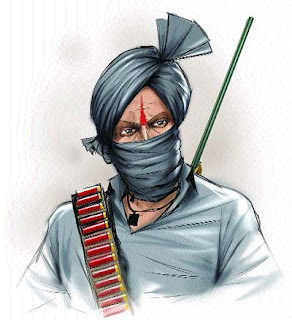
Ever since the 13th century, the maze of deep ravines and scrub forests of the Chambal region of Central India have been home to generations of daring and dreaded outlaws, known locally as ‘Dakus’. Popularized in folk for performing essential social services in hard times and adjudicating local issues, and romanticized in Bollywood movies like Bandit Queen, Sholay, Jis Desh Mein Ganga Behti Hain, Ganga Yamuna etc, the dacoits, nevertheless, unleashed a reign of terror in the nearby areas, committing countless cases of mass murders, kidnappings, rape, extortion and armed robberies, mostly targeted at people of higher castes whom they looked upon as the prime beneficiaries of an unjust, corrupt and biased system. From Daku Man Singh - the revered ‘Chambal ka Sher’ - the once poor Rajput whose fight against discrimination has got him a cult-like status among the locals to the Bandit Queen - Phoolan Devi, the dacoit turned politician who was directly responsible for the infamous Behmai massacre, these outlaws have sharply divided the opinion of the Indian masses, with some condemning them for their unlawful and violent activities while others hailing them as heroes for their Robin Hood-like characteristics. With the death of most wanted dacoit, Nirbhay Gujjar at the hands of policemen of the Special Task Force in November, 2005 and surrender by many others, dacoity in the Chambal valley has drastically declined to such an extent that it has been wiped out of most of the region.

With normalcy being restored, the Madhya Pradesh government has decided to cash in the situation. Come October, the State government in collaboration with Uttar Pradesh and a private player, Chambal Safari, is starting a special adventure tourism programme in Bhind district, aptly called ‘The Chambal Challenge’ from Oct 11th - 17th, mainly targeted at the foreigners who will visit the nation for the Commonwealth Games in New Delhi, allowing them to traverse the terrain infested with crocodiles and chat one on one with former bandits. Earlier the Rajasthan government had announced special packages for the Games tourists including a visit to the ghost town of Bhangarh near Jaipur.


The bloodline of the Chambal Ghatti (Valley) is the Chambal River, which originates at Manpura in the Vindhya Ranges and forms the boundary between the states of Madhya Pradesh and Rajasthan, before turning southeast to join the Yamuna at the confluence of five rivers in Uttar Pradesh. Legend has it that large scale Yagyas (ritual of sacrifice to please the Gods) used to be organized on the banks of this river, where animals were slaughtered and their skins (leather) was dried, earning it the name ‘Charmavati’. One of the earliest mentions of dacoity in the region comes from the travelogue of the famous Chinese pilgrim, Huen Tsang, who is said to have been robbed near present day Dhaulpur. It is believed that ever since the Tomars came down to the Chambal valley after being pushed out of Delhi by the Chauhan kings, the region has been established as a safe heaven for rebels and dacoits. The bandits are also mentioned in the memoirs of the first Mughal Emperor, Babur. The tradition seems to have continued well into the 20th century with the Chambal bandits being accused of regularly preying upon the caravans of the erstwhile princely state of Gwalior.

Thanks to the fear of the dakus that inhabited its banks, the Chambal River, unlike other Indian rivers, has largely remained pollution free and hosts an amazing riverine faunal assemblage including several species of endangered mammals, indigenous reptiles and migratory birds, even today. The area lies within the semi-arid zone of North Western India and the vegetation consists of typical thorn forests characterized by sparse ground cover along the severely eroded banks and adjacent ravine lands. However, the major eco tourism destination in this region is the National Chambal Sanctuary, consisting of the large arc described by the river in its 960 km odd journey and encompasses areas in the states of Rajasthan, Madhya Pradesh and Uttar Pradesh. The crystal clear waters of the river is home to nearly 1300 gavials, known locally as the Gharials and also supports a 500 strong population of the Indian Mugger. Besides eight species of fresh water turtles, one can also spot the Smooth Coated Otters and the elusive Gangetic Dolphins. Apart from supporting a variety of avian species like Black Bellied Terns, Sarus Cranes and Black Necked Storks, the sanctuary is fast emerging as an ideal place to spot the Indian Skimmer.


Besides these natural wonders, the district of Bhind is dotted with myriad areas of archaeological and religious importance. The 17th century fort of Ater, located deep in the ravines, 35 km west of Bhind city was once the abode of the kings of the Bhaduria dynasty and also a favorite sanctuary for the bandits in the later period. The main attractions in this fort are Khooni Darwaza, Badan Singh ka Mahal, Hathiapor, Raja ka Bangla, Rani ka Bangla and Barah Khamba Mahal. The fort, once in a dilapidated state, is being restored to its past glory by the ASI (Bhopal Circle). Another fort in the Bhind city, the Bhaduria capital, houses two canons that tell a tale of deceit – a treacherous general filled them up with millets instead of gun powder, leading to its fall. A third fort at Gohad, built in the 16th century by the Jat king Maha Singh, located on way to Bhind from Gwalior is renowned for its ‘Kachhari Mahal’ – a unique example of Iranian Art. Another 10 km from the fort is Maharajpur, where several British officers and soldiers were killed in a revolt that took place 13 years prior to the First War of Indian Independence.

The Vankhandeshwar Temple in Bhind, dedicated to Lord Shiva was built by Prithviraj Chauhan in 1175 AD. It is said that the ‘Jyoti’ is continuously flamed since then. The centuries old Jain temples of Baranso were built to commemorate the visit of lord Mahavir in this area. Located in Gohad Tehsil, near Mau, at a place called Jamdara, is the Mata Renuka Temple believed to be the birthplace of the sixth avatar of Lord Vishnu – Maharshi Parashuram. Folklore linked to Parashuram is that his father ordered him to cut the head of his mother, Renuka which he complied and as a prize asked for the revival of his dead mother which his father, Maharshi Jamadagni solicited. The temple built at the place of this activity, has the idol of the deity Renuka, with the head being separate from the rest of the body. Another attraction peculiar to the region is the Naraddev temple, where Maharshi Narad is worshipped. The Bhind district with the Malanpur industrial area is now the new hub of development in Madhya Pradesh.


The Chambal Challenge will provide the international tourists a unique opportunity to experience the various aspects of the Chambal Ghatti. Besides getting to know the flavours, the aroma of the valley, they will also be treated to local folklore, the typical Alha and Languria style of singing. As a bonus, the tourists will be provided free accommodation in tent houses in the camping site near the majestic Ater Fort. The adventure activities planned for the tourists include Water rides (including a motor boat ride to Ater fort), Banana ride, Alligator and Dolphin spotting in the National Chambal Sanctuary, Para Sailing, Hot air Ballooning, Rock Climbing and Zorbo ball. However, the main adventure event is the Chambal Treasure Hunt – a nerve wrecking, adrenaline pumping race against time for the body and the brain where the participants have to find their way through the seemingly endless maze of the ravine topography to seek the treasure hidden deep inside the wilderness within a stipulated time period. A definite area in the Beehad region has been embarked for this year long activity. The person who finds the treasure in the shortest possible time among the participants for the whole year will walk away with the bumper prize and the reputation of being the best in brawn and brain.

However, no trip to the former ‘Dacoit Capital of India’ is complete without an encounter with the dakus of the Chambal Ghatti. The former dacoits, who ruled the valley fiercely for so many years, whose very mention was enough to strike terror in the minds of the people, now out either on parole or after completing their term in jails, will guide the tourists to the beautiful Chambal valley. The tourists now can have a live experience of the rustic terrain along with the former outlaws and even interact with them.


The State government has launched a massive publicity campaign to popularize the event. The Bhind district administration is spending around Rs. 50 lakh to build suitable infrastructure to transport the tourist to the valley. Speaking of the event, an official said “We have contracted leading tour operators and agencies, and are trying to mobilize support for our innovative Chambal Challenge and we hope this will open a new avenue of progress in this ravine-curtained territory”. In tune with their extremely popular tourism campaign entitled, ‘Madhya Pradesh – The Heart of Incredible India’, the State Tourism Department has come up with the following poem to promote the event:

Chambal ki tum Dhar dekho,
Dolphins ka Pyar dekho,
Dakuoon ki Behaad dekho,
Ater ka Itihaas dekho,
Barah Atishay Kshetra dekho,
Ghadiyallon ke Ansoo dekho,
Bhind dekhoo, Bhind dekho,
Bhind dekho, Bhind dekho.

The Chambal Challenge is truly a masterstroke of the Shivraj Singh Chauhan government to attract the visitors to the Chambal valley and put it into the global travel map. A large chunk of credit must also go to Kunwar Ram Pratap Singh, the head of the Chambal Conservation Foundation. Alumni of IIT Rourkee, he and his wife, Anu, left their lucrative jobs to set up the Chambal Safari, an eco-tourism endeavour committed to the sustainable use of natural resources and has been a instrumental in making the ambitious venture, a reality. Tourism will play an important factor in healing the wounds those years of dacoity and negligence have inflicted upon the people of Bhind. Hopefully, this novel initiative will give the whole region an image makeover and usher in a new era of peace, progress and prosperity.


SOURCES:

(1) WWW.WIKIPEDIA.ORG

(2) WWW.CHAMBALCHALLENGE.COM

(3) WWW.CHAMBALSAFARI.COM

(4) WWW.BHIND.NIC

February 08, 2010

Atithi Devo Bhavah

Credit: International Crane Foundation

The real India, as Mahatma Gandhi once said, lies in her myriad villages and no worthwhile development is possible on the national front without the active participation of our rural brothers. Although most of our villages are still plagued by social evils and insufficient infrastructure development, there is no doubt in the fact that village communities have the potential to improve their living, without much assistance from the government, when the people are inspired and their infinite energies are directed in the right manner. The village of Khichan in the Jodhpur district of Rajasthan is a perfect example of how community development and social activism at the rural level can help villagers improve their living standards. The village, which has become popular among bird watchers, achieved international recognition when it was featured in Birding World magazine in an article titled, “Khichan - the Demoiselle crane village."

Located in the pristine sands of the Thar desert, Khichan is just like any other village located in the region. From the outside, there is not much in the village that makes it stand apart from the other villages that surround it. The economy is agrarian and the nearest town, Phalodi, located 4.5 km away, is renowned for its salt industry. However, with the onset of winter, winged visitors from plains and steppes of Eurasia and Mongolia come to this village, primarily due to the tradition of feeding wild birds established here, a few decades ago. The feeding programme, coupled with the presence of sand dunes and water ponds, has made this place a favourite destination for the migratory Demoiselle cranes, while on their stay in India.

The Demoiselle cranes (Anthropides virgo) are the smallest and second most abundant species of cranes in the world, with sightings being reported from as many as 47 countries. They weigh about 2-3 kg with a height of 89 cm and wing span of 155 -180 cm. Essentially grassland birds, the cranes have plain bluish gray plumage and are omnivores. They mainly feed on plant materials, insects, peanuts, beans and other cereal grains, and small animals. Demoiselle cranes have to take one of the toughest migrations in the world. In late August through September, they gather in flocks of up to 400 individuals and prepare for their flight to their winter range. Along their arduous journey they have to cross the Himalayan mountains to get to their over wintering grounds in India, many die from fatigue, hunger and predation from birds such as eagles. At their wintering grounds, Demoiselles have been observed flocking with Common cranes, their combined totals reaching up to 20,000 individuals.

The annual feeding spectacle began when a local, belonging to the Jain community, started offering grains to the feathered visitors or Kurjars, as they are locally known here. Soon as the number of people looking after the cranes grew, the feathered visitors seem to have been deeply impressed by the 'Khichan brand of hospitality'. This can be inferred from the fact that the number of Demoiselles arriving in this place annually, grew from a few dozen in the 1980s to well over 15,000 today. Although omnivores, villagers in the Khichan, like in other parts of the Thar, venerate them for their perceived vegetarian eating habits and for the norm of keeping a single life partner all through their lifetime. In fact both of the above perceived behavioral patterns of these cranes are consistent with the teachings of Mahavir, the founder of Jainism, which continues to thrive in this part of the country.

Credit: International Crane Foundation

With the donations coming primarily from the Jain community, the villagers have constructed a rectangular enclosure 50x60 m at the edge of the village, known locally as Chugga Ghar(Feeding Centre). The children of the village chip in their bit and it is their duty to spread the grains before the flocks of cranes arrive for their breakfast session of about 90 min. After feeding, the cranes, in large congregations, are seen at some of the water bodies and sand dunes to the north of Khichan. They face the sun, their tie-like black chest feathers contrasting with the blue winter sky. A short while later they depart in different directions in small family flocks in a disciplined order led by the female, followed closely by two young ones with the male forming the rear guard. Again, during mid-day, they assemble for a drink, followed by an occasional bath, and a second feed. Acrobatic exhibition of mutual affection between couples is also seen. They roost in faraway agriculture fields and return to the same water bodies next day, early in the morning. As per the report of the International crane Foundation:

"All cranes engage in dancing, which includes various behaviors

such as bowing, jumping, running, stick or grass tossing, and wing flapping.

Dancing can occur at any age and is commonly associated with courtship, however,

it is generally believed to be a normal part of motor development for cranes

and can serve to thwart aggression, relieve tension, and strengthen the pair bond."

The people of this village are very protective of their annual visitors. This fact comes into prominence from the story of Sevaram Mallu Parhivar, a local contractor. Seeing that a large number of birds were getting electrocuted, he filed a complaint with the District Administration, asking for placing the electric transmission lines underground. As the DC ignored his repeated complaints, he approached the High Court against the State Electricity Board. However, inspite of his noble intentions, the Court imposed a fine of Rs. 4 lakhs on him. But with the help of the State Forest Department, Sevaram filed an appeal in the High Court and eventually won the case.

Credit: International Crane Foundation

In fact such is the love and admiration of the Demoiselles that they have become a part of the local tradition and culture. They are an integral part of the desert love lore about Marwari migrants of yore who were forced to live separately from their loved ones due to compulsions of trade. Fussy eaters amongst the kids are known as 'Kurjars' and engaged girls are fondly referred to as 'Kurjaris'. The birds are revered as messengers of God and are believed to yield magical powers.

The place is soon developing into a magnet for tourists. A large number of travelers, both local and international, come to Khichan to see and study these migratory birds from such close range and in such large numbers. Their flights, in the setting of the conventional mansions (some of them are heritage buildings being converted to tourist lodges) of the village, present brilliant photo-ops. The Marwar Crane Foundation has pledged financial support to the feeding program. A director of the International Crane Foundation has visited Khichan. This foundation is also supporting the efforts of Marwar Crane Foundation in feeding the cranes. The government, for a change, has been quick enough to realize the potential of this place as a popular tourist attraction, thanks to the cranes and peculiar indigenous architecture. As such, the State government has given heritage status to the village and it has also got a package of Rs. 75 lakhs from the Union government in the last budget.

In recent times, the cranes have been disturbed by dogs and passing villagers. To add to the problems, illegal encroachments have developed over the years, much to the consternation of bird watching vacation tourists. There has been also an effort to move the prevailing feeding area as it has become too crowded but it has not yet been implemented. Also, the feeding program has led to a drastic increase in the number of crows, pigeons and rats in the village, which has increased the vulnerability to diseases. Besides, a significant number of the people here feel that it would be better if the money was spent on the poor and the needy, rather than the migratory birds.

Although there will be skeptics, the village of Khichan is a testimonial to the fact that man and nature can co-exist peacefully. The villagers here have realized the fact that their own survival is inter-linked with that of their feathered friends. It is instances like this that bring to light, the amount of knowledge that is present in the interiors of India, and make us proud to be Indians.

Credit: International Crane Foundation

Special Thanks to : Vishwanath Bhat


SOURCES


(1) NDTV Profit: Apollo Presents - The Unstoppable Indians (Link)

(2) The Hindu - Desert turns birds’ paradise (Link)

(3) Lal Nivas - Demoiselle Cranes: The Royalty of Khichan (Link)

(4) Wikipedia – Khichan (Link)


IMAGES


(1) Credit: International Crane Foundation (Link)
Original: Demoiselle Cranes

(2)  Credit: International Crane Foundation (Link)
Original: Demoiselle Cranes

(3) Credit: International Crane Foundation (Link
Original: Demoiselle Cranes

 (4) Credit: Wikipedia (Link)
Original: Anthropoides virgo at Twycros Zoo